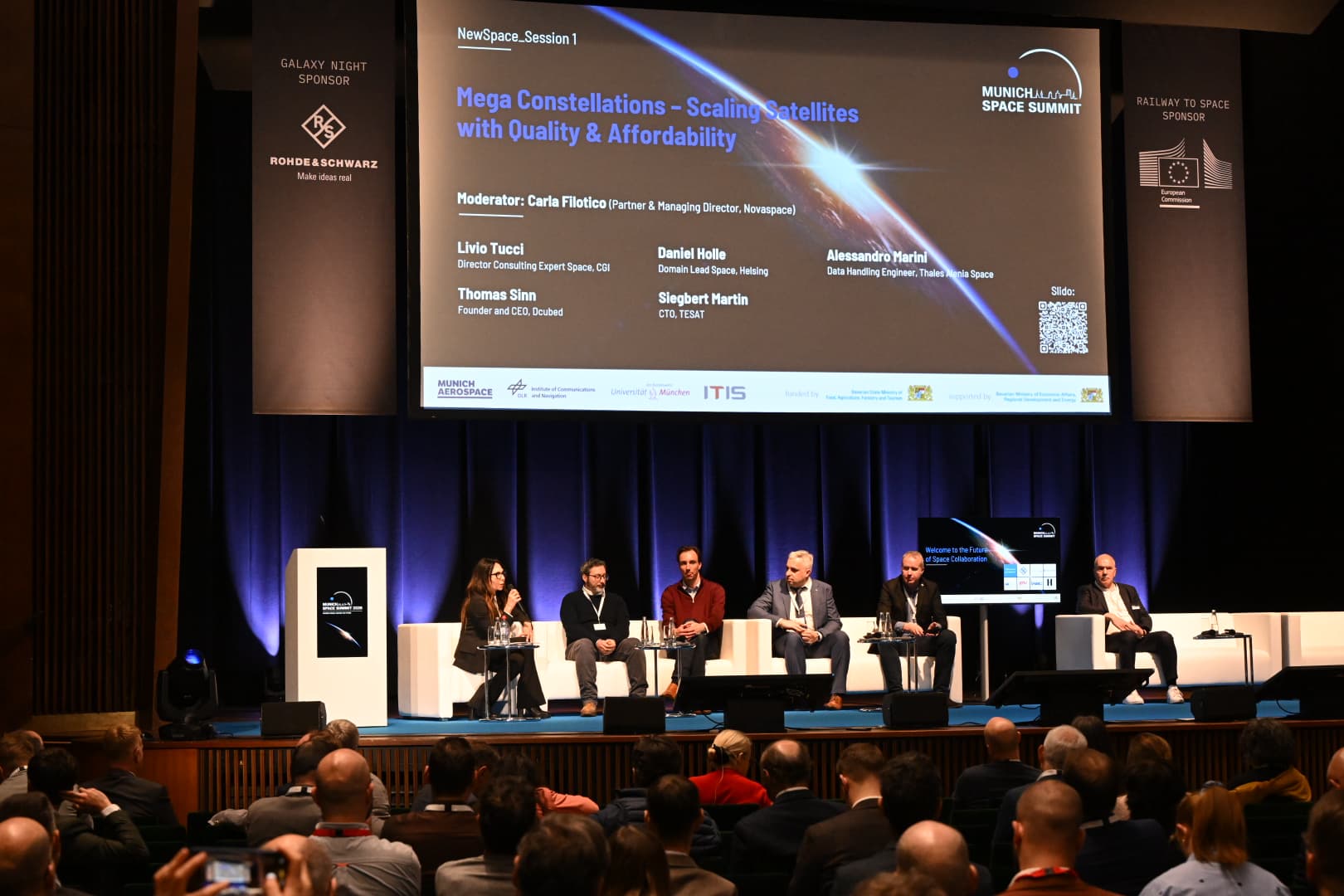

Daniel Holle, Domain Lead Space at Helsing, sees mega-constellations primarily as a software and data problem – not fundamentally a hardware issue. He revealed this during the Munich Space Summit in a panel discussion. Joining him on the panel were Livio Tucci (Director Consulting Expert Space, CGI), Thomas Sinn (founder and CEO Dcubed), Siegbert Martin (CTO Tesat), and Alessandro Marini (Data Handling Engineer Thales Alenia Space). For Europe’s space ecosystem, this is crucial because competitiveness in the future will be defined by AI, software cycles, and system orchestration, not by individual satellite programs.
What makes this discussion particularly compelling: many players still talk about unit numbers and programs. Helsing clearly shifts focus to the operational reality of large constellations. Because as satellite numbers increase, the complexity of data processing, control, and security grows exponentially.
Helsing: AI to orchestrate thousands of satellites
For Holle, the central paradigm shift lies not only in scaling satellites but especially in how they are operated. Classical, heavily human-controlled systems reach their limits with constellations of hundreds or thousands of units. His approach therefore focuses on targeted deployment of artificial intelligence. This should take on central orchestration tasks in the future: from controlling and coordinating entire satellite networks to prioritizing and processing large volumes of data through to automating real-time operational decisions. In this way, Helsing describes a model where constellations are no longer managed manually but function as largely autonomous systems.
Software cycles instead of hardware thinking
A central point in Holle’s argument is the discrepancy between hardware and software innovation cycles. While satellites are developed over years, new software and AI functions emerge in weeks or months. From his perspective, this represents a fundamental strategic shift for space exploration. More intelligence must be moved into software, satellites must be updateable in the long term, and computing power in orbit must already be planned for future applications. Holle deliberately draws parallels to the automotive industry and consumer tech platforms, where systems are no longer static but continuously developed and improved.
“When I worked at Google in Mountain View, I integrated Android software into cars. And it was really, really hard to convince all manufacturers to adopt this way of thinking in their vehicles. We need to think about this model for space too.”
says Daniel Holle in the panel discussion at the Munich Space Summit.
New role of satellites: data and compute nodes in space
As a consequence, the role of individual satellites is fundamentally changing. For Helsing, they are no longer just carriers of sensors or communications but active nodes in a networked system. They take on tasks such as direct data processing in orbit, forwarding and fusing information between different satellites, and leveraging free computing capacity for additional applications. In this way, space exploration increasingly approaches familiar architectural principles from cloud and network infrastructure – only relocated to space.
Helsing’s space strategy: end-to-end rather than niche solution
When asked, Holle also clarified Helsing’s strategic direction in the space sector. The Munich company pursues a clear end-to-end approach. This encompasses both the integration of satellite hardware and data processing in orbit as well as analysis and use on the ground. Helsing doesn’t rely exclusively on proprietary development but strategically pursues partnerships. As an example, Holle mentioned collaboration with Kongsberg and Hensoldt. This way, they can jointly cover this value chain. Space is therefore far from a side venture for Helsing but rather a strategic expansion of existing competencies in defense and AI.
Europe’s structural problem: too slow, too little scalability
Beyond technological issues, Holle also addressed structural weaknesses in Europe’s ecosystem. His main criticism: Europe still thinks too much in small numbers and too little in industrial dimensions. While Europe has excellent engineering expertise, production capacities are too low, scaling is approached hesitantly, and time-to-market is too slow compared internationally. Thus Holle confirms the assessment that Europe’s challenge lies less in the technology itself but rather in consistent industrialization and implementation at large scale.
Hardware remains important – but insufficient
While Helsing clearly focuses on software, the panel made clear that hardware continues to play a central role. Companies like Dcubed are working to make components available in large quantities. This creates the industrial foundation for constellations.
But this is exactly where the interplay becomes apparent: without scalable hardware, no large constellations – without intelligent software, no efficient use of these systems.
Competition is decided by speed
To conclude, Livio Tucci brought the day’s discussion at the Munich Space Summit to a decisive point: scaling constellations must not be confused with pure growth. Rather than launching ever more satellites, future focus must be stronger on sustainable and efficient operations. A prerequisite is the implementation of automation and autonomy, as human control no longer scales at this magnitude. At the same time, trust in these systems is essential. This works particularly through transparent and reliable human-machine interfaces that provide decision-makers with a solid foundation.
Additionally, Dcubed founder Thomas Sinn advocated for fundamental rethinking in Europe: instead of acting cautiously, the industry must think significantly bigger. Especially compared to the USA, it becomes clear that more ambitious scaling and bolder investment occurs there – a standard Europe must also meet in the future.