

Munich’s creative quarter at Leonrodplatz exudes a slightly dilapidated charm on this rainy, cold February day. Yet here lies Munich’s source for the city’s creative future. For in this twenty-hectare area, much is to happen in the coming years.
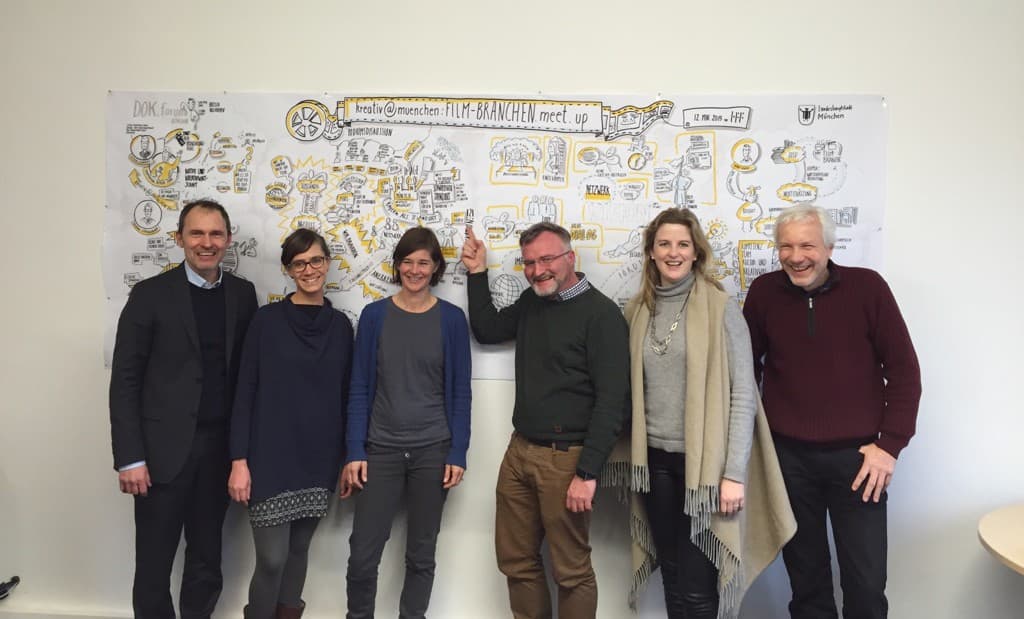
Jürgen Enninger, who heads the competence team for culture and creative industries of the city of Munich, has recently taken up residence here. Munich Startup visited him and his team. The nine members of the competence team are to make Munich’s creatives more economically successful and support artists and cultural professionals with questions about funding, spaces, and networking.
The industry and the team
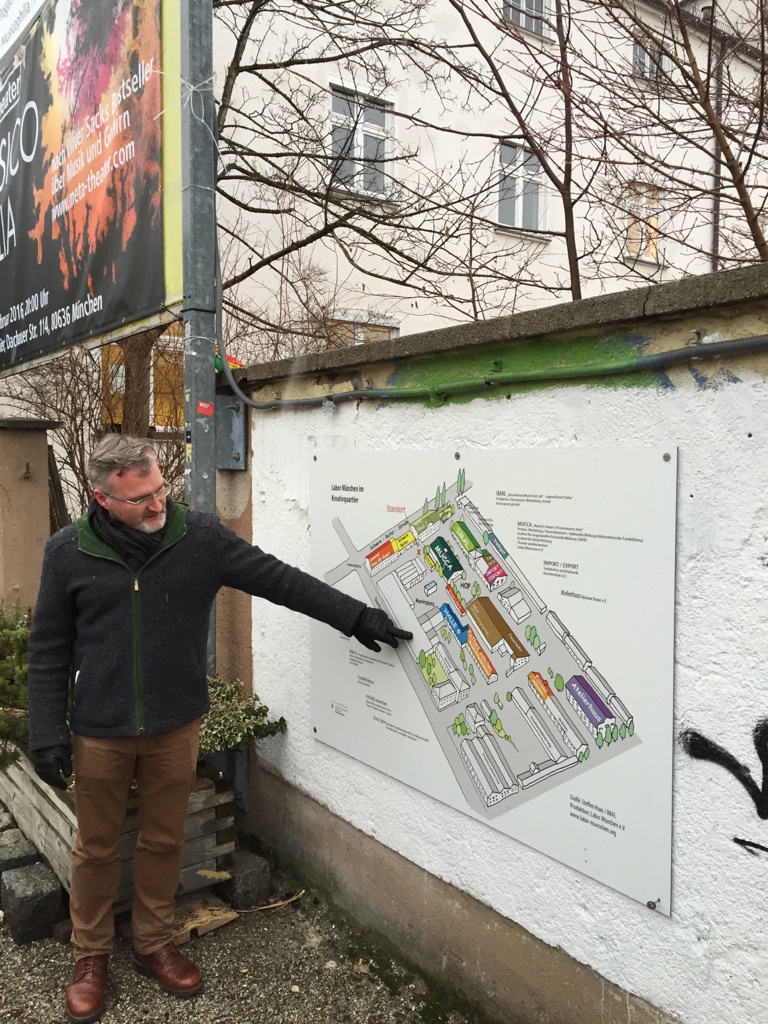
Jürgen Enninger explains the future plans of the creative quarter.
Who are these culture and creative industry professionals? The eleven heterogeneous sub-sectors comprise the architecture market, design and film industries, music, press, book and art markets, the performing arts market, broadcasting and advertising industries, and the software/games industry, as well as all related exploitation networks within these sub-sectors. What connects these areas is the so-called “creative act”. Their cross-sectional qualities make culture and creative industry professionals bridge builders – the industry links industry and startups, services and crafts.
The competence team itself is colorfully mixed and can thus optimally meet the needs of the scene: documentary filmmaker meets real estate manager meets lawyer meets cultural economist. Jürgen Enninger, who recently advised Bavarian creatives on their economic opportunities on behalf of the federal government and previously served as managing director of a record label, says:
“In the industry, it’s a lot about self-realization. But culture and creative professionals also work in economic contexts. These need to be made conscious and handled competently. That’s why there’s high demand for orientation conversations.”
Although the industry is very well-positioned, growing above average in Munich, and Munich ranks first in a European comparison, as a recently published study showed, there is still much to do for the competence team.
According to Enninger, the five biggest challenges facing the scene are
- giving more appreciation to creative work,
- increasing the visibility of culture and creative industry work,
- building relevant and cross-industry networks,
- offering improved space for culture and creative industry work, and
- creating an easily accessible contact person from the scene for the scene.
“Drop-off point for absurd space offerings”
The last point on the list – check. Because with the comp etence team, what Enninger calls an “outstretched hand toward the scene” has been created. The experts primarily provide tips on the path to professionalization and in conveying “entrepreneurial know-how”, point to funding opportunities, help in the search for workspaces, and also support the activation of vacant spaces and areas for creative interim uses. Correspondingly, the team understands itself as “a drop-off point for absurd space offerings and a space problem solver”, because events and meet-ups such as the team’s monthly meetup are to strengthen the Munich creative network. In addition to industry hearings to better understand value chains, event formats such as “Meet the Company” are also to be created.
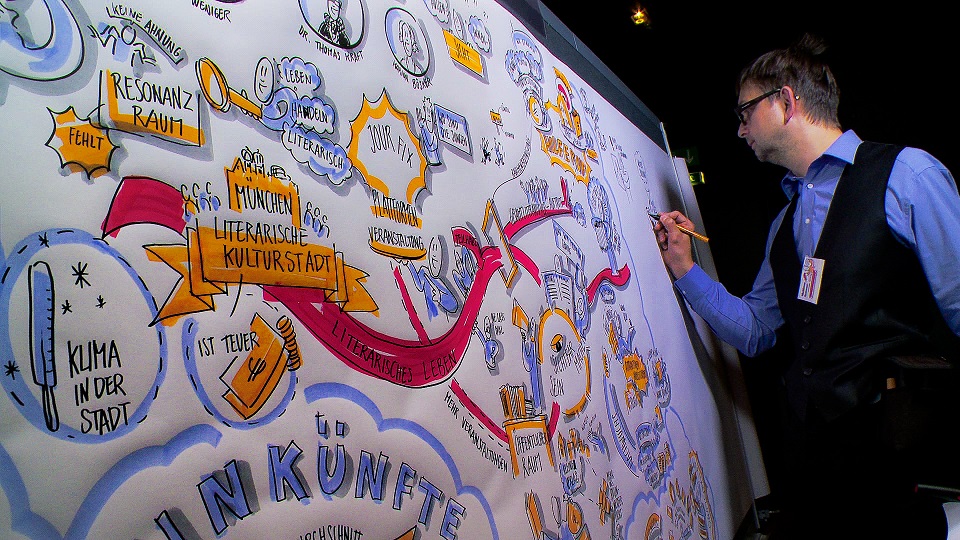
To better understand the different sub-sectors and their heterogeneous needs, Enninger organizes industry hearings and prepares needs analyses. (Copyright: Landeshauptstadt München)
A typical case for the competence team culture and creative industries
What does a consultation look like in practice? In a “typical case”, it would be about topics such as customer acquisition, defining the product or service more precisely, or showing what an invoice should look like. “A huge topic is pricing and a healthy self-confidence with regard to your own performance. We often encounter the prejudice here: business administration is evil. Our job is to translate business management vocabulary into the vocabulary of the scene,” Enninger adds.
Space for creatives – the creative quarter
And a few more words about the creative quarter and its future: The area is divided into four sub-quarters. The core is the “creative lab”, which is also where the competence team is based. Here, an urban mix of uses comprising culture, creative industries, housing, social services, commerce, and retail in old and new buildings is being pursued.
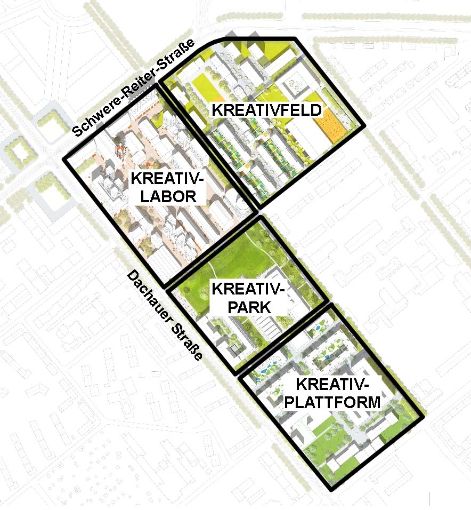
A predominantly culture and creative industry use will also be given to the “creative park” sub-quarter. The two listed heritage halls – the Jute hall and the Barrel hall – which are currently vacant, will be renovated and subsequently used accordingly. But it may take a while before that happens.
To round out the concept, a new founders and innovation center is to be built southwest of the Barrel hall (Munich Startup reported). The Munich city council approved the approach in mid-February. The creative quarter is completed by the “creative platform”, an expansion of the University of Applied Sciences, and the “creative field” as a green residential, working, and primary school location.
Anyone interested in a consultation by the city’s competence team for culture and creative industries of the city of Munich should best arrange an appointment at kreativ@muenchen.de.