


Why mediocre leadership is one of the biggest growth risks for startups
Startups measure many things very precisely: runway, burn rate, user growth, conversion rates. What often falls short is something else: the quality of leadership. Yet it is one of the strongest levers for sustainable growth – especially in young, dynamic organizations.
Because startups rarely fail due to ideas or motivation. They fail because leadership is clarified too late.
Growth brings leadership ruthlessly to light
In the early phase, many things work through commitment, proximity, and improvisation. Roles are fluid, decisions are quick, conflicts are either ignored or solved pragmatically. As growth increases, that changes. Teams get larger, dependencies become more complex, expectations become more diverse.
By then at the latest, it becomes clear: leadership is not a byproduct of performance. Leadership is a task of its own.
I regularly encounter founder teams and young leadership circles that are technically strong and work with high motivation – yet appear to be held back. Meetings drag on. Decisions require multiple attempts. Tensions are palpable but rarely addressed openly. Outwardly, the startup looks ambitious and professional. Internally, it costs focus, speed, and trust.
The difference between startups that scale stably and those that stumble often lies precisely here.
Good performers are not automatically good leaders
Many startups promote based on an understandable principle: whoever excels technically and carries significant responsibility takes on leadership. In early stages, this is often the only option. As the organization grows, it becomes a risk.
Technical excellence is an important foundation. But it cannot replace leadership. Leadership means formulating expectations clearly, resolving conflicts, distributing responsibility, and making decisions – even when they are uncomfortable.
Excellent leadership does not emerge automatically with the next title. It emerges when people learn to take shared responsibility and act as a real leadership team.
When loyalty prevents clarity
A real-world example:
A founder holds onto a leader who delivers reliably in technical terms but doesn’t really fit culturally with the team. No obvious total failure. No low performer. Rather someone who regularly clashes, provokes, escalates discussions, or deliberately distances themselves.
The founder senses the problem – but doesn’t intervene. Out of loyalty. Out of a desire to be fair. Not to “let anyone down”. The conflict is postponed.
What happens is predictable: two other leaders, technically strong and culturally well-suited, decide to leave. Not from being overwhelmed. But because they no longer see a prospect of taking shared responsibility in this environment.
The message is clear: if this behavior is tolerated, culture is apparently negotiable.
This is exactly where many growth problems originate:
C-players are kept for their performance – and A-players leave due to lack of leadership clarity.
Why performance alone is not enough
Those who evaluate leadership exclusively on results make decisions that seem logical in the short term – and become expensive in the long term. What matters is not performance or cultural fit, but the combination of both. The so-called top-grading thinking model helps here – not as a rigid method, but as clear decision logic.
The two axes
X-axis: Performance
Results, implementation power, reliability, ownership. Are agreed-upon goals achieved? Is responsibility taken? This is measurable.
Y-axis: Cultural fit
How someone leads, communicates, and collaborates. How conflicts are handled. Whether core values are not just named but lived – even under pressure.
This combination yields four groups.
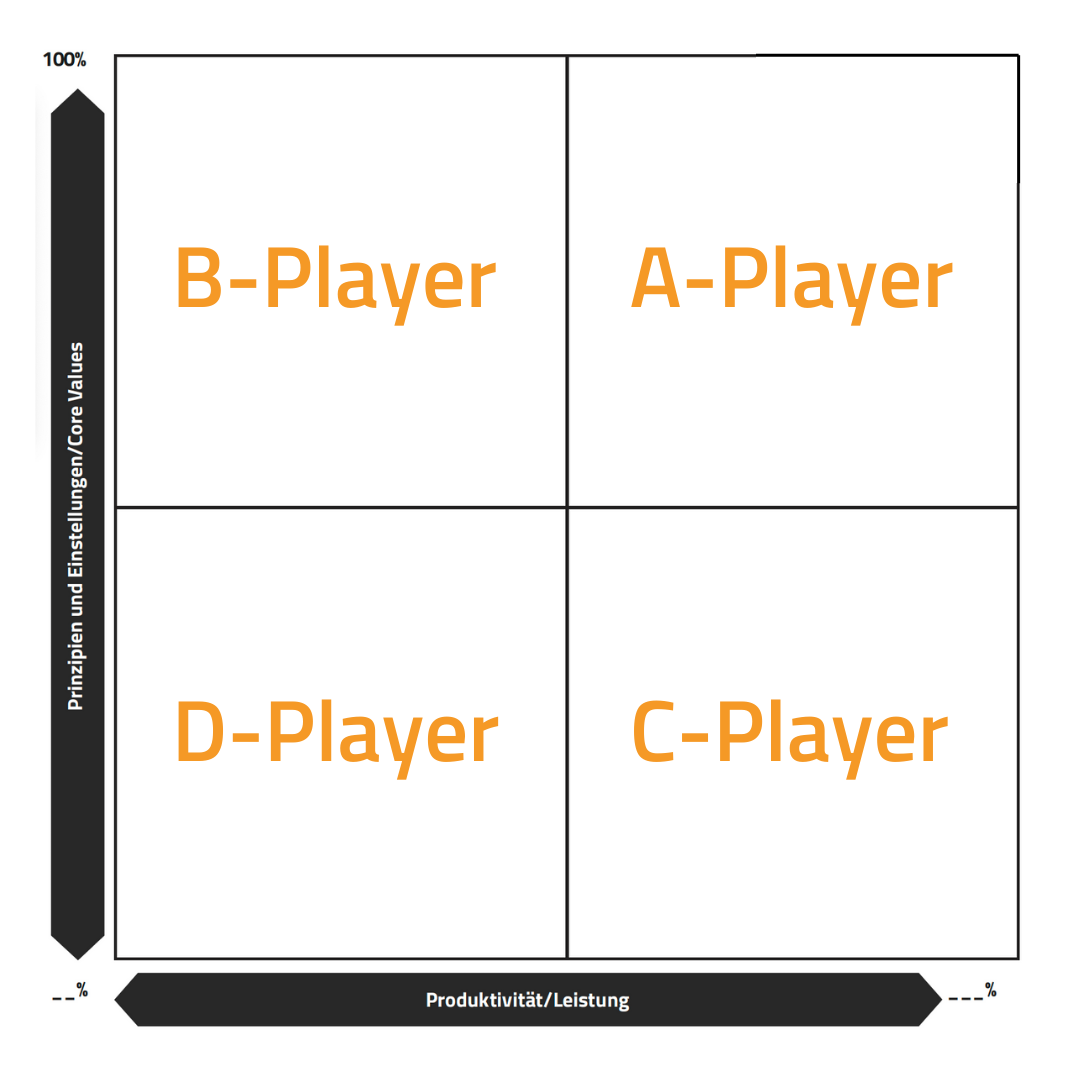
The four quadrants – and what they mean for startups
A-players: High performance, high cultural fit
They deliver results while strengthening culture. They think along, take responsibility, and develop others. A-players are the engine of every organization. Leadership here means: challenge, support, visibly appreciate – and protect. A-players rarely leave because of too much work. They leave because of mediocre leadership around them.
B-players: High cultural fit, performance (not yet) at A-level
B-players fit culture excellently but don’t yet deliver consistently at top level. The key word is yet. Performance can be developed. Attitude and values barely. B-players are classic development cases – and one of the most important tasks for leadership in growing startups.
D-players: Low performance, low cultural fit
Misplacements. This is not about coaching, but about clarity. A clean, fair separation is not a sign of harshness but of responsibility – towards the team and the organization.
C-players: High performance, low cultural fit
The most dangerous quadrant. C-players deliver numbers but create friction, undermine trust, and burden collaboration. In the long run, they drive away exactly the people you actually want to keep. Tolerating C-players sends a clear signal: performance trumps values. And that’s when culture tips.

Munich Startup Experts regularly brings practice-oriented know-how from the Munich startup ecosystem to the point. Selected experts from different areas such as law, PR & communication, funding advice, and HR & people share their knowledge in exclusive specialist articles and derive concrete learnings and actionable tips for founders.
Clarity is a leadership decision
Many founders actually know very well where everyone stands – but don’t say it out loud. Because it’s uncomfortable. Because conflicts take time. Or because short-term results are overvalued.
Strong leadership teams work differently:
- They define performance clearly and measurably.
- They translate values into concrete behavior.
- They conduct regular structured conversations – not just annual feedback.
- They follow through with consequences when agreed-upon development doesn’t happen.
Consequence is not opposed to humanity. It is its prerequisite. Or in other words: culture is not a feel-good topic. Culture is a hard-nosed performance lever – with a time lag.
Leadership starts at the top
People don’t orient themselves to mission statements, but to what is actually tolerated. What leadership permits becomes the standard. Those who don’t address mediocre leadership limit the potential of the entire organization.
Startups that grow sustainably protect their culture – even when it hurts in the short term.
Four questions that expose mediocre leadership
- Would you put this person in exactly this leadership role again today?
- Is the team gaining or losing strong employees in their environment?
- Does she embody core values even under pressure, or only on paper?
- Does the team take responsibility independently – or only after constant prompting?
If you can’t answer these questions clearly, it’s not an HR issue. It’s a leadership problem.
Growth begins in the leadership team
In the end, much comes down to one simple question: how much real clarity exists in the leadership team?
Growth rarely fails due to lack of competence. It fails because leadership is developed too late or too unclearly. Those who view performance separately from values create friction. Those who regularly reflect on both and act consistently make growth plannable.