

Munich is among Germany’s most expensive and dynamic office markets. Anyone founding a company here quickly faces numerous questions: How do I find a space that fits my company? How long do I have to commit? How much space do I actually need? What budget do I really need? And where should my office be located, not just today but also in the coming years?
As a consultant who works with companies searching for the right office every day, I repeatedly see startups either committing too much too early or overlooking valuable opportunities. This article is meant to change that.
How Munich’s office market works
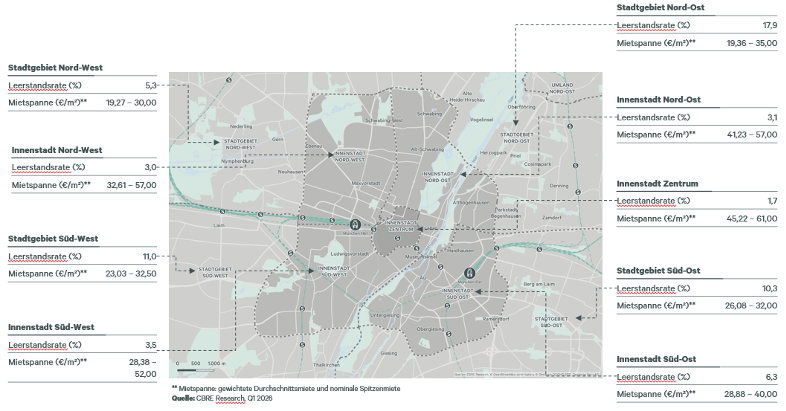
Munich is not a homogeneous market. The city differentiates strongly by location, with significant differences in rental levels, supply density, and the character of individual submarkets.
The city center and close-to-center locations like Altstadt, Maxvorstadt, Schwabing, and Lehel are the most expensive addresses in the city. Top rents here are often well above 60 euros per square meter per month, which is often not economical for a young company. Central locations like Obersendling, Frankfurter Ring, Moosach, and Ramersdorf offer a good balance between accessibility, location quality, and rent, typically between 18 and 28 euros per square meter. Surrounding municipalities like Garching, Unterföhring, Ismaning, Unterschleißheim, and Aschheim are significantly cheaper and are popular with tech-oriented companies that need a combination of office and test or workshop space.
The pandemic clearly accelerated one trend: today, companies especially want to be located at well-connected public transit hubs in modern buildings. This concentrates demand on a comparatively small number of properties. At the same time, many companies have reduced their total space but invest more in better quality and more attractive work environments. The office is now in direct competition with working from home. If you want to bring employees into the office, you need to offer a place that beats working from home.
The startup dilemma: Flexibility vs. market standard
The classic Munich office lease runs for five years, and for larger spaces or new buildings, even ten to 15 years. This is a structural problem for startups – not because growth is unlikely, but because it’s unpredictable.
Will I need twice as much space in 18 months? Will I have 30 employees or 12? These questions are often honestly impossible to answer in the early phase. And a lease agreement that ignores this uncertainty can quickly become a real economic obstacle.
The small segment between 200 and 600 square meters is highly competitive in good locations. Small units often disappear within a few weeks. If you hesitate or negotiate too long, you lose.
My advice: Define your non-negotiables early. Maximum lease term, acceptable commute for your team, space size with buffer for growth. This saves time and prevents you from being dazzled by a good address that structurally doesn’t fit.
One point that is often underestimated: the actual budget. The net cold rent is only part of your monthly costs. Add to that operating costs for heating, electricity, cleaning, and building maintenance, as well as an administrative cost allowance that landlords typically charge separately. Depending on the property and location, these items can significantly increase your total burden. Those who base their budget only on net cold rent often get a surprise when they sign the first lease.
Direct lease: What many tenants don’t know
Those who decide on a classic direct lease should understand one thing: commercial properties work fundamentally differently than residential properties. The value of an office property is usually calculated using so-called multiples – a multiple of annual rental income. This has an important consequence for negotiations.
For an owner, it’s not just the monthly rent that matters, but the combination of rent and lease term. A long-term lease at a good rental rate directly increases the property’s market value. That’s why owners are often willing to grant attractive incentives if rent and term are right. Rent-free periods of several months, tenant improvement allowances, or moving cost contributions are not exceptions in commercial real estate – they’re an established negotiating tool.
If you can handle the lease term and your growth is calculable enough, a well-negotiated direct lease can be more economical than you might think. The key is knowing these levers exist and addressing them actively.
Why sublease spaces are an exciting alternative
For startups that prefer to invest capital in product or growth, sublease spaces are often an exciting alternative. They’re already built out, often furnished, and offer shorter lease terms than the classic rental market.
Many established companies have more space in their portfolios than they actually use today due to home office / remote work and changed space strategies. They sit on completed, high-quality office spaces and are looking for subtenants to reduce their costs. This creates an offering for startups that didn’t exist in this form a few years ago.
There’s also an often-underestimated advantage: subtenants are typically far more flexible with credit checks than classic owners. The reason is simple: they don’t bear the risk of costly tenant improvements that would be lost if the tenant defaults. For startups with short company history or limited track record, this is a real door-opener.
But there are also points you should know: You don’t have a direct contract with the owner, but with the main tenant. This means you’re dependent on their creditworthiness and the remaining term of their lease. Before signing, definitely check: How much longer does the main lease run? Has the landlord approved the sublease? What happens if the main tenant gets into trouble? With the right advisor by your side, these questions can be clarified cleanly.
Tim Bäulke advises companies at CBRE in their search for suitable office spaces in Munich and supports them in location and lease decisions. Through his daily work in the Munich office market, he knows the challenges startups face as well as the developments and opportunities in the local real estate market.
How do you find the right sublease spaces?
Sublease spaces are typically marketed through brokers. Large corporations often have framework agreements with consulting firms like CBRE, which then exclusively handle the marketing of these spaces. This means: those who have access to these broker networks often hear about available spaces before they even come on the market actively.
A practical tip to wrap up: A broker’s service in your office search is typically free for you as a tenant or subtenant. Standard broker fees are paid by the landlord or subtenant. So you outsource the entire search process without paying for it. It’s a lever that surprisingly many startups don’t use.
What startups should watch out for
Munich’s office market is complex, but it offers startups more options today than it did a few years ago. Those who ask the right questions, think flexibly, and actively include the sublease market will find a space in this expensive city that makes economic and operational sense. What’s important is to address this issue early, because good spaces don’t wait.