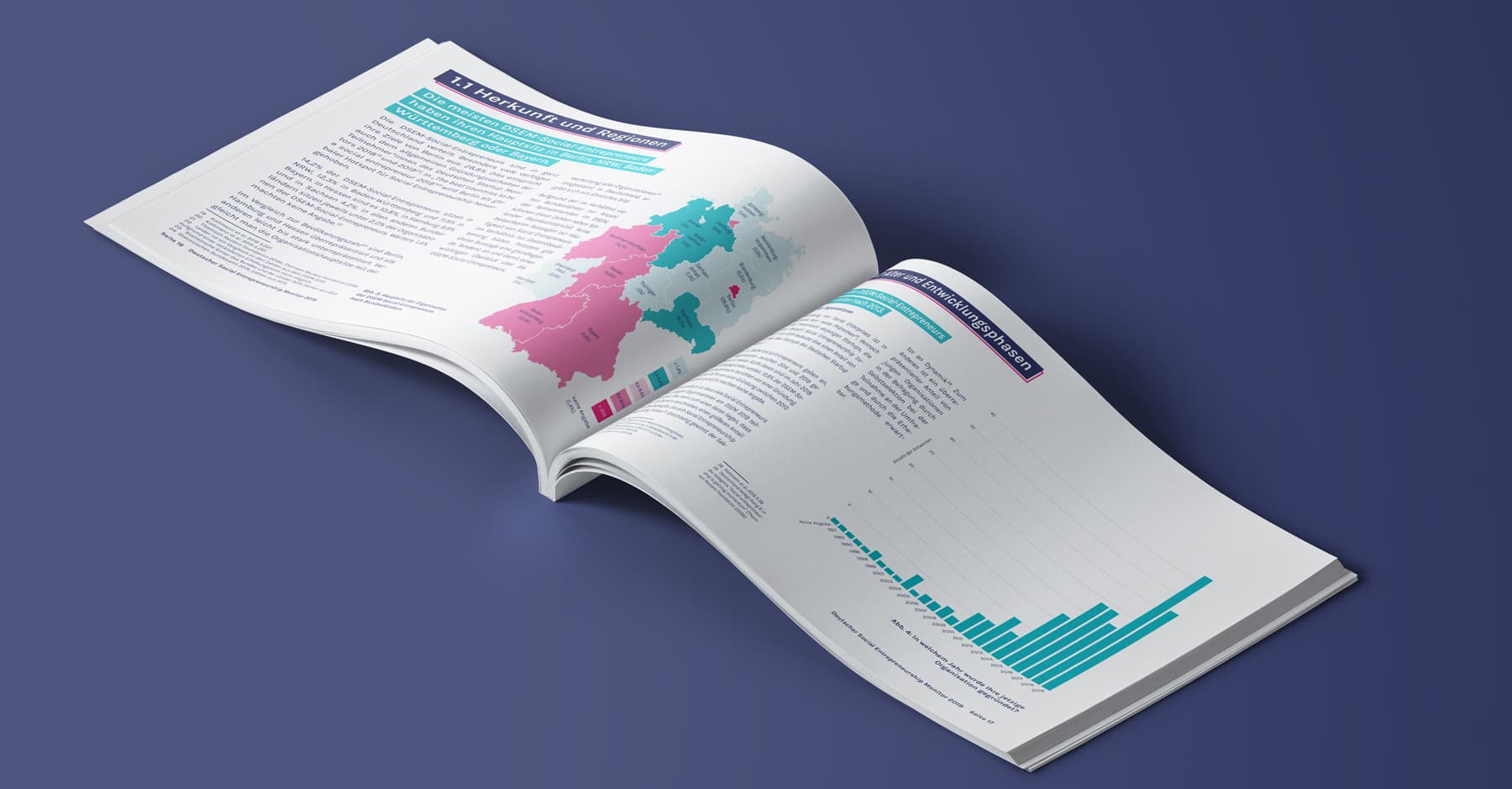

Since 2018, the DSEM has provided information about the German social entrepreneurship ecosystem. The monitor aims to provide decision-makers from politics, business, and civil society with a foundation for supporting social enterprises. In addition to conventional metrics such as organization size and revenue, the DSEM collects specific data relevant to the ecosystem. This includes, for example, data on non-profit status or the number of volunteer employees.
More than half of DSEM social enterprises were founded by women (in part)
The 5th DSEM 2024 demonstrates the enormous potential of social enterprises: they operate in all sectors, particularly in education, health, and social services. More than 75 percent of companies offer products or services for or with specific target groups. They frequently focus particularly on children and young people, people with a migration background, women, and people in poverty. Additionally, over 90 percent of social enterprises rely on solutions that address multiple of the 17 sustainable development goals (SDGs), with particular emphasis on social and environmental sustainability.
Furthermore, the surveyed social enterprises are:
- Established: More than a third (35 percent) have been active with their business for longer than a decade.
- Impact-oriented: More than half (62 percent) already measure their impact today to make informed decisions, with a further 29.2 percent planning impact measurement in the future.
- Female-led: More than half of DSEM social enterprises were founded by women (in part).
- Environmentally conscious: Ecological responsibility in the supply chain plays an important to very important role for the great majority (76.0 percent), with 58.4 percent also addressing ecological development goals in their business model.
- Digital: Artificial intelligence and machine learning are by far the most relevant technologies in their business model.
Financing for social enterprises remains challenging
Financing remains the biggest challenge. More than half of social enterprises report that there is still a lack of appropriate public support systems and that the allocation of public funds is often difficult to understand. Additionally, 57 percent of DSEM social enterprises wish for better understanding of their needs from policymakers. This includes:
- Demand-driven financing instruments that reduce systemic injustice and are tailored to the needs of social enterprises, regardless of their market participation or legal form.
- Creation of an ambitious social impact fund, funded by unclaimed bank accounts and with a clear market development mandate that mobilizes capital from various sectors without burdening the federal budget.
- Structural anchoring in the federal government through the creation of specialized departments in the BMWK and BMBF, as well as cross-departmental management rounds between various ministries to effectively promote social entrepreneurship and anchor the measures of the National Strategy in law.