
Munich Startup: What problem does your solution address?
Hanh Nguyen, Co-founder & CEO: The world’s strongest permanent magnets, used in every electric vehicle motor, wind turbine, and robot, depend on rare earths whose supply chains are fragile and geopolitically concentrated. Alqem uses AI to discover high-performance magnets (and thermoelectric materials) that don’t require rare earths, so industry isn’t dependent on a single supplier. Permanent magnets are our initial focus, but the platform we’ve developed can also be used to discover other critical materials for industries driving technological progress.
Munich Startup: What can only you do today?
Hanh Nguyen: First, we’re proud of the quality of our models, which are based on the expertise of the team that developed Alexandria – the widely-used open-source materials database. Our experimental results prove this, as they fall within expected standard deviations of our predictions. Second, most AI providers in materials science focus only on prediction. We cover the entire process: from our materials database (Al-mine) through property prediction (Al-oracle) to an LLM (Large Language Model) that controls synthesis in the lab (Al-forge). In hard magnets, the real challenge isn’t predicting a promising compound, but turning it into an actual magnet. It’s precisely this ability to complete the process in this specific field that sets us apart.
Solving material constraints instead of circumventing them
Munich Startup: What triggered the founding?
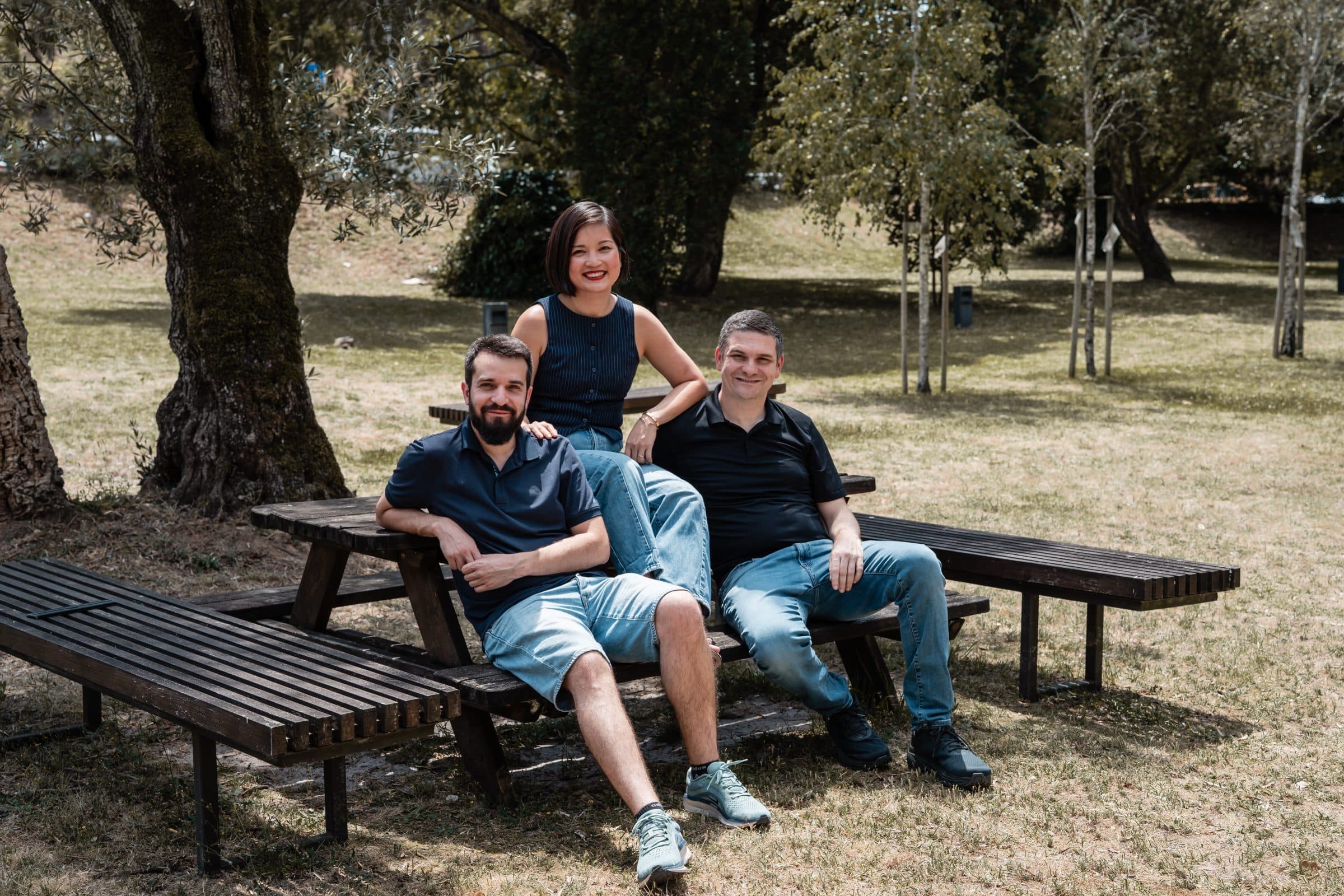
Hanh Nguyen: Milan and Tiago met through an international consortium for room-temperature superconductivity. There they developed a working approach that tightly links theory, computation, synthesis, and characterization. My long industry experience taught me that companies typically circumvent material constraints rather than solve them. These two insights led to Alqem.
Munich Startup: Was there a moment when you thought about giving up?
Hanh Nguyen: So far, I don’t think there’s been a single moment when I considered giving up. We’re a founding team of experienced specialists pursuing a shared goal: finding materials and scaling their production that could change the world. We’re convinced we have a unique technical foundation and a promising approach: if the universe offers fundamentally better materials, we have the means to find them. We’ll know in a relatively short time whether there are promising candidates. Such short-term indicators help us stay focused.
Munich Startup: How will you know in a year that you’re on the right track?
Hanh Nguyen: At least one validated, rare-earth-free magnet candidate has made the journey from prediction to developing real, characterized samples, and industrial partners have committed to co-developing it further. If our synthesis process produces materials that customers actually need in their products, we’re on the right track.
Munich as a hub for world-class physics
Munich Startup: Would you found again in Munich and why?
Hanh Nguyen: Yes. Few places combine this density of world-class physics from TUM, LMU, and the Max Planck Institutes with top-tier industrial customers from automotive, robotics, and energy right on the doorstep, plus deeptech investors who understand deeptech timelines.
Munich Startup: Focus or diversification?
Hanh Nguyen: Focus. In the coming months, we’ll intensively tackle a difficult and urgent problem: magnets without rare earths, and thereby secure the opportunity to expand the platform to other fields later.