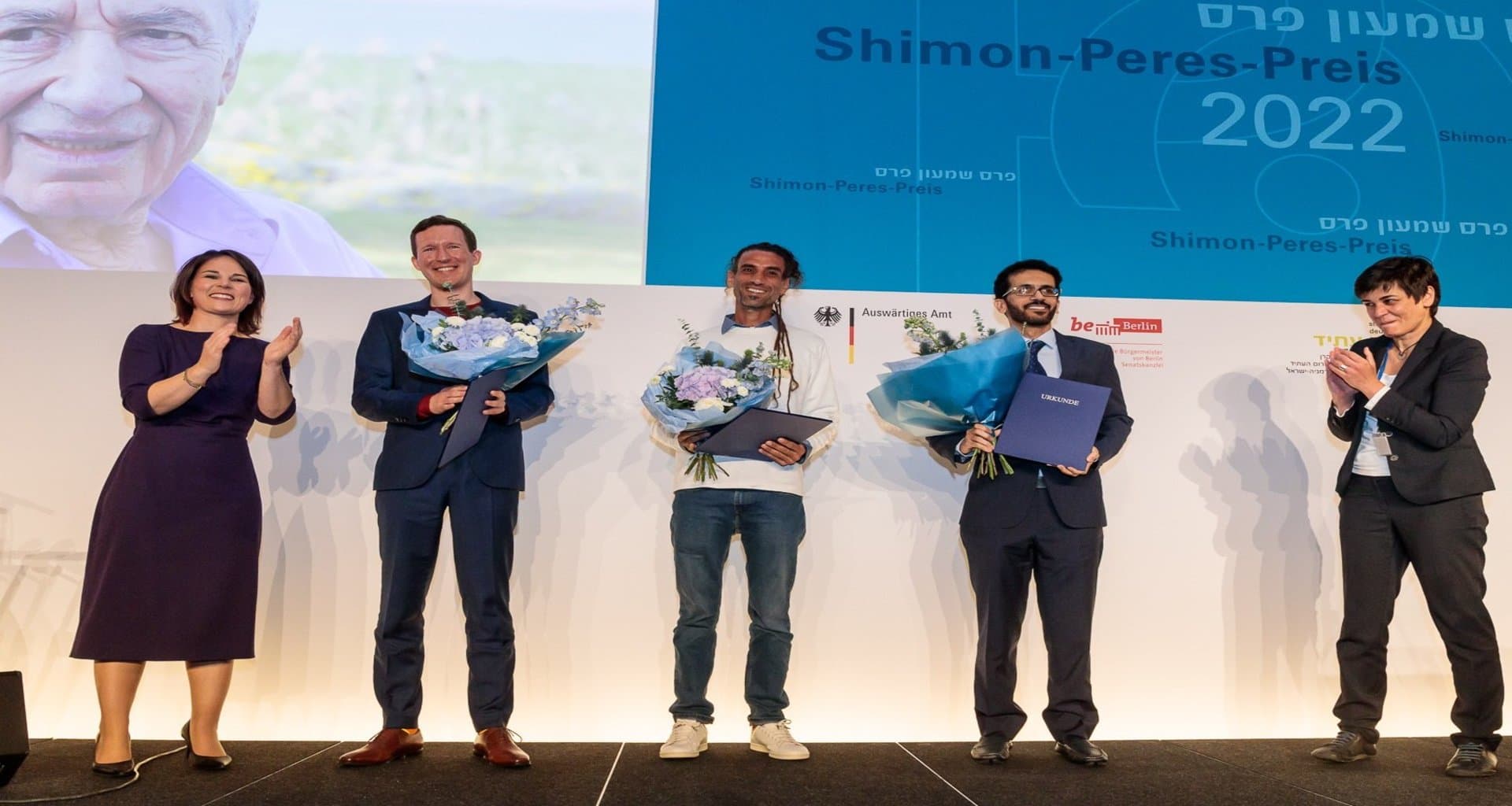

Representatives of Strascheg Center for Entrepreneurship (SCE) from Hochschule München, Israel, and the United Arab Emirates accepted the Shimon Peres Prize 2022 on behalf of the entire BIPA consortium. The award is announced annually by the Foundation German-Israeli Future Forum and the German Federal Foreign Office.
The international BIPA program advocates for mutual understanding between nations and against discrimination, using the training of young people and economic cooperation as its vehicle. Since 2021, in addition to Hochschule München and its founder center SCE, TH Deggendorf, OTH Regensburg, FOM University of Applied Sciences, and Israeli partner Tech7 from Be’er Sheva, Khalifa University Abu Dhabi from the United Arab Emirates has also been part of the cooperative program. The Bavarian Ministry of Economic Affairs, the Israeli General Consulate for Southern Germany, and the Department of Economics and Labor of Landeshauptstadt München support the program.
In memory of the former Israeli President and Nobel Peace Prize laureate Shimon Peres, who passed away in 2016, the German Federal Foreign Office established the prize. The Shimon Peres Prize is awarded annually to two projects and is endowed with 10,000 euros each.
Shimon Peres Prize for BIPA: “I’m delighted that this approach was chosen”
The BIPA program, which was awarded the Shimon Peres Prize, is aimed at students and young professionals from Bavaria, Israel, and the United Arab Emirates. The program was launched in 2015. Ten editions so far have included 250 participants and over 50 companies. Since 2021, students from the United Arab Emirates have also been involved. In international, interdisciplinary teams, they work on real-world problems relevant to companies, for which innovative solutions are developed.
Federal Foreign Minister Annalena Baerbock said in her speech on the occasion of the prize presentation about BIPA:
“I’m delighted that this approach was chosen. Because it’s not just about government representatives meeting, but also regional actors. That’s exactly what we need for future projects. So here, young Israeli, German – Bavarian – and Emirati professionals and students are together searching for solutions to the pressing questions of our time, particularly ecological ones.”