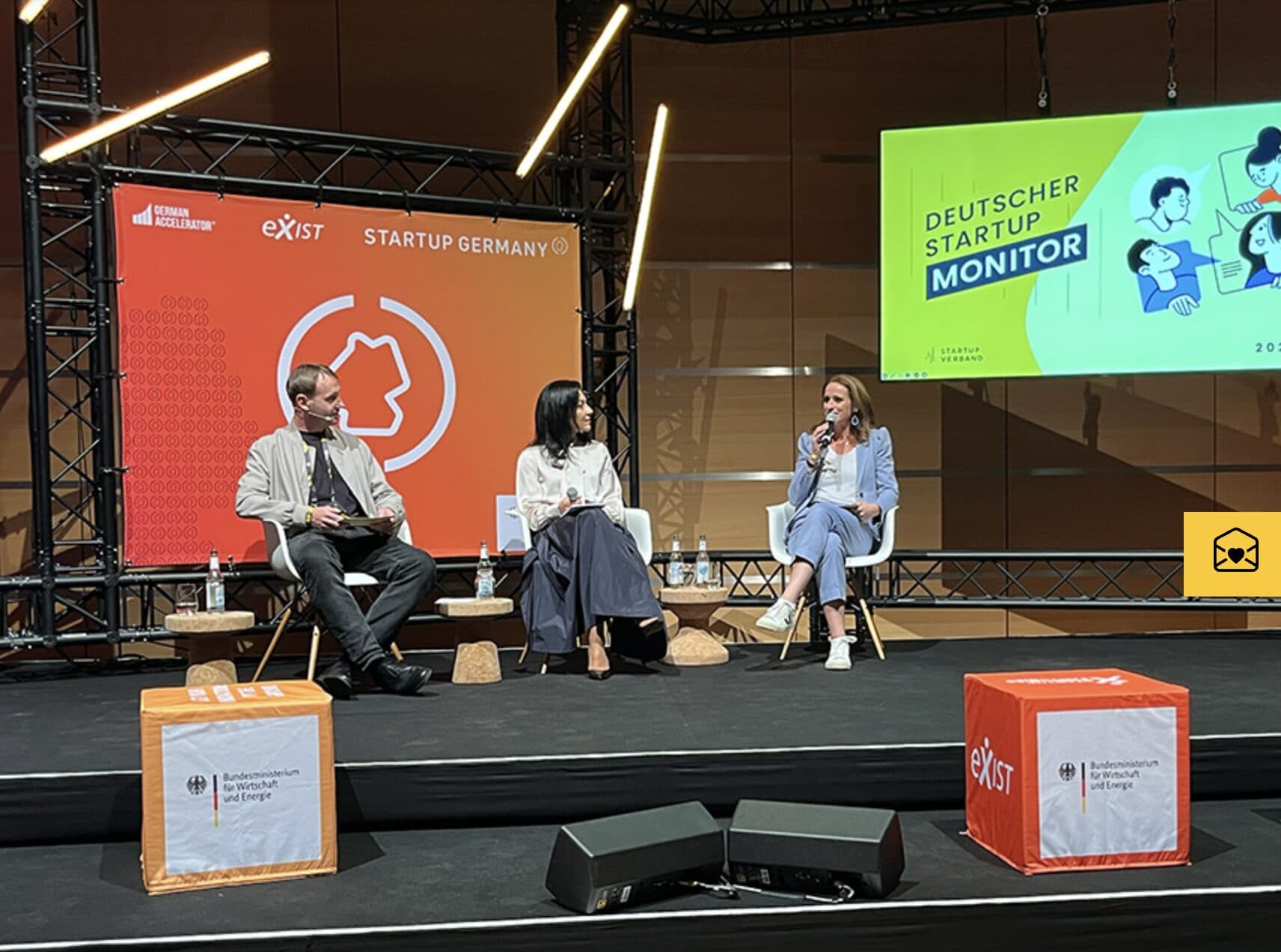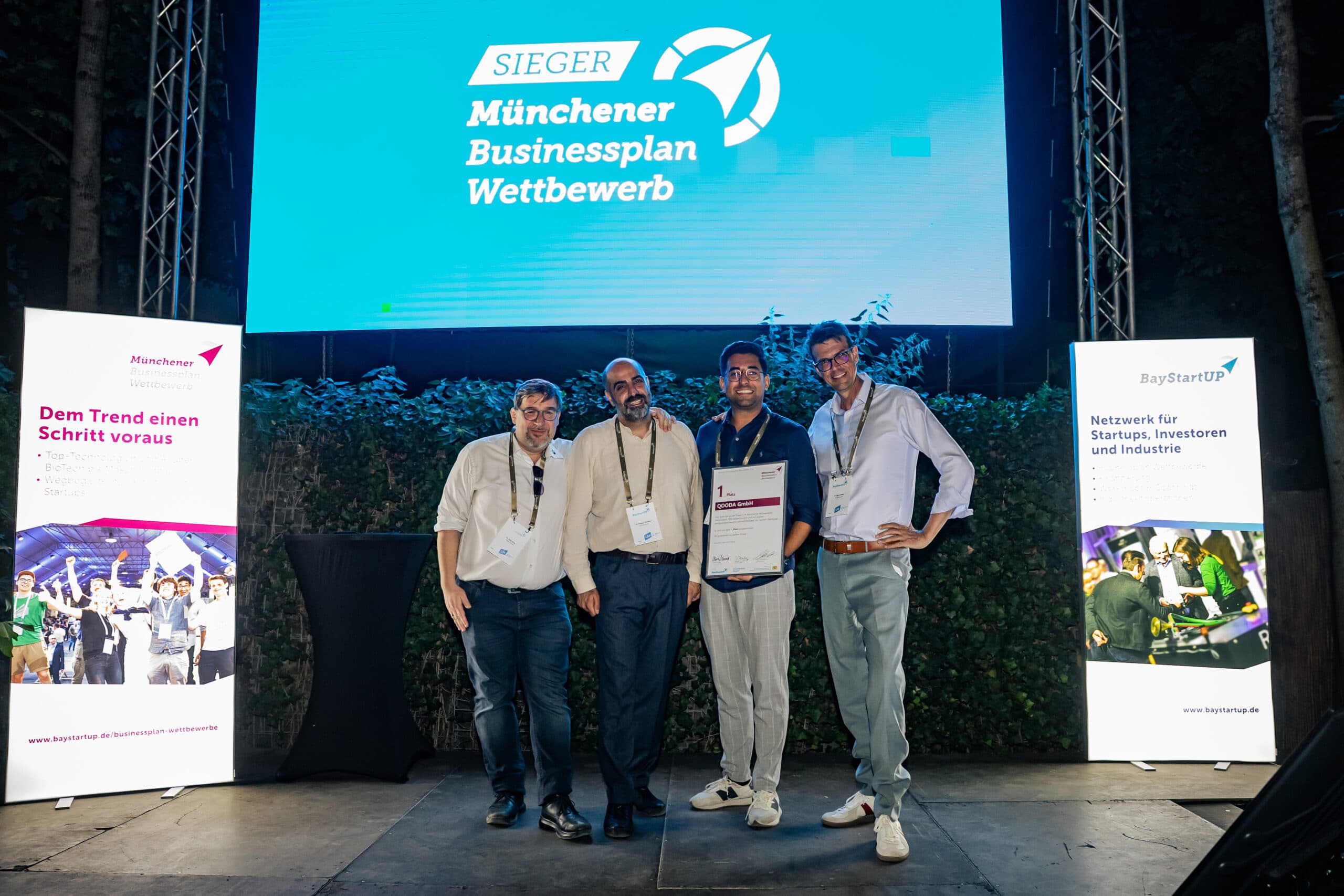

Not every startup needs to expand globally. The four panel guests at the Munich Startup Festival on July 22, 2026 at Backstage Munich were largely in agreement on this. However, those who want to grow internationally need more than capital, a large target market, and a persuasive presentation: The business model must be transferable, the founding team must be able to sustain the expansion, and a stable foundation should already exist in the home market.
Using Flix as an example, co-founder Daniel Krauss showed how an initially German long-distance bus provider became an internationally active mobility company. At the same time, the other panelists made it clear that the Flix strategy cannot simply be applied to every startup.
The discussion was moderated by Christina Niedermeyer, Head of Corporate Partnerships at Plug and Play.
Two Paths to Internationalization: Necessity or Market Opportunity
Daniel Krauss distinguished between two fundamental reasons for early expansion. Some startups have to internationalize because their home market is too small. This can be observed particularly often among companies from smaller European countries. Other companies expand because initial successes show that their offering could also work in additional markets. Flix belonged to this second group.
After the Flix model had established itself in Germany, new opportunities arose through the opening of additional European long-distance bus markets. France and Italy offered similar conditions: alongside cars and trains, there was room for an additional long-distance transport offering with buses.
“If the legal basis is similar, then: Let’s do it,”
is how Krauss summarized the thinking at the time.
Flix seized an unplanned personnel opportunity in Italy
Krauss used the Italian market as an example to show how much expansion can depend on key individuals. The man who would later head Flix in Italy for many years originally came to Munich because his wife had started a new job there. He joined Flix and won over the founding team within a few months. The company then suggested that he build up the business in Italy from Milan.
“We simply seized the opportunity that was right there because we believed it would work pretty well elsewhere, too,”
said Krauss.
The episode illustrates one of the central points of the panel: International expansion is not merely a strategic decision at the executive level. It also depends on whether a company can find suitable executives who understand a new market and can act independently there.
Start2 Group: A startup is global when local management takes over
Matthias Notz, CEO of Start2 Group, therefore put the founding and management team front and center. Capital, regulation, and networks are important. However, the decisive factor is whether the company has people who can actually execute expansion.
“If you really want to go global, you naturally need people who understand what that means,”
said Notz. The assumptions that apply in the home market cannot automatically be transferred to other countries. This applies above all to product-market fit, but also to culture, management, and internal processes.
For Notz, a company is only truly global when the founders no longer have to manage every market themselves. He explains:
“I think you are a global startup when you have local management and it still works.”
Local executives need to understand both the respective market and the company’s philosophy. The challenge lies in giving them sufficient autonomy without losing the shared strategic direction.
Why Flix went to the US before a major competitor emerged there
According to Krauss, Flix‘s expansion into the US followed a different logic than its European market entries. The company wanted not only to capitalize on an additional growth opportunity, but also to forestall a potential competitor.
The large US domestic market could give a local provider sufficient scale and capital to subsequently expand to Europe. Flix wanted to prevent an American competitor from first building momentum in its home market and later attacking the fragmented European market.
“The only one who could somehow become dangerous to us would be an American competitor, because the home market is so large,”
said Krauss. The consequence was clear:
“Then we’ll go to the US first and establish ourselves there.”
Regulation determines whether a business model can be transferred
In addition to team and competition, regulation played a central role for Flix. The business model only works in markets where private long-distance transport services and cooperation with local bus companies are legally possible.
“As long as the regulatory framework fits, meaning we can carry out our business model, then we just do it,”
said Krauss.
In doing so, he also identified a limit to scalability: Even if demand exists, differing laws, tariff structures, and technical systems can make expansion more expensive or prevent it altogether.
This becomes particularly clear when working with local public transport associations. A standardized integration of the last mile is hardly possible because cities and regions operate with different tariffs, technical solutions, and incentive systems.
“Every outfit is different. They have different tech systems, they have different tariff systems. It’s simply a total muddle,”
Krauss said about the various local public transport organizations.
As a result, comprehensive technical integration could become so expensive that it makes no economic sense.
Wow Urbane Utopien: Every City Can Be Its Own Market
Benjamin Domnik, co-founder of Wow Urbane Utopien, represented the perspective of a young company with a local and European focus on the panel. The startup develops solutions for public spaces and, according to its own statements, produces as locally as possible.
For Domnik, internationalization in this area cannot be separated from the respective cities. The use, financing, and design of public spaces differ significantly depending on the country and region.
“Everywhere there are different habits and different influences shaping how people behave in public spaces,”
he said.
These differences influence both the demand for products and the available public funds and regulatory requirements. While cycling infrastructure, for example, is a high political priority in the Netherlands, other countries set different priorities.
For a startup with physical products and municipal customers, strong local roots can therefore be an advantage. Knowledge of permits, procurement, and local materials is difficult to copy.
Krauss confirmed this assessment. With a business model like Wow’s, almost every city can represent its own market. For Flix, on the other hand, entire countries tend to be the relevant units.
Europe offers high standards – but also high expansion costs
At the same time, Domnik pointed to a potential strength of the European market. Those who develop products that meet strict data protection, sustainability, and regulatory requirements can also gain advantages in other regions.
“If you find solutions that are both GDPR-compliant and meet certain European standards, then of course a very large market is open to you,”
said Domnik.
However, Europe is significantly more fragmented than the US. The American market more frequently enables more uniform scaling, whereas European companies have to take a multitude of national and local rules into account.
Krauss also sees this as a major cost factor. In terms of market potential, the US is almost as important for Flix as Europe, but it can be expanded into with less organizational effort.
“The costs of cultivating this market, meaning America, are significantly lower than cultivating Europe,”
he said.
Thus, the size of a market alone is not a sufficient criterion for expansion. What is also crucial is how many different sub-markets a company has to serve operationally, technically, and from a regulatory standpoint.
Market penetration is more important to Flix than a maximum number of countries
Krauss warned against expansion at all costs. Especially in a network business like Flix’s, sufficient market penetration is essential to operate sustainably and profitably.
A startup, on the other hand, could get “tangled up” if it tackles too many markets at the same time. Companies therefore need to weigh whether to concentrate their resources on deeper penetration of existing markets or on additional countries.
This tradeoff varies depending on the business model. A largely digital software provider can often test markets faster than a company that requires local infrastructure partners, permits, or physical supply chains.
Hochschule München: International networks aimed at facilitating startups
Klaus Sailer, Managing Director of Strascheg Center for Entrepreneurship at Hochschule München, brought the role of higher education institutions into the discussion. In his view, universities should not only impart knowledge, but also be part of the innovation ecosystem.
This also includes stronger international collaboration. Sailer referred to a network of 35 universities through which teams are to gain access to different fields of expertise and markets.
“The world is so complex, everything is interconnected,”
he said.
Universities must therefore ask themselves how to deal with this interconnectedness. A robotics startup, for example, could benefit from a university in Portugal, while Munich attracts international teams in other areas. Such networks enable knowledge exchange, market access, and long-term contacts without every university needing to build its own complete support structure.
For Sailer, this is not just about the success of individual startups. Universities should also help make innovations usable for societal and economic challenges.
The Munich startup ecosystem already offers a strong foundation
In the discussion on state and regional support, Krauss emphasized that Flix was able to draw on existing structures in Munich. Among other things, he referred to financing partners, business plan competitions, entrepreneurship programs, and early investors.
“You don’t really need much more than that,”
said Krauss with regard to the support landscape.
However, additional programs or delegation trips could not replace the personal decision to build a company for the long term. Entrepreneurship is a calling and not a standard career path.
“Not everyone has to become an entrepreneur,”
Krauss said, adding:
“Some are made for it and some are not.”
In his assessment, founders must ask themselves whether they are prepared to take long-term responsibility for their own company. Evaluation by outsiders should not be the deciding factor.
“Either you step on the gas or you don’t,”
said Krauss.
Matthias Notz: Global markets are not only in Silicon Valley
At the same time, Notz warned against equating international expansion exclusively with the US or Silicon Valley. Worldwide, new startup ecosystems are developing, such as in Africa, Latin America, India, China and Southeast Asia.
“The world doesn’t only consist of Silicon Valley,”
said Notz.
“They are setting off everywhere.”
For German startups, this could lead to new partnerships and sales markets. Trips and political delegations are merely a small building block in this regard. What is more important are lasting bridges, concrete collaborations, and actual business.
“The real stuff is when we simply build bridges and do business there,”
Notz explained.
Germany already has numerous successful scaleups. Flix is one of the most visible examples, but it does not stand alone. What is crucial is that successful founders later give back capital, experience, and contacts to the domestic ecosystem.
Munich, Berlin, and other locations should cooperate more closely
The panelists also spoke out against excessive competition between German startup hubs. While comparisons between Munich and Berlin generate publicity, they do little for international competitiveness.
“The time when we somehow work against each other in cities or federal states – it’s over,”
said Notz.
Sailer added that Europe and Munich should not merely try to copy other ecosystems. Anyone who just chases after Silicon Valley or China will permanently remain in the role of an imitator.
“We need to find our own path,”
said Sailer. Munich and Europe are fundamentally well positioned for this. What matters now is making better use of existing strengths and expanding cooperation between universities, startups, investors, established companies, and policymakers.
Domnik nevertheless sees concrete structural hurdles. Young founders in particular are burdened by bureaucratic processes and a lack of digital standards.
“These are such simple levers that could take the whole thing to a new level.”
Less administrative burden would allow young companies to invest more energy into product development, customers, and growth.
5 lessons for international startup expansion
Five key takeaways can be drawn from the panel discussion:
1. The home market must provide a stable foundation.
Krauss emphasized that startups cannot overestimate the importance of their home market. Without a functioning core business, expansion can exacerbate existing problems.
2. The business model dictates the pace.
Software is often easier to internationalize than physical products or locally regulated services. For some companies, every country is its own market, while for others, every city is.
3. Local management is essential.
According to Notz, a startup is only truly global when local teams can make decisions independently and implement the company strategy.
4. Regulation can be both an opportunity and a hurdle.
Market openings enabled Flix to enter new countries. However, fragmented regulations and technical systems can make scaling significantly more expensive.
5. Expansion requires courage – but also the willingness to retreat.
A market attempt is allowed to fail. The key is to learn quickly and not stick permanently to a strategy that isn’t working.