
The oversubscribed round of Munich-based spacetech Dcubed is led by Warsaw Equity Group (WEG). The European Innovation Council (EIC) Fund, the HTGF Opportunity Fund, and existing investors also participated.
Dcubed develops components for satellites, including release mechanisms and deployable solar arrays. For example, the release mechanisms hold solar panels securely together during rocket launches and only release them once in space. There, the modules can deploy and generate electricity.
The startup focuses on standardized products that customers can order for their satellites without time-consuming new development. According to the company, Dcubed has already supplied more than 170 customers across Europe, the US, and Asia. More than 500 of its products are currently in space. The company now employs 87 people.
Production capacity set to quadruple
Dcubed plans to invest part of the new capital in production facilities, automation, and additional personnel. Supply chains are also set to be expanded. The goal is to quadruple production capacity in Germany and the US.
Back in August 2024, the startup had closed a Series A financing round of around 4.4 million euros. At the time, Dcubed also announced the expansion of its manufacturing operations and opened a location in the US state of Colorado.
The new financing is also set to enable the market launch of the Araqys product family. This includes solar modules and other power supply solutions for satellites and other space applications.
Thomas Sinn, Founder and CEO of Dcubed, summarizes:
“Demand for our products is going through the roof, so now is the time to scale significantly. Fast delivery is already one of our strengths, and by expanding production in Germany and the United States, we will become even faster and be able to meet this rapidly growing demand. Our goal is simple: to make space hardware as easy to buy and use as anything on Earth, and to make affordable, abundant power through Araqys the foundation for entirely new applications and markets in space.”
Foldable Solar Modules for More Power in Space
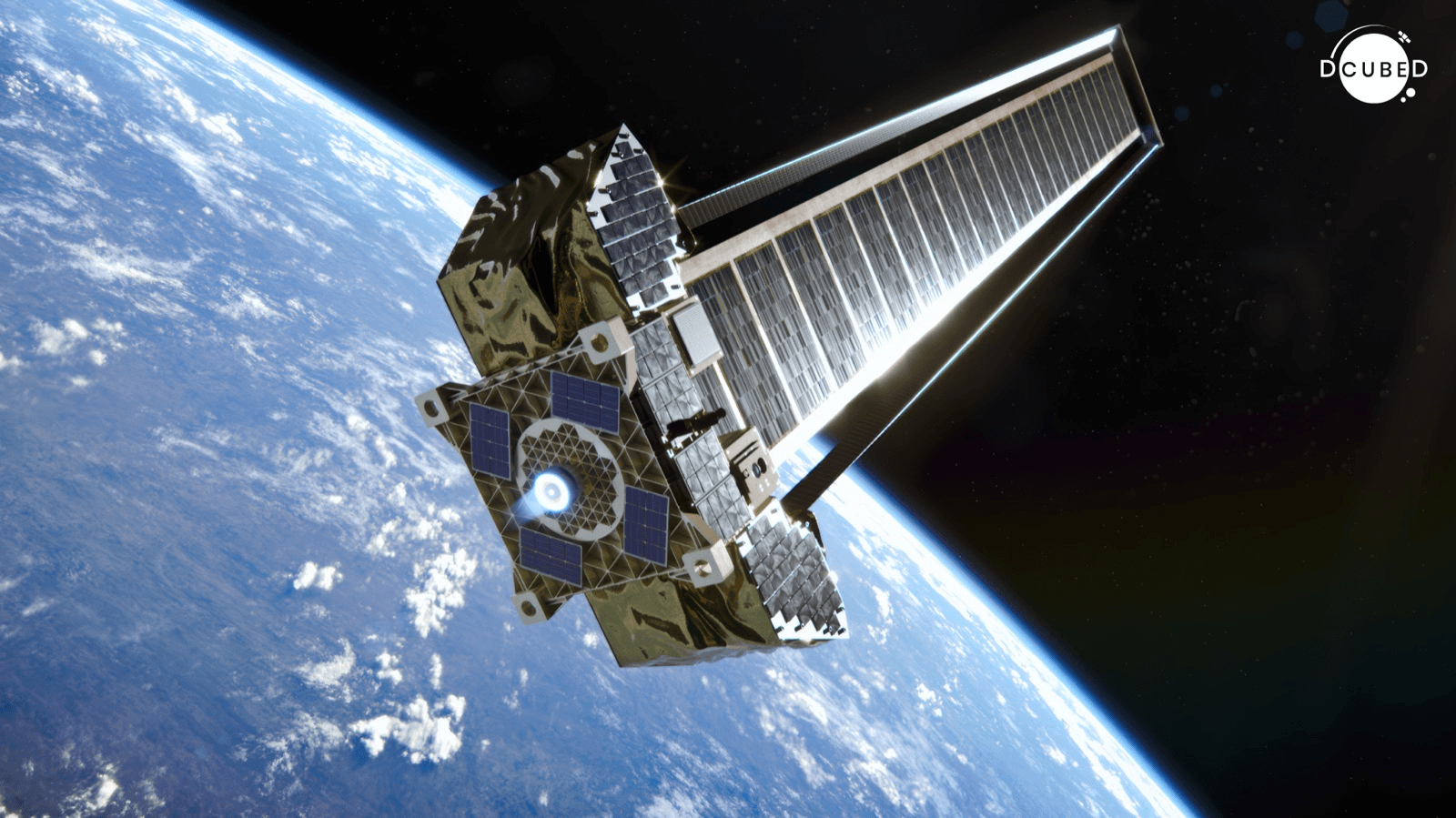
A central component of Araqys is the Halo solar module. It uses an origami-inspired folding technique: during rocket launch, the module takes up very little space, unfolding into a significantly larger surface in space. Dcubed plans to use conventional silicon solar cells for this and significantly reduce the cost of power generation in space. In the long term, this is also intended to enable systems with capacities of several tens or hundreds of kilowatts.
The startup is planning its first space test for 2027. During the Araqys-D3 mission, a Halo module with an output of two kilowatts is set to reach space on a SpaceX rideshare mission. In addition, Dcubed wants to demonstrate a ten-meter-long boom that is manufactured and deployed only once in space.
The technology builds on the company’s previous developments. In an interview with Munich Startup back in March 2026, CEO Sinn explained how Dcubed intends to enable larger satellite components using foldable structures and in-space manufacturing.