
Munich Startup: Who are you and what does ZURÜCK do?
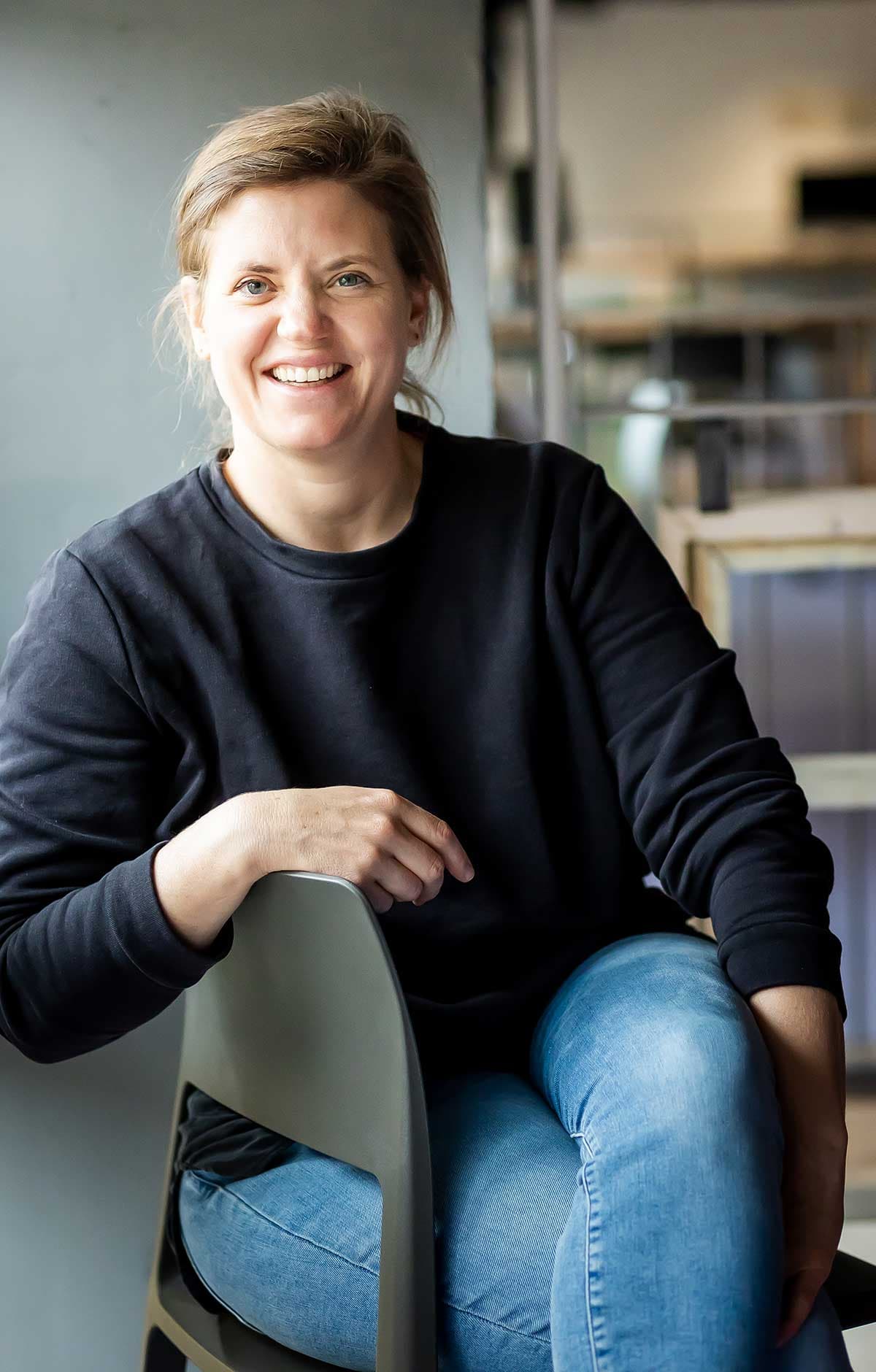
Anna Diermeier, founder of ZURÜCK Studio: We are a design studio for zero-waste and upcycling projects. Every day, valuable resources end up in the trash. We design new things from them on behalf of companies. The selection of materials is diverse. We work with textile scraps, advertising banners, or paper waste. What the materials have in common is that they were only briefly or not at all in use, even though some were designed for long-term use. The leftover materials are further processed locally and fairly in Germany or even in and around Munich.
Think about circular economy from the start when designing products
Munich Startup: How do you integrate the concept of circular economy into your business model?
Anna Diermeier: For our upcycling projects, we use existing materials that have completed their first lifecycle, such as advertising banners. We apply the re-use principle here. This means a material is given a second purpose and reused.
It becomes even more exciting when the second use is considered right from the design of the original product. We did this, for example, with the Bavarian Chamber of Architects for an exhibition. When creating the exhibition banners, we already incorporated a cutting pattern with product graphics positioned on the back. So after the traveling exhibition, which runs for about a year, practical cable bags are sewn from the banners.
Our offer is primarily aimed at companies that have large amounts of waste and want to create something new from it and have it realized. We focus on customized solutions, meaning products that the company’s target audience really needs, and on local further processing.
ZURÜCK: Positive communication as an important part of the work
Munich Startup: What can other startups learn from you?
Anna Diermeier: We see positive communication as an important part of our work. That’s why we communicate the background of projects – how it came about, where it was made, and how it was used – on social media and our website. We also like to participate in panels and discuss the topic of circular economy. Just talking about the topic and getting it into people’s awareness is already a success. From the beginning, I work with a photographer for the photos and videos I publish. I believe that’s an important part of success. I think attractive photos are super important.
Munich Startup: What are your current challenges?
Anna Diermeier: I find it difficult to find the right balance. Balancing the fluctuations between perceived “idle periods” and “overwhelm” is tough, everything tends to come at once. I work alone on the conceptual side, but I’ve built a great network of businesses that then implement the products. A continuous order situation with a few recurring projects would be great.
Adjust regulations so disposable products no longer “make sense”
Munich Startup: What other circular solutions do you find interesting?
Anna Diermeier: Upcycling is, if we produce circularly, of course no longer necessary. Then there are no more leftover materials, overproduction, and single-use products. There are a few companies that have already internalized the circular mindset and have even adapted their business model. Patagonia and Vaude come to mind, of course. A reusable system like Recup or Vytal also makes total sense. But the prerequisite is that the cups are actually reused and don’t end up sitting in our kitchen cabinets. It would also be great if all stores agreed on one system and didn’t offer their own solutions.
Munich Startup: Where do you see yourselves in 5 years?
Anna Diermeier: In 5 years, ZURÜCK is a well-utilized design studio with many beautiful projects in the area of upcycling and especially in product development with a focus on zero-waste and circular economy. The regulations have been changed so that it no longer makes sense to produce disposable clothing, disposable furniture, or elaborate disposable packaging. We have been able to dramatically improve our resource waste and waste problem. By the way, Munich has the goal of becoming a zero-waste city. We are a crucial part of that!