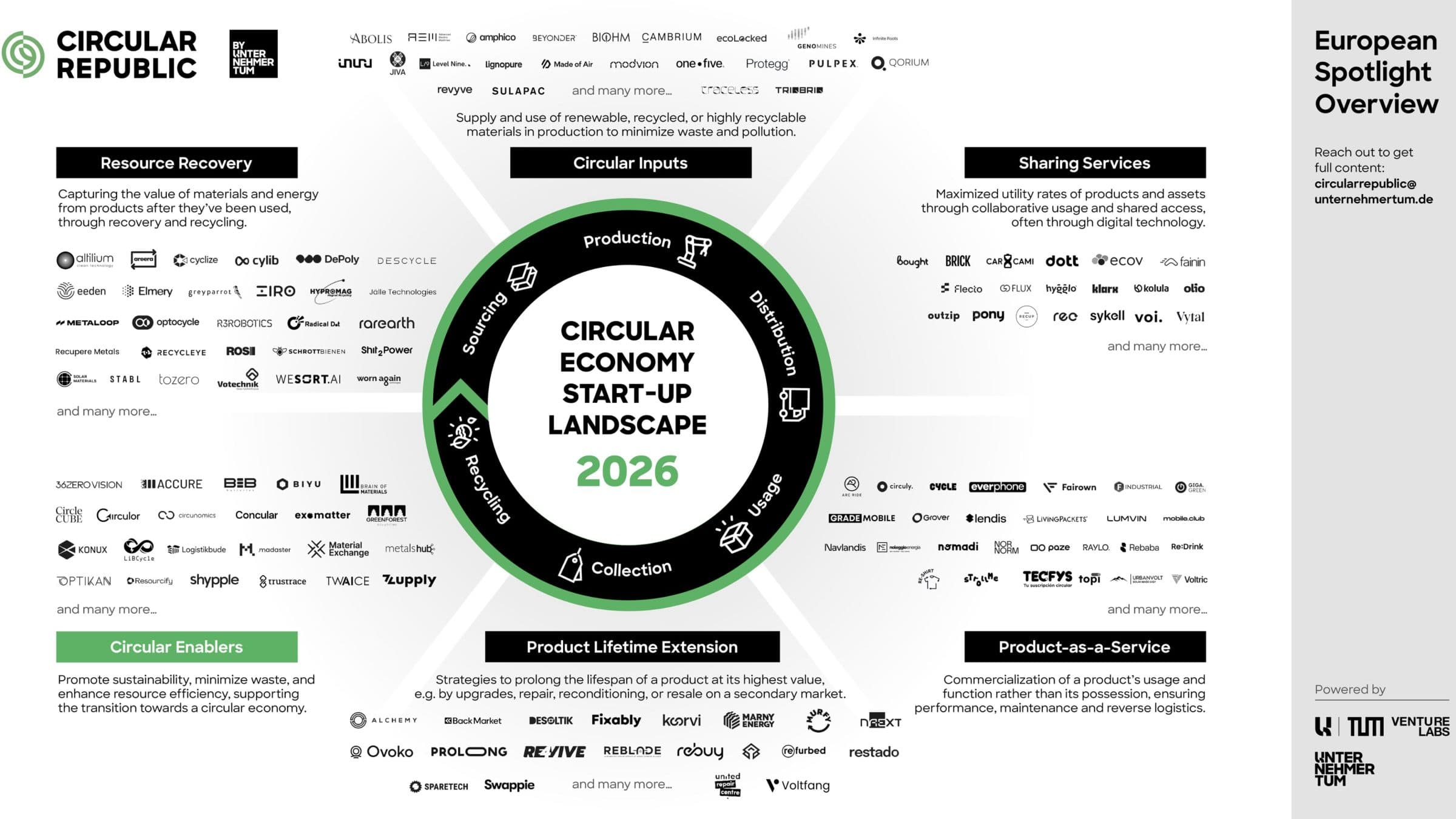

Europe is emerging as a global hub for circular economy startups. The new startup landscape from Circular Republic, the circular economy initiative of UnternehmerTUM, illustrates a strategic shift. Circular economy is increasingly no longer understood primarily as a sustainability issue, but rather as an industrial policy lever for Europe’s economic resilience.
Against the backdrop of geopolitical tensions, fragile supply chains, and rising raw material prices, the recovery of critical raw materials is becoming increasingly important. Europe has been heavily dependent on imports for rare earth elements, which are used in wind power plants, robotics, and electric motors – according to Circular Republic, dependence on China for individual materials is as high as 95 percent.
This is precisely where new startup opportunities are emerging. Technologies for automated disassembly, AI-powered sorting, and modern recycling processes are intended to help recover valuable raw materials more efficiently in the future and make industrial cycles economically scalable.
Germany, United Kingdom, and France lead Europe’s circular economy scene
With around 2,800 identified startups, Europe remains a global hotspot for circular business models, according to the analysis. Particularly many companies continue to emerge in Germany, the United Kingdom, and France.
However, relative to population size, Estonia and Finland rank among the most dynamic ecosystems in the circular economy sector. The study thus underscores that circular innovation is increasingly distributed across Europe and does not emerge exclusively in the major industrial nations.
According to Circular Republic, the study is the largest data-driven analysis of European circular economy startups to date. In addition to the companies, financing trends and technological focus areas were also captured.
Automated disassembly and critical raw materials recovery as new growth markets
This year’s survey places particular emphasis on industrial applications. The focus is on technologies for automated disassembly of industrial products, AI-powered systems for sorting material flows, the recovery of critical raw materials, as well as robotics-based recycling processes and so-called physical-AI applications for industrial cycles.
The combination of AI and hardware-based recycling technologies is considered a future field in particular. However, according to the analysis, fewer than five percent of circular economy startups are currently working explicitly on solutions around critical raw materials.
At the same time, around 15 percent of European circular economy startups are engaged with recycling technologies for closing material cycles.
Leonhard Teichert is the program manager at Circular Republic and says:
“The few companies that exist at the intersection of circular economy and AI, however, are the absolute top performers.”
Europe sees opportunity for technological leadership
For Circular Republic, this presents a strategic opportunity for the European industrial location. While Europe has lost market share to the United States and China in areas such as internet platforms, solar industry, or electric mobility, a new industrial leadership role could now emerge in recycling and disassembly technologies.
Matthias Ballweg, co-founder of Circular Republic, explains:
“But now we have a new opportunity with disassembly and recycling technology to do better and this time secure market leadership from Europe.”
However, the study also warns that Europe could lose its current lead without consistent industrialization and scaling.
You can find the European startup landscape for the circular economy sector here.