
The EXIST funding program remains a central driver, particularly for technology-oriented startups in Munich and beyond. The current monitoring report demonstrates just how strong the effect actually is: 63 percent of surveyed teams report that they would not have implemented their founding without the funding.
The data comes from monitoring by the project sponsor Jülich and is based on funding data as well as surveys of funded teams. They make clear: funding like EXIST is not only support for many projects, but a prerequisite.
Bavaria as a central EXIST hub
Since 2007, around 6,051 applications have been submitted, 3,331 projects received funding. This corresponds to a success rate of approximately 55 percent. Overall, nearly 368 million euros flowed into science-based startups.
Bavaria ranks among the most significant federal states in the EXIST program. Together with North Rhine-Westphalia, Baden-Württemberg, and Berlin, the Free State leads in applications, approvals, and funding. Universities form the backbone of this development, particularly research universities. Institutions such as the Technische Universität München have been among the most active players for years.
A look at the funded technology fields reveals clear priorities: software stands in first place by a large margin, both overall and in 2025. This is followed by internet-based business models and communication technologies. Other relevant areas include medical technology, biotechnology, and energy.
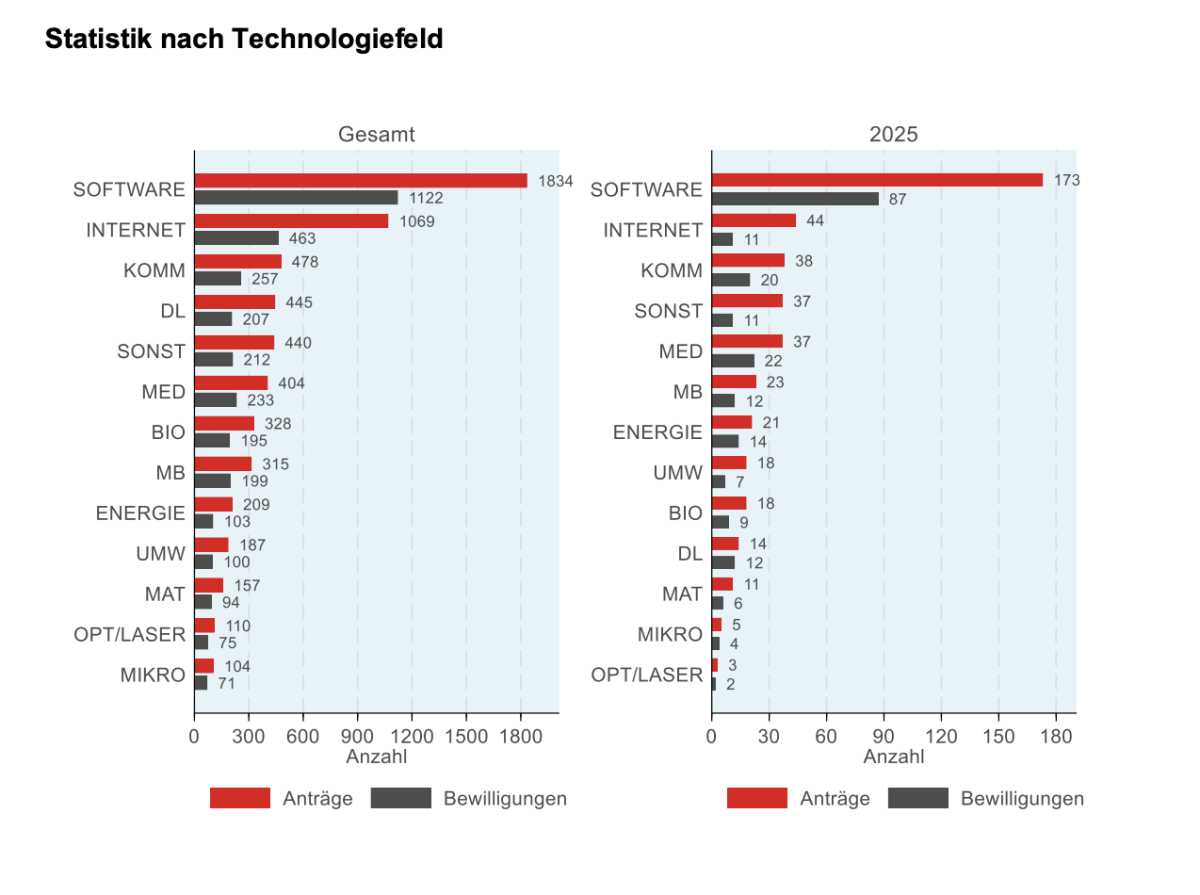
The structure of funding thus reflects the priorities of technology-oriented startups. Digital business models dominate, while other technology fields hold smaller but consistent shares.
Success metrics remain high. Approximately 87 percent of funded teams actually establish a company. Five years after funding ends, nearly 80 percent are still active in the market. By the end of 2025, around 32,700 jobs subject to social security contributions were created.
More women founding with EXIST
Beyond economic effects, the report also shows structural changes in the startup ecosystem. The share of women in EXIST-funded teams has been rising for years and reaches an all-time high in 2025 with over 30 percent. EXIST-Women helps as its own program for female founders.
This transforms an area that was long male-dominated. Funding programs in the EXIST environment aim to attract more women to entrepreneurial paths in science and technology. Developments over recent years suggest these approaches are working.
Team preparation is also coming into sharper focus. The so-called Stage of Business Planning measures the maturity of business planning in areas such as business model, market analysis, and financing. The report shows a clear correlation: teams with higher planning maturity found more often and have better chances of raising capital.
Overall, the monitoring report confirms EXIST’s role as an interface between research and market. Particularly in innovation-rich regions like Bavaria, the program helps turn scientific projects into viable startups.