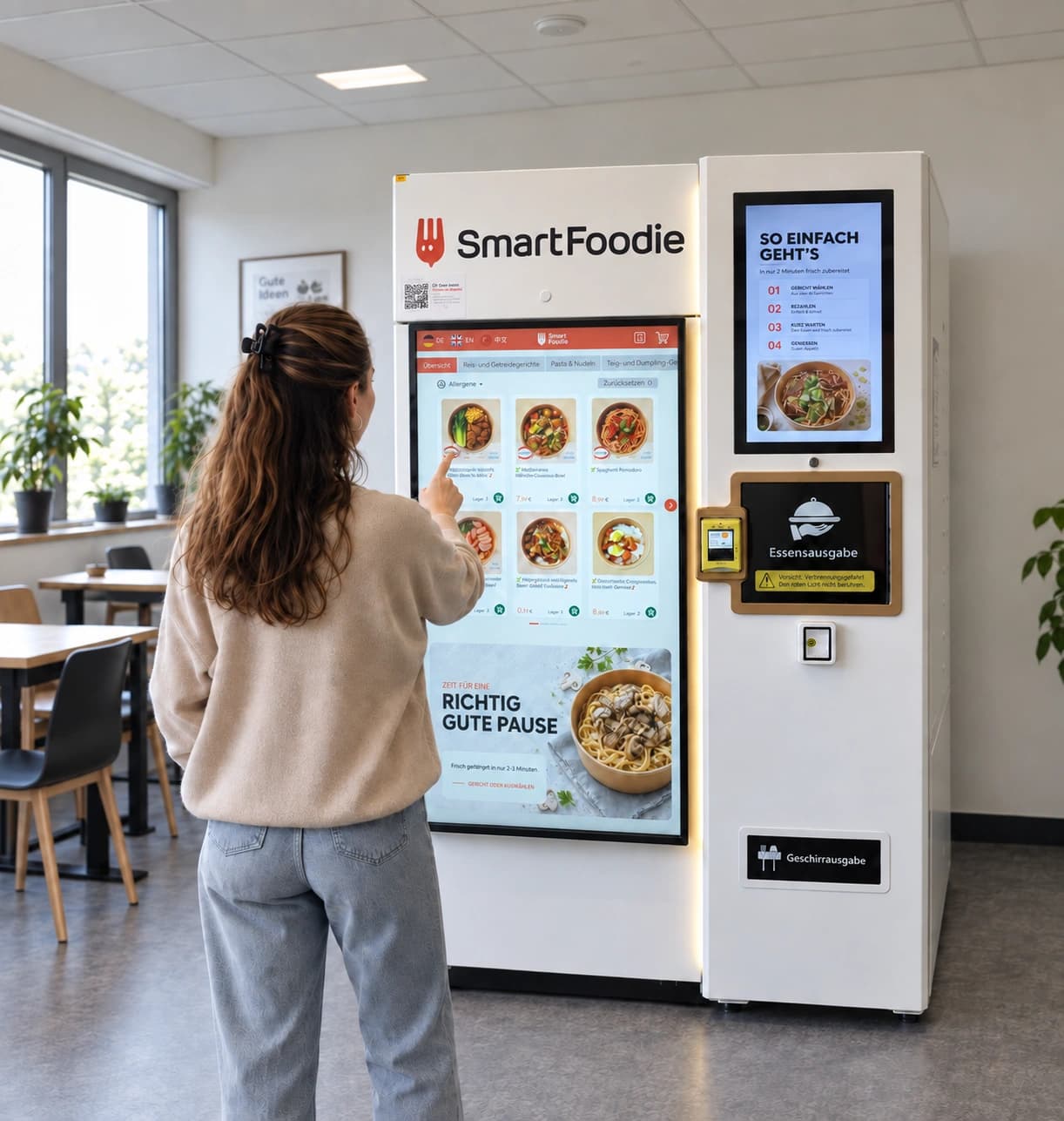

Anyone clocking off after a long late shift or in the middle of the night knows the problem: you’re starving, but the canteen has long since closed and options for a hot meal are limited. Especially for train drivers and maintenance crew working around the clock, this is part of everyday working life. Munich-based foodtech startup SmartFoodie wants to close this supply gap: with automated mini-canteens that offer hot meals at any time.
Since the end of August 2026, two of these mini-canteens have also been operating at Südostbayernbahn’s Mühldorf location. The initial figures show that the concept is being well received: nearly 1,400 orders were recorded by early November, with at least one in five placed between 8 pm and 6 am.
The deployment at Südostbayernbahn also marks an important expansion step for the Munich startup founded in 2024: Mühldorf is its first location outside the Munich metropolitan region. According to the company, SmartFoodie now operates more than 30 locations and has processed over 84,000 orders in total.
SmartFoodie reaches night shift workers
Initial usage figures from Mühldorf show that demand for the automated canteens extends well beyond classic lunch hours.
Several key trends stand out:
- 256 distinct app customers used the service. More than three-quarters of them ordered multiple times.
- Over 50 percent of orders were placed outside lunchtime hours between 11 am and 2 pm.
- At least 20 percent of orders occurred during nighttime hours between 8 pm and 6 am.
- The stations were also used regularly on weekends.
According to the company, the station located directly next to the train drivers’ dispatch room is particularly busy. There, employees can purchase a hot meal between check-in and handover.
The figures indicate that automated catering is particularly in demand where working hours do not match the opening times of traditional cafeterias. How usage develops over the long term remains to be seen over further months of operation.
Mini-canteens prepare meals in two to three minutes
SmartFoodie’s technical concept combines centralized food preparation with automated on-site dispensing. The meals are prepared fresh daily in the company’s own kitchen near Munich and then transported chilled to the stations. Once ordered, the meals are cooked to completion with steam within two to three minutes. A permanently staffed kitchen or additional cafeteria staff is not required on site.
A unique aspect of the Mühldorf project is the security requirements. Both stations are located in access-controlled areas of Südostbayernbahn. Restocking therefore takes place according to defined time windows and in compliance with operational safety regulations.
Theo Guo, co-founder and managing director of SmartFoodie, explains:
“The railway is one of the environments we specifically wanted to tap into, because it takes our core problem to the extreme: around the clock, far removed from classic regular working hours, and out of reach of any cafeteria.”
Expansion: SmartFoodie grows to more than 30 locations
With the project at Südostbayernbahn, SmartFoodie is expanding its area of operation beyond the greater Munich area. Mühldorf was followed by another location in Kaufbeuren in September 2026.
The company now counts businesses, hospitals, universities, and transit companies among its customers. The more than 84,000 orders processed to date demonstrate that SmartFoodie has already tested its concept in a variety of deployment settings. A vending machine is also located at the Munich Technology Center (MTZ) and is proving very popular. Arno Eggers, Head of MTZ:
“Many of our startups at MTZ work late into the evening on their innovations. In those moments, SmartFoodie provides quick, straightforward access to fresh refreshments. A total win.”
For Südostbayernbahn, the two mini-canteens complement the existing catering offering. Managing Director Matthias Krause emphasizes that employees will now also have access to hot meals at night and on weekends. SmartFoodie sees further potential applications in reporting rooms, maintenance facilities, and operations control centers, among others.