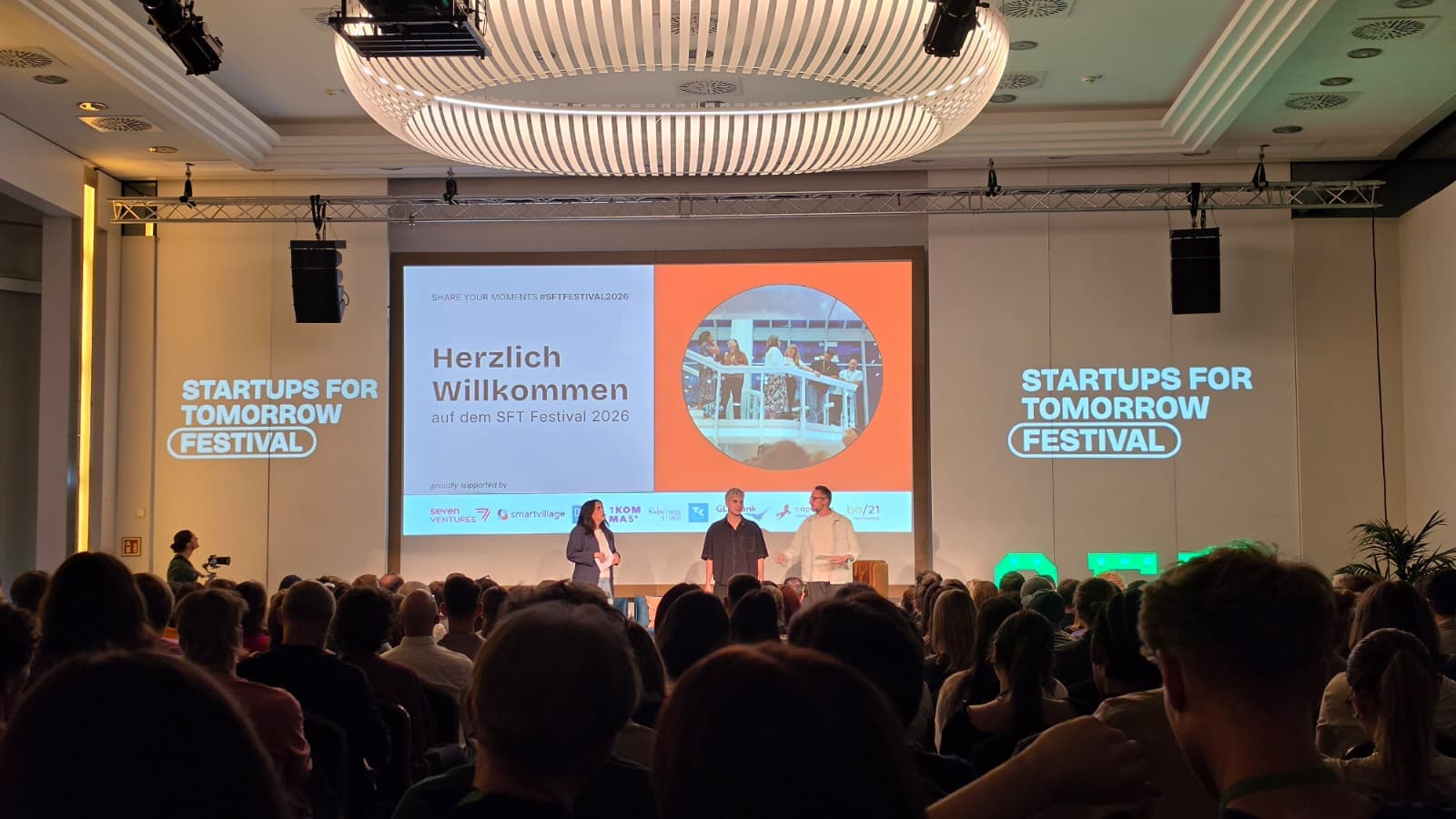

Biotech can sound quite abstract. RNA, epigenetics, fluorescent probes, personalized medicine: the people behind the technical terms can quickly get lost. That’s why Dr. Philipp Baaske, Vice President for Entrepreneurship at LMU, founder and Executive Chairman of NanoTemper, makes it clear at the beginning of the panel “Founding in Biotech: How Research Becomes a Business” at the Munich Startup Festival why the topic is very personal to him.
His mother was diagnosed with breast cancer in 2006. Her life was saved by a biotech drug, Baaske explains. His father also had cancer, and three of his four grandparents died from it. As a physicist, he may not be able to develop drugs himself. But what he can develop are measuring instruments that help others develop new drugs faster.
This sets up the panel’s central question: How does research make the leap from the lab to where it can actually make a difference?
When a Paper Is No Longer Enough
For Christina Port, founder of 2NA Fish, this very question was a key trigger for her journey into entrepreneurship. During her postdoc, she had worked on and published about a topic that could have helped patients with a rare form of cancer. But scientifically, the next project was supposed to follow: The previous topic was already published, meaning a follow-up project would no longer be considered novel enough.
Port was troubled by this logic. She felt that “too much blood, sweat, and tears” had gone into the research to end up bringing none of it into the real world. In parallel to her postdoc, she therefore delved deeper into entrepreneurship, conducted user and expert interviews, and spoke with scientists and physicians. In doing so, she realized that there was a concrete medical need. Her conclusion was remarkably straightforward:
“I’m just going to do it.”
For Yasmin Gärtner, founder of Epicure, the journey started in a less planned manner. At the time of the panel, her venture had not yet spun off, but was instead based as a project at the university. Gärtner herself describes getting started as something she kind of fell into. A biochemist was needed for the planned spin-off, she found the idea exciting, and joined in.
Her academic career wasn’t mapped out in detail from the start either. Gärtner came from industry, having first completed vocational training and worked before pursuing a degree. She hadn’t even necessarily planned on doing a PhD initially. Through networking, she eventually landed in Thomas Carell’s research group, and her collaboration on a project alongside her actual doctorate gradually evolved into a spin-off venture.
Two quite different paths, then, that lead to the same conclusion: Good research alone isn’t enough if it doesn’t result in an application.
The Right Therapy for the Right Patients
Port’s technology is designed to help visualize gene activity directly within tissue. Using specific DNA nanostructures, RNA molecules are measured in the context of the tissue without requiring the tissue to be dissolved. Fluorescent probes bind to the respective target RNAs, after which microscopy images are taken and evaluated using AI-based software. This is intended to produce a quantitative analysis within one to two hours.
The goal behind it: to better predict which therapy might work for which patients.
Port points out that billions are being invested worldwide in developing new therapies. At the same time, a large proportion of cancer patients do not respond to their respective treatments. In her view, better diagnostics could help assign patients more precisely to the right therapies.
This would not only affect the treatment itself. Patients could already be selected more precisely in clinical trials, potentially making the development of new therapies faster and more cost-effective.
A molecule against tumor heterogeneity
Gärtner’s project addresses a different challenge in cancer medicine: the heterogeneity of tumors.
The team has developed a small molecule that acts at the epigenetic level. In simple terms, epigenetics deals with which genes in the DNA are switched on or off. In tumors, according to Gärtner, the problem is often that not every cell is identical to another. As a result, a single therapy may not reach all cells equally.
This is precisely where the newly developed molecule is intended to take effect: it alters the epigenetics of the cells, enabling it to act more heterogeneously on the tumor. Looking ahead, the molecule could theoretically even be administered as a tablet. However, Gärtner emphasizes that further research is still required for that.
This clearly illustrates just how long the journey of a biotech startup can be. The founding process does not begin with a finished product. It can start at a point where key scientific questions still need to be answered.
First the patent, then the paper
And something else changes when taking the step from research toward a startup: priorities.
In academia, publications play a central role. For a company, on the other hand, intellectual property becomes crucial. Gärtner works in a research group that already has experience with spin-offs. That makes the process easier. Even so, founding a company requires a shift in mindset: whenever new protectable IP is created, it must first be secured before anything can be published.
Port, in turn, did not found a company directly out of her PhD. After completing her doctorate, she initially began a postdoc and became increasingly involved with entrepreneurship. She even took her first steps as an entrepreneur outside of biotechnology with her own e-commerce project, which she ran alongside her scientific research.
Both paths show: The transition from academia to entrepreneurship is more than just a career change. It requires a different way of thinking about one’s own work.
“It wasn’t the right mountain.”
Why take on this additional burden in the first place?
Port describes a moment during her PhD when she thought deeply about what she actually wanted to do with her life. Even back then, she was working a lot, but increasingly felt like she was climbing a mountain that wasn’t the right one for her.
At the same time, she noticed in her scientific environment that an academic career was regarded as the highest achievable goal, making other career paths sometimes seem like a second choice. But that notion never felt right to her.
Ultimately, she decided to give entrepreneurship a try. The thought behind it: if she didn’t try, she might regret it later. While there are certainly days when she questions her decision, most of the time she is glad to be able to do what she personally believes is right.
What keeps her going above all is her conviction in her own technology. Port believes that it works and has great potential. Her self-imposed principle: she keeps going until the venture succeeds—or crashes and burns for good. So far, the latter hasn’t happened.

“There’s no point in having a patent if you don’t do anything with it.”
Gärtner also cites the technology itself as her primary motivation. She works with the product in the lab and, by her own account, sees stable and robust data. It is precisely these results that convince her of the venture’s potential. And she wants to make this potential accessible:
“There’s no point in having a patent on it if you don’t do anything with it.”
In addition, she is drawn to personal development. Founding a startup offers her the opportunity not only to keep learning scientifically, but also to understand the bigger picture of a business for the first time: How does a market work? How does a company work? How are decisions made?
For Gärtner, the spin-off is therefore not only an attempt to commercialize research, but also an opportunity to take on a completely new role.
Still Too Few Female Founders
The presence of two female founders on stage eventually leads the conversation to the role of women in the startup ecosystem.
Gärtner has personally had rather positive experiences. She says she doesn’t feel out of place as a woman and generally perceives people in the scene as open-minded.
Port, on the other hand, perceives her environment as distinctly male-dominated—in some cases even more so than academia. Especially in the biotech and life sciences sector, she also sees structural reasons for this. Anyone ready to start a company in their early 30s after studying and completing a doctorate might face timing conflicts with family planning. Men often have more flexibility in terms of time, which can discourage women from founding a company. For Port, it is therefore clear that the framework conditions also need to change.
20 million euros – and then?
At the end of the panel, Baaske asks a provocative question: Would Port sell her company if someone offered her 20 million euros for it?
Her answer clearly shows why she founded the company in the first place. Of course, 20 million euros is a lot of money. For her, however, the decisive factor would be what happens to the company afterward.
If the technology were to disappear into a drawer after the sale, she wouldn’t make the deal. After all, she would then have invested five years of work without the result actually being put into practice.
“The paper all over again,”
as Port puts it.
Gärtner, on the other hand, cites freedom and the opportunity to shape things herself as further appeals of entrepreneurship. She appreciates being able to organize her own workday and have a direct say in decisions. However, she has had to learn to deal with uncertainty: many entrepreneurial decisions involve risk, and their outcome simply cannot be known in advance.
Founding suddenly also means leading
And, of course, the move to a startup brings tasks that barely played a role in the lab.
For Port, team leadership is one of the biggest changes. Scientific work is often shaped by individual projects. While collaboration exists there as well, leading a team is something completely different.
Another surprise: the bureaucracy. Port had expected things to become easier outside of academia after dealing with research grant applications and university processes. That hope clearly didn’t materialize. The “bureaucratic madness” after founding can easily rival that of the university, she says.
What remains from the panel is therefore less a blueprint for the perfect biotech spin-off than a fundamental insight: the step from the lab to a startup doesn’t necessarily start with the desire to become an entrepreneur. It sometimes begins with a different question: What should actually happen to my research?
For Yasmin Gärtner and Christina Port, it’s not enough if the answer is simply a patent or a publication. They want research to turn into real-world application. To achieve this, they have to trade scientific certainties for entrepreneurial uncertainty, take on new roles, and make decisions whose outcomes they cannot know.
Because good research alone isn’t enough. At some point, it has to get out of the lab.