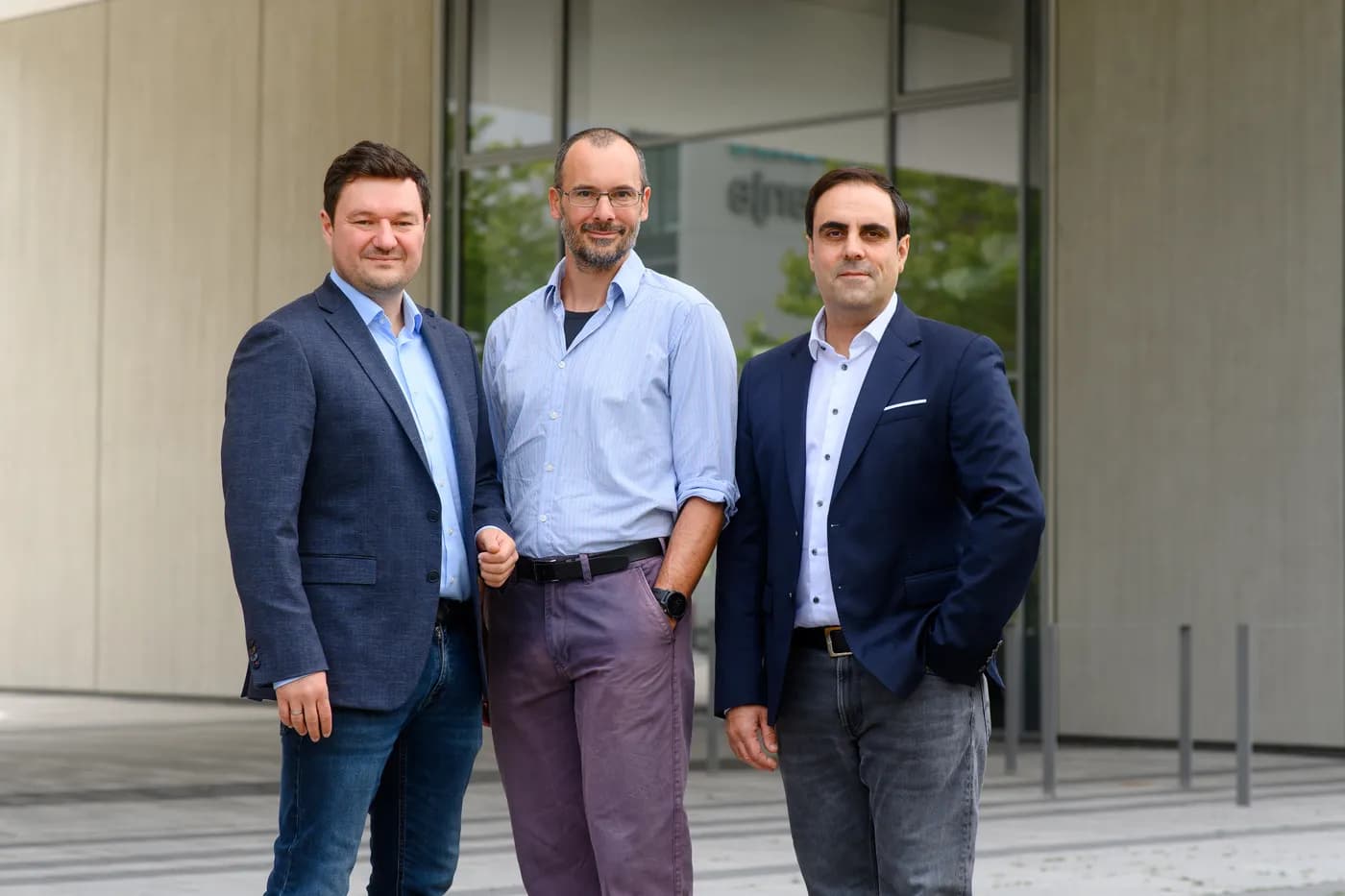

Founded by machine learning researchers Moritz Hardt and Reinhard Heckel, the startup Grubel develops AI systems designed to automatically specialize in individual legal matters. In principle, every complex legal case requires its own specialized AI. To achieve this, the team aims to automate a previously labor-intensive process – from selecting relevant data to tailoring models and agents and continuously evaluating results.
€3 Million Pre-Seed Funding for Grubel
The pre-seed round is led by European early-stage investor Point Nine. Several prominent angel investors from the international AI research and startup scene are also participating: Jeff Dean, Chris Ré, Ion Stoica, as well as the two Harvey co-founders Gabe Pereyra and Winston Weinberg.
The capital will be channeled into three areas: research, product development, and team expansion. Grubel is hiring research scientists and engineers, among other roles, and is expanding its activities in Munich and Tübingen.
Grubel’s Approach to Legal Matters
When using generative AI in the legal sector, there is a fundamental problem: general models do not automatically know the specifics of a particular case. These include, for instance, documents and facts, parties involved, legal terminology, previous work results, or specific client requirements.
Grubel therefore wants to automate the entire specialization process. The company refers to this approach as a “specialization loop.” It comprises three core components: a data engine identifies and curates relevant information, followed by the adaptation of the model, agent, and technical environment to the specific legal matter. Finally, the results are continuously evaluated against task-specific criteria.
This cycle is designed to allow an AI system to be optimized step-by-step for the respective task, rather than having a team of lawyers and developers manually work on adaptations for each use case.
Legal AI Meets Complex and Unstructured Data
Grubel sees the limitations of today’s general-purpose systems particularly in complex legal work. While in programming, for example, tests or compilers can provide comparatively unambiguous feedback, legal tasks often lack a similarly clear automated evaluation system.
In addition, there are large amounts of unstructured data. In a research note, Grubel references, for instance, Harvey’s Legal Agent Benchmark (LAB), which includes 1,660 legal tasks from synthetic legal matters. For particularly data-intensive due diligence tasks, the underlying data rooms can, according to Grubel, range from tens of thousands to several million tokens.
Compared to the overall volume of legal services, the use of technology remains relatively small. A market overview published by DLA Piper estimated the global legaltech market at $26.7 billion for 2024, compared to around $1.05 trillion for legal services as a whole.
At the same time, the customization of legal AI is increasing. Major law firms are increasingly investing in proprietary or tailored AI solutions to map complex legal tasks using proprietary data and workflows.
Moritz Hardt and Reinhard Heckel Combine TUM and Max Planck Research
But who is actually behind Grubel? Moritz Hardt is a director at the Max Planck Institute for Intelligent Systems and was previously a professor at the University of California, Berkeley, as well as a researcher at Google Brain. His co-founder Reinhard Heckel is a professor of machine learning at the Technical University of Munich.
The founding team is complemented by technical employees with experience at companies including Mistral, Aleph Alpha, and Thomson Reuters. This enables Grubel to pool expertise in the areas of training data, model training, retrieval, and evaluation.
“For complex legal matters, there is neither good training data nor can legal work be evaluated automatically,”
explains Reinhard Heckel.
“The challenge lies in finding the right data, processing it into training data and task environments, adapting the system to the respective legal matter, and subsequently checking whether the legal work is good.”
Smaller AI models should suffice for routine tasks
In the long term, this approach could also become relevant for the cost structure of legal AI. According to Grubel, specialization does not necessarily require ever-larger models. For simpler tasks, smaller, more efficient models could be used, while more powerful systems handle complex cases specifically.
The company speaks of “frontier performance at lower cost” and aims to make open models more competitive through case-specific specialization as well. Furthermore, Grubel envisions local deployments where sensitive data can remain on the respective user’s infrastructure.
However, whether the approach can deliver on this promise in productive use remains to be seen. Publicly accessible information on customers, revenue, or specific commercial pilot projects is not yet available. The results communicated so far are based on experiments and research work.