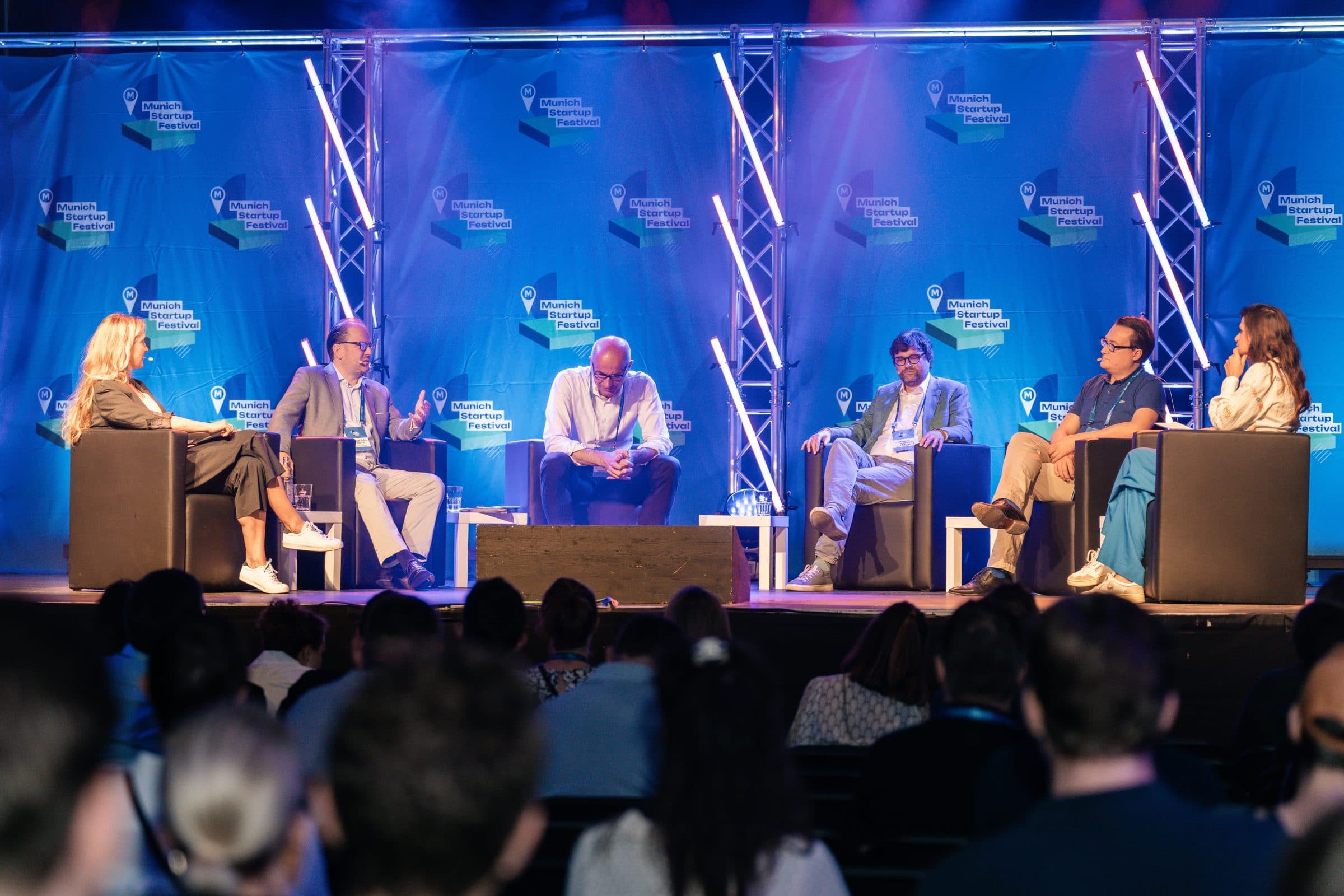

Startups pitch their ideas regularly, and the reverse pitch from investors is no longer a rarity either. At this year’s Munich Startup Festival, another variant was added: the politician pitch. At the beginning of the panel “Visions for the Munich ecosystem: questions and answers from the city council,” the participating city councillors – Manuel Pretzl, CSU/FW faction leader in the Munich city council, Fritz Roth, FDP city councillor, Sebastian Weisenburger, Green Party city councillor – Rosa Liste, and Felix Sproll, SPD/Volt faction city councillor – were able to present their perspective and their vision for the Munich startup ecosystem in a short pitch.
But what are the major challenges that the city councillors see for startups in Munich? And what options does the municipality have to change things here?
Cutting red tape
The first point in the discussion was bureaucracy, or rather its reduction. Even when presenting future visions, Felix Sproll explained that he wished for a company to be founded in the future in just a few minutes from a smartphone on the go. A point that moderator Magdalena Oehl, founder of TalentRocket and deputy chair of the Startup Association, was only too happy to take up. Because from the association’s perspective and that of the startups organized within it, bureaucracy is a very major problem. However, changes, such as the introduction of digital business registration, often took a very long time.
Fritz Roth explained why this was the case: in many authorities, especially in the KVR, there is no service mentality, according to his analysis. The forms and their processing needed to finally be digitalized, smart solutions should be introduced. In addition, there was too much risk aversion, which greatly slowed down decision-making processes. A point that Sebastian Weisenburger also agreed with. However, he pointed out that change takes time, also because organizations, like the people in them, have different histories. Manuel Pretzl added to this with the explanation that public service employees often spend their entire careers there – and thus some could still remember how the fax was once a revolution.
Access to commercial property
Another problem is Munich’s perennial issue: high rental prices – whether commercial or private. Felix Sproll advocated expanding Munich upwards here. And rather less in the form of new high-rises, but through extensions of existing buildings. Whether residential or commercial buildings, an additional floor on top could quickly provide additional space. Some progress has already been made here too, but as with cutting red tape, it takes time before decisions take effect. Ironically, also because of bureaucracy, as Roth interjected: since an extension is administratively more difficult than a new building on a green field, there are certain “inertial elements” that avoid this work.
Festival moderator Caro Matzko, who had stepped in as a second moderator for the panel in place of ailing Bits founder Bernd Storm van’s Gravesande, then brought up the ominous rule according to which nothing in Munich could be built higher than the Frauenkirche. Pretzl made clear that this decision was based on a citizens’ initiative and had not been valid for a long time. Nevertheless, some still felt bound by it – especially because Munichs repeatedly made it clear that they did not want high-rises.
As another means of alleviating the problem, Sebastian Weisenburger suggested extending the temporary uses established in the art and culture sector to commercial real estate as well. And Pretzl added that outside of city center locations, investors and owners of commercial property are now again significantly more willing to respond flexibly to the needs of smaller companies.
Shortage of skilled workers
The ubiquitous shortage of skilled workers had a double appearance in the panel. On the one hand, of course, when it came to the fact that work permits for highly qualified startup employees needed to come faster. On the other hand, when the number of female founders in the Munich ecosystem was discussed. Magdalena Oehl pointed out that in the state capital this was only 13 percent, while nationally it was 20 percent. In addition to the reasons for this – the focus on STEM topics in the Munich scene was identified as a source of the inequality – there was also the question of reconciling family and work. This led to a shortage of childcare places and thus a shortage of skilled workers for daycare centers and kindergartens.
At this point, the greatest differences between the positions of the factions became apparent. While Manuel Pretzl focused on accelerated access for highly qualified employees, Felix Sproll emphasized that he wanted this for all workers. A solution in the form of a welcome center at the KVR was emerging, as Weisenburger announced.
Open data and mentoring program
Another point that the city councillors raised was the topic of open data. The city has plenty of data, for example on topics like mobility and the environment. Here Felix Sproll wished that this data be published and shared more with companies.
As the only one among the city councillors, Fritz Roth also dared to look at other ecosystems. Specifically, his gaze turned to Mainz, where with Biontech backing there is a strong focus on life sciences. The city and state have developed a clear vision of how development should look over the coming decades. In addition, there are regular events and a mentoring program.
Homework for the city councillors
At the end, the city councillors unanimously appealed to the founders to contact the factions with their concerns. Because only in this way could politics know what companies need and engage with them to jointly develop ideas and solutions. Magdalena Oehl then had a very concrete idea. She obligated the politicians to choose one of the topics discussed and now work on solutions for it – preferably immediately after the panel. Felix Sproll then agreed to focus on accessibility with more data, Sebastian Weisenburger took on commercial real estate, Fritz Roth wanted to take care of a mentoring program based on the Mainz model, and Manuel Pretzl wanted to focus on faster, less bureaucratic permits.