
It has never been technically easier to develop a digital product. But as a result, key competitive advantages are shifting: it’s no longer just coding skills that count, but fast decisions, customer access, and the ability to successfully market a product.
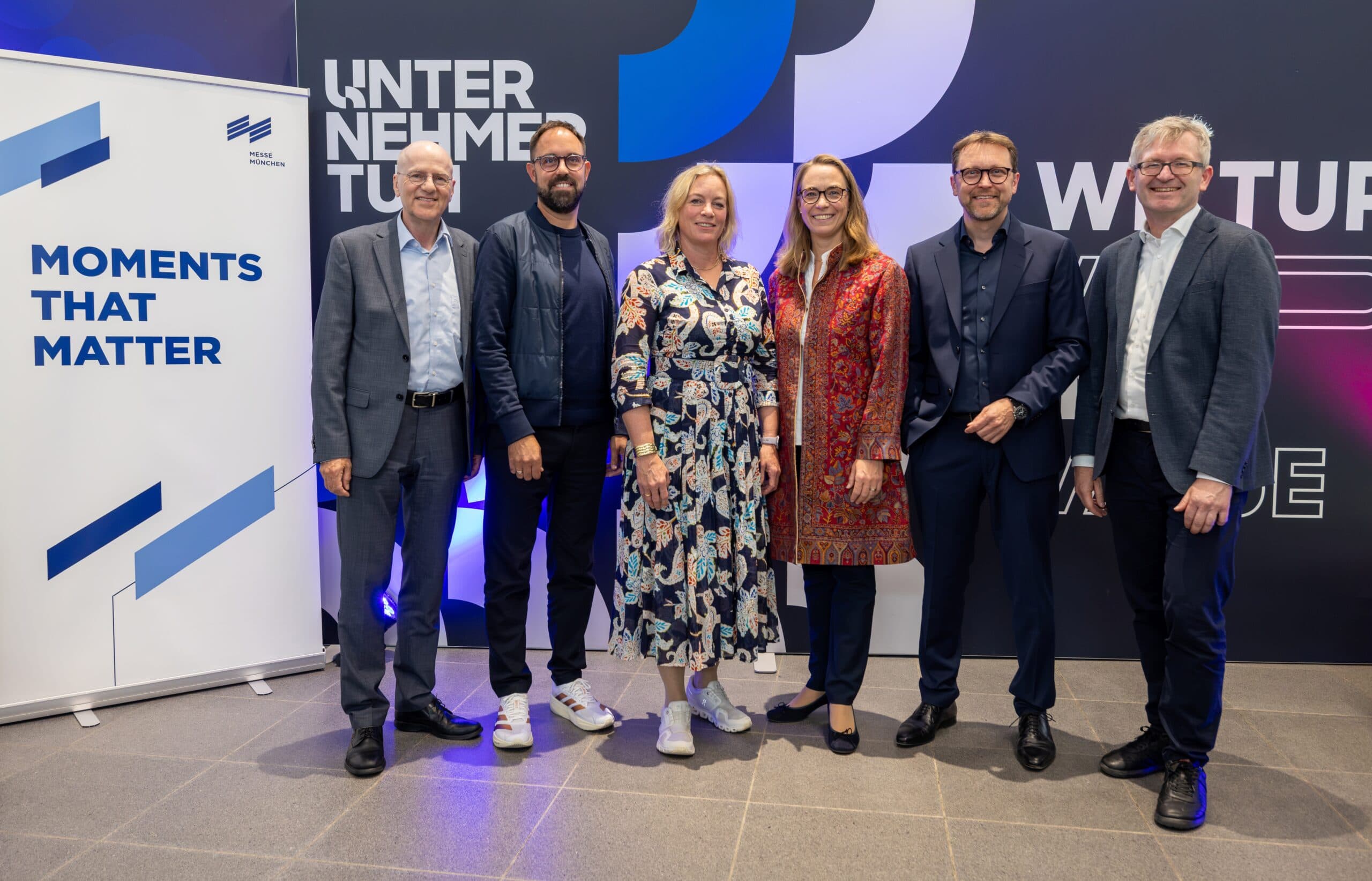
On July 22 at Backstage during the Munich Startup Festival, Janina Wiedenbach from Munich Innovation Ecosystem, Dr. Robert Richter from WERK1, Dr. Carsten Rudolph from BayStartUP, serial founder and investor Chris Obereder, and Marcus Betz from Stadtsparkasse München discussed this as part of the panel “NextGen Takes over – Setting the course for the next generation”. The panel was moderated by Nikola Nikolic and Matthias Ebbinghaus.
AI-native Startups Work Faster and with Smaller Teams
According to Janina Wiedenbach, more and more AI-native startups are emerging where AI is not just part of the product, but shapes processes, roles, and corporate structures. This enables small teams to develop faster and launch with less capital.
Chris Obereder, however, does not see this as a lasting competitive advantage: Since almost all founders have access to powerful AI models, distribution is becoming the decisive factor. Success comes to those who build visibility, acquire customers, and think internationally early on. Marcus Betz also observes that startups today present themselves more professionally and integrate foreign markets into their strategy at an earlier stage.
Speed Is Becoming a Location Factor
Munich boasts strong universities, research institutions, talent, industrial companies, investors, and support programs. The central question is therefore how these prerequisites can be translated more quickly into marketable companies.
As an example, Wiedenbach cited Ludwig-Maximilians-Universität München, which aims to significantly accelerate the transfer of intellectual property to spin-offs. Fast technology transfer can be crucial, especially for research-based startups.
At the same time, Robert Richter sees a structural problem: Munich’s ecosystem is strong, but sometimes fragmented. Werk1 therefore wants to develop the Werksviertel into a more consolidated startup hub where founders can reach investors, accelerators, and corporations all in one place.
Broader Access to Customers Is Decisive
For BayStartUP Managing Director Dr. Carsten Rudolph, the success of a startup is not demonstrated by its first customer, but by its transition into a broader market.
“Finding a few crazy people as your first customers isn’t that hard,”
said Dr. Carsten Rudolph. The decisive factor is whether a company can also win over its fifth, tenth, or hundredth customer.
When making investments, Obereder also pays attention to how quickly teams make decisions, learn, and react to changing market conditions. From the customer’s perspective, a product must not just be “okay,” but has to convincingly solve a relevant problem.
186,000 companies are facing succession
In addition to new business foundations, corporate succession is becoming a key task for the next generation. According to estimates by the Institute for SME Research Bonn (Institut für Mittelstandsforschung Bonn), around 186,000 family businesses are up for handover between 2026 and 2030.
For young entrepreneurs, this presents the opportunity to take over and further develop existing customer relationships, employees, brands, and production structures. Nevertheless, entrepreneurship is still mostly associated with founding a new company, Rudolph said.
Succession is still too opaque for many young people. There is a lack of attractive company presentations, suitable matching offers, and understandable financing models.
Richter sees potential in making better use of existing data. Chambers, banks, and economic development agencies possess information on companies and succession situations that could be used for smarter matching.
Startups and SMEs can benefit from each other
Marcus Betz is already observing a stronger exchange between startups and established companies. Medium-sized businesses are taking stakes in young companies or using them as external innovation partners.
Startups gain access to industry knowledge, production capacities, and distribution channels as a result. In return, established companies benefit from speed, new technologies, and agile ways of working.
Five skills for the next generation of entrepreneurs
At the conclusion of the panel, the participants largely agreed on which qualities the next generation of entrepreneurs should possess. In addition to the courage to start or take over a business, they particularly highlighted good judgment in order to make the right decisions in an increasingly dynamic environment.
Equally important, they noted, are the ability to learn, perseverance, and the willingness to continually adapt to new market conditions. Marcus Betz added a commercial perspective to these entrepreneurial virtues: Even the best business idea can only be successful if the financial foundation is right. He summed up his conclusion with a well-known principle: “Cash is King.”