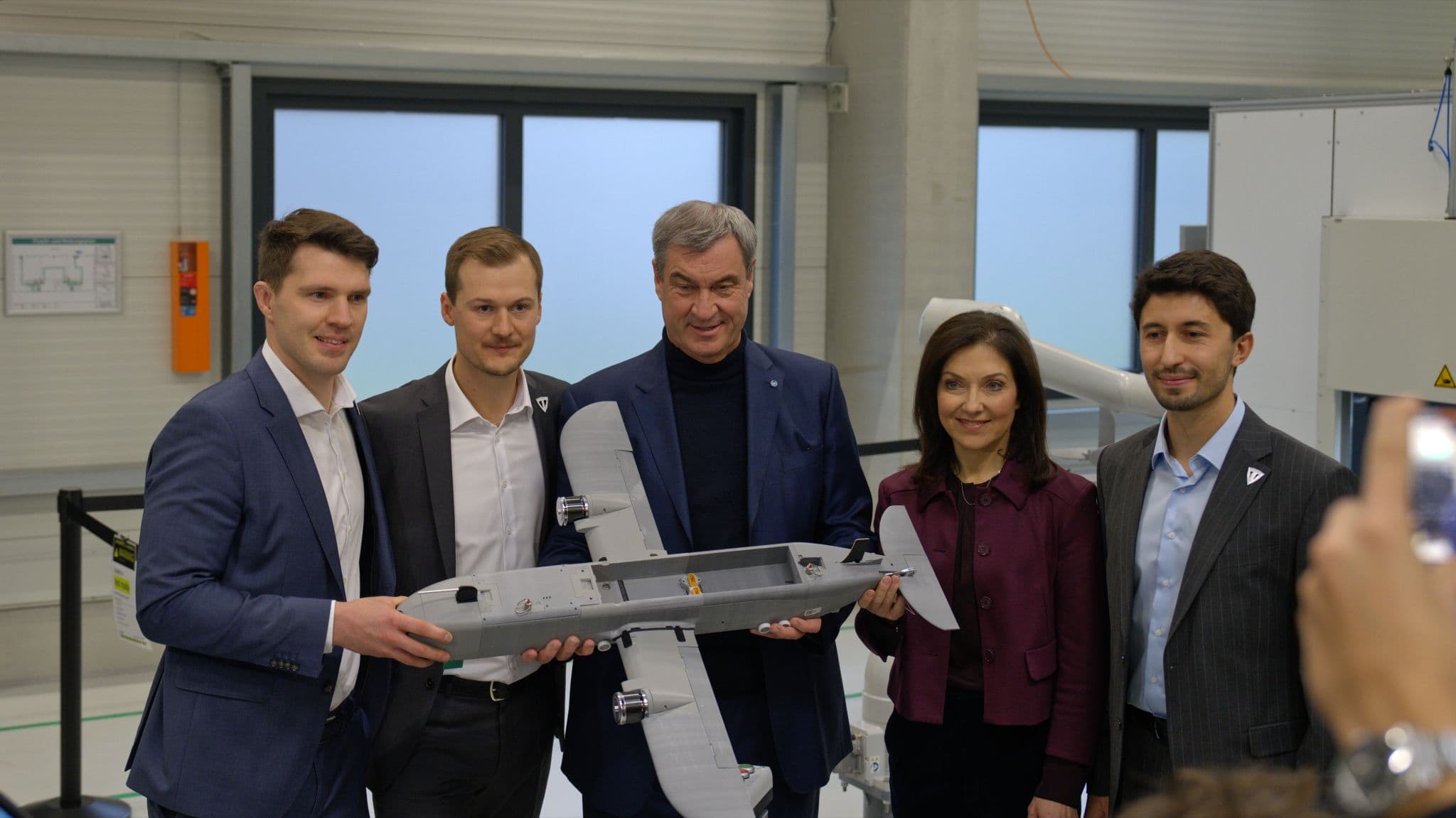

Munich-based startup Nomadic Drones has raised around €5.5 million ($6 million) in a seed funding round. With drones that land on live high-voltage power lines and recharge there, the company aims to detect bottlenecks in the power grid and make better use of existing transmission line capacity.
What makes it special are Nomadic’s drones weighing around four kilograms, which can land directly on high-voltage power lines of up to 420 kilovolts without requiring the power to be switched off. There, they recharge inductively and collect data on the condition and transmission capacity of the lines. According to the company, these so-called Nomads have already completed more than 20,000 operating hours on live lines.
Founded in 2024 by Andreas Moldskred (CEO) and Lauritz Weil (CTO) at the University of California, Berkeley, the startup is now based in Munich. Its technology is already being used in German transmission and distribution grids. The drones have also been deployed in Norway and the US.
How Nomadic detects bottlenecks in the power grid using drones
The technology addresses a central challenge of the energy transition: while electricity demand is rising due to data centers, industry, and electrification, expanding power grids often takes years.
According to the International Energy Agency (IEA), annual investments in electricity grids could rise by around 50 percent by 2030 from a level of around 363 billion euros (400 billion dollars).
At the same time, existing high-voltage power lines are not always utilized up to their actual physical load limits. To date, grid operators have determined permissible transmission capacity using weather and grid models, among other things. However, these models can only account for local variations along a power line to a limited extent.
Yet individual connectors, older components, or line sections cooled to varying degrees can limit the capacity of an entire power line.
This is where Nomadic comes in. The Nomad drones can inspect different sections of a power line to identify the critical points. A single system is reportedly capable of covering around 25 kilometers of line. By comparison, according to the company, permanently installed sensors are often placed at intervals of one to five kilometers.
Foundamental leads $6 million seed round
The funding round of just under 5.5 million euros ($6 million) is led by venture capital investor Foundamental. Additional investors include Verve Ventures, Cyan Ventures, as well as existing investors Outlander VC and Asia2G Capital. Business angels from the alumni network of the Foundation of German Business (sdw) also participated.
Nomadic plans to use the capital to expand its drone fleet for grid operators in Europe and the US, as well as to grow its team at the Munich location. Another key focus is automation: starting in 2027, the remote relocation of drones between different power line sections is set to enter regular operation.
Nomadic OS combines sensor data with weather and grid models
Alongside drone hardware, Nomadic is developing its own software platform. Nomadic OS combines measurement data from the drone fleet with weather data, grid models, and historical information about power lines.
This is intended to help grid operators better assess how much load individual power line sections can handle under current conditions.
Andreas Moldskred, CEO and co-founder of Nomadic, explains:
“Grid operators usually know pretty accurately what is happening at substations. What happens in between, over many kilometers of power lines, has been much harder to see until now, because you can hardly install anything on a live power line.”
The combination of mobile measurement systems and software could become particularly relevant where new grid connections are needed, but expanding the infrastructure is not possible in the short term.
More than 20,000 operating hours on lines with up to 420 kV
The first prototypes were deployed in German distribution grids about a year ago. Since then, Nomadic has also tested its systems under demanding conditions.
The drones are designed to operate reliably at temperatures down to minus 25 degrees Celsius and on high-voltage power lines of up to 420 kilovolts.
One technical challenge here is the power supply. Instead of having to return to the ground regularly, the drones draw their energy inductively from the magnetic field of the live power line.
For development, Nomadic set up its own test grid with real conductor cables and high current levels. There, new versions are tested before being deployed by grid operators.
Lauritz Weil, CTO and co-founder, describes the development as a demanding robotics problem:
“Landing on a power line with up to 420 kV in wind and minus 25 degrees, and then operating with energy drawn from the line’s magnetic field: that is a really tough robotics problem.”
Autonomous drone operations to be expanded in 2027
Until now, the drones have been placed onto the power lines on site by grid operator pilots. After just a few minutes, they can begin capturing measurement data there.
Looking ahead, the Nomads are intended to move from one line position to the next without requiring personnel on site each time. Control will be handled from the respective grid operator’s office.
Nomadic plans to transition this feature into regular operation by 2027. This would allow the company to scale its technology across larger sections of the grid.