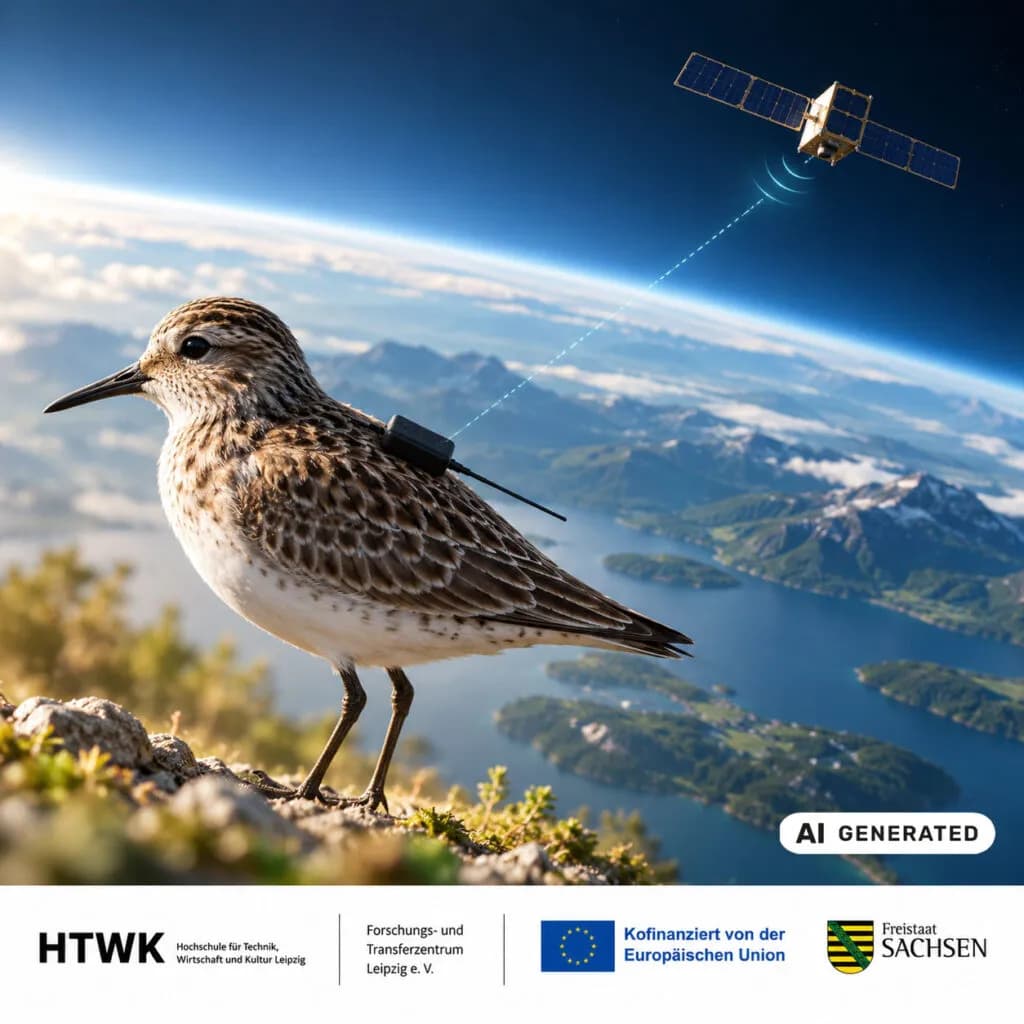

Tracking animals and objects worldwide with a transmitter weighing just around one gram in total: this is the next generation of devices Talos is working on. The recently completed Hermes1 development project lays the groundwork. The focus was on determining the position of ultra-small, energy-efficient transmitters using low Earth orbit satellites, without requiring the devices themselves to have a receiver for global navigation satellite systems like GPS.
The satellite’s movement reveals the location
For the project, the Leipzig University of Applied Sciences (HTWK Leipzig) developed an algorithm that utilizes the Doppler effect. When a transmitter on the ground and a satellite move relative to each other, the frequency of the radio signal received by the satellite changes.
The algorithm evaluates these frequency shifts during a satellite flyover. From this, the position of the transmitter can be determined. A dedicated GNSS receiver on the device is not required for this purpose.
Less hardware, smaller trackers
Eliminating additional positioning hardware is intended to reduce energy consumption and the technical complexity of the transmitters. This is particularly relevant where size, weight, and power requirements limit deployment—such as in tracking small animals.
Talos sees potential applications in wildlife research, environmental monitoring, and other satellite-based Internet of Things use cases. The combination of lightweight hardware, direct satellite communication, and satellite-based localization is designed to enable tracking smaller animals and objects worldwide in the future.
Icarus: Observing animals from space
Talos is also collaborating with the Max Planck Society on the “Icarus” animal tracking project. For its next-generation project, “Icarus 2.0,” the partners agreed to build their own fleet of small satellites. Animals equipped with transmitters are set to provide researchers with data on their migrations and environmental conditions.
Among other things, this is intended to help them better understand biodiversity loss, the impacts of climate change, and the spread of animal diseases. Even lighter transmitters could also make smaller animal species accessible to research in the future.
The one-gram target is up next
The findings from Hermes1 will directly feed into Talos’ next generation of ultra-light satellite transmitters. The target is an overall weight of around one gram.
At the same time, the project expands the company’s satellite architecture: future devices will be able to transmit data while their position is determined via the satellite infrastructure. Part of the technical complexity is thus shifted from the terminal device to the satellite and ground systems.