
Munich Startup: What measurable difference does your solution make today?
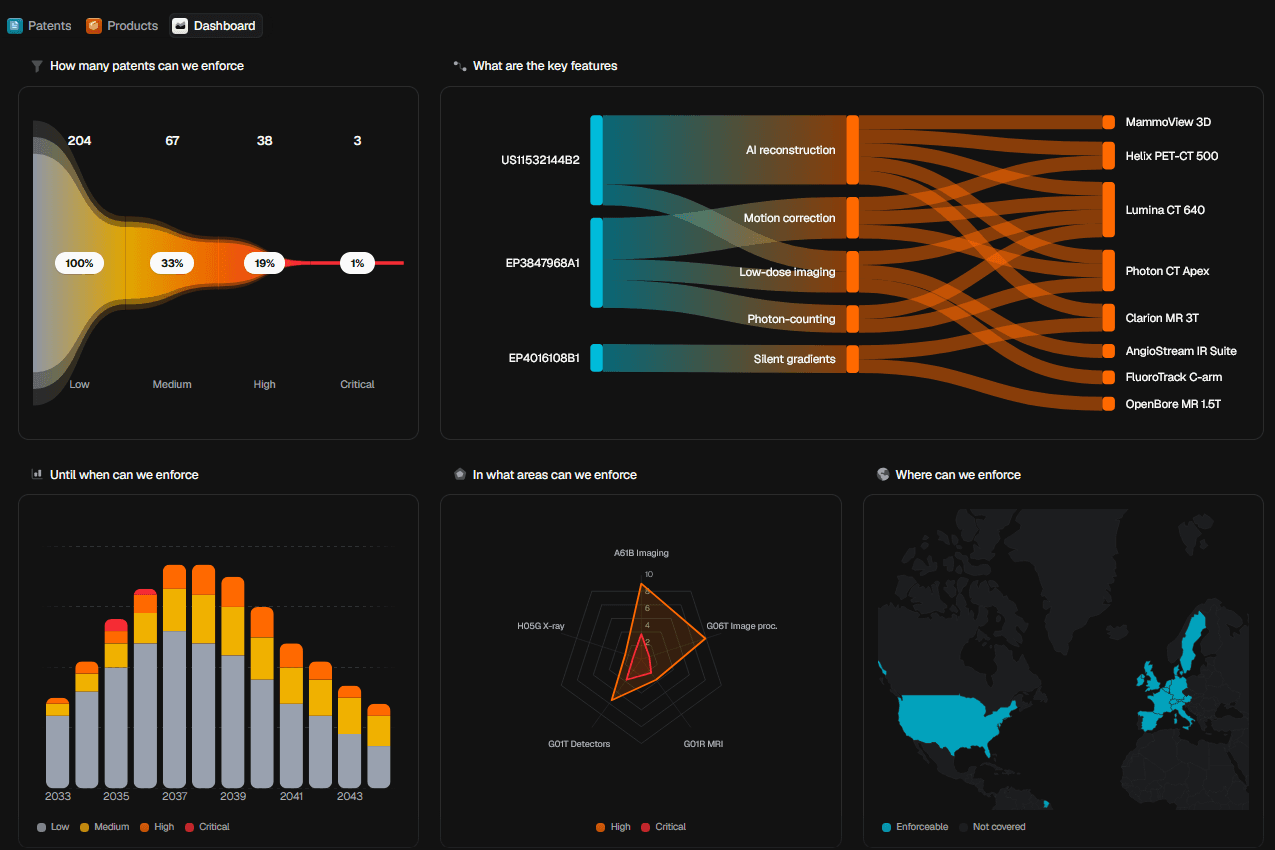
Daniel Stoll, Founder & CEO: A freedom-to-operate analysis, which checks whether a product infringes existing patents, typically takes weeks and costs several thousand euros. Patalyze delivers initial results in under five minutes for around three euros per reviewed patent. This turns the claim chart—a work product that previously cost many attorney hours—into a single data point in a comprehensive analysis. The key lever is coverage: where previously only a fraction of relevant patents could be reviewed due to resource constraints, we find the needle in the haystack and thus reduce the risk of overlooking an infringed patent.
Munich Startup: Why are you faster, better, or more courageous than established providers?
Daniel Stoll: Established tools typically work exclusively with patent data and make it searchable in some form. This makes sense because this data is already well-structured and publicly available. However, this information is usually too abstract to support fact-based decisions.
Patents only become practically relevant when you understand which products fall within their protection scope. That’s why Patalyze also incorporates product data into the analysis, which is much more difficult to process since it’s unstructured and comes in various formats. By comparing product features and protection scopes, patent infringements become apparent—a solid basis for strategic decisions.
“The pain point lies in mapping between product and patent”
Munich Startup: What decision was most important so far?
Daniel Stoll: Architecturally, the decision to build our own data and presentation layer instead of just placing a language model on an external database was the most important step. Strategically, it’s central for us to focus on freedom-to-operate and claim chart automation rather than building “yet another AI patent search tool.” The market is full of search tools—but the real pain point lies in manual mapping between product and patent.
Munich Startup: Which phase gave you the most growing pains?
Daniel Stoll: The jump from a functioning prototype to a scalable system. The first prototype was already very impressive, and the feeling of having built a production-ready product creates impatience. In reality, it requires significant development work to build a system for many users and large amounts of data. Accordingly, we had to scrap our architecture several times during this phase.

Patalyze was founded in 2024 by Daniel Stoll and develops AI-powered software for patent analysis. The startup automates so-called freedom-to-operate reviews and helps companies assess patent risks faster and more thoroughly.
Founder and CEO Daniel Stoll studied data engineering & analytics at the Technical University of Munich with a focus on graphs, graph analytics, and machine learning. Previously, he worked as a software engineer at Mgm Technology Partners, at the Leibniz Supercomputing Centre, and on research projects at TU München.
Munich Startup: Where do you want to be in five years, and what must happen by then?
Daniel Stoll: In five years, Patalyze is the standard layer on which patent-related business decisions are made. For this, patent experts need to become AI natives. Since this target audience has traditionally been very open to technology, I’m confident that we’ll achieve this.
Munich as the mecca of the European patent scene
Munich Startup: What works particularly well in the Munich startup ecosystem, and where would you like more support?
Daniel Stoll: With the European Patent Office, the German Patent and Trade Mark Office (DPMA), the Federal Patent Court, the Unified Patent Court (UPC), and the regional courts, Munich can certainly be described as the mecca of the European patent scene. Add to this the high density of companies from IP-intensive industries. That’s good soil for us.
But when it comes to getting in touch with founders and deeptech talent, TU München and UnternehmerTUM offer an excellent environment. In formats like the Patenza rounds, the exact combination of IP law and tech that works for us emerges. Particularly noteworthy is the work of Legal Tech Colab: The team has an open ear for the ecosystem’s needs and advocates for companies like us.
Munich Startup: Go international or establish market leadership in DACH first?
Daniel Stoll: The product naturally addresses a global group of tech companies, since virtually all of them typically file their patents in Europe as well. Patents are filed locally, but applicants know no borders, and our analyses run on a global corpus and in English. So we’re not internationalizing “later”—we already are, fundamentally. Deliberately, we’re anchoring trust in Patalyze in the DACH region: through the first reference law firms and IP departments, which demonstrate that FTO decisions can be based on Patalyze.