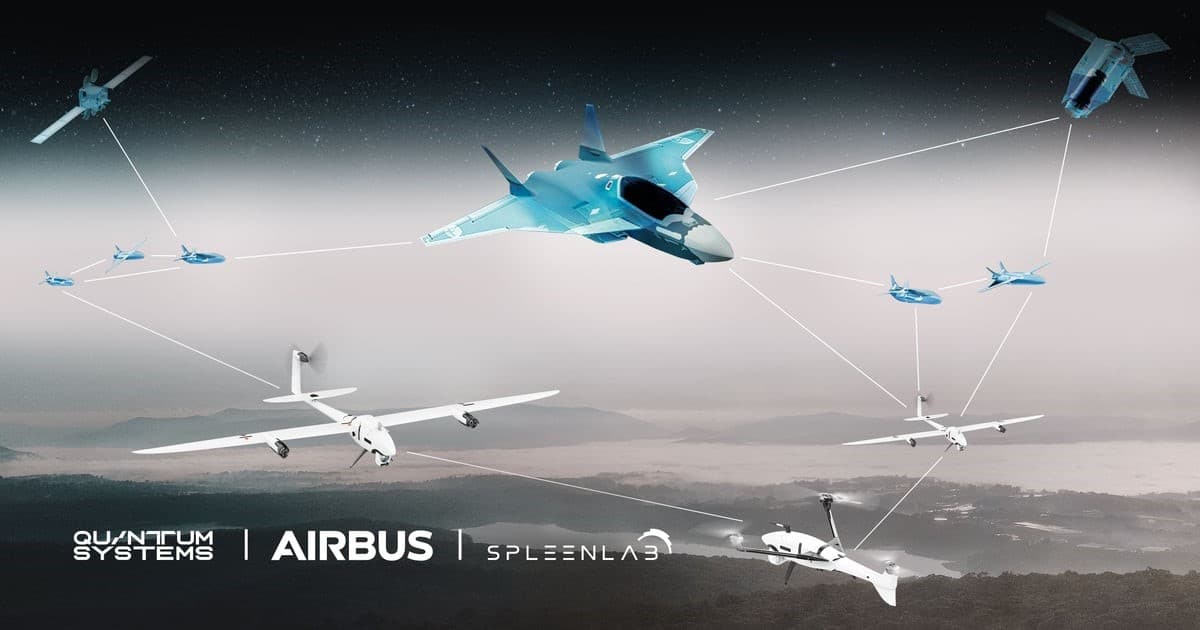

The partnership between Quantum-Systems and Airbus Defence and Space comes about as part of a research contract that the Bundeswehr’s planning office has awarded to both companies. A third partner is the machine learning startup Spleenlab from Thuringia. The goal of the project is to demonstrate and analyze AI components needed for the deployment of swarms of tactical drones (UAS, Unmanned Aircraft Systems) in a real-world scenario. The project, titled KITU 2 (Künstliche Intelligenz für taktische UAS), is funded by the German Defense Ministry. The study focuses on the effectiveness of tactical UAS.
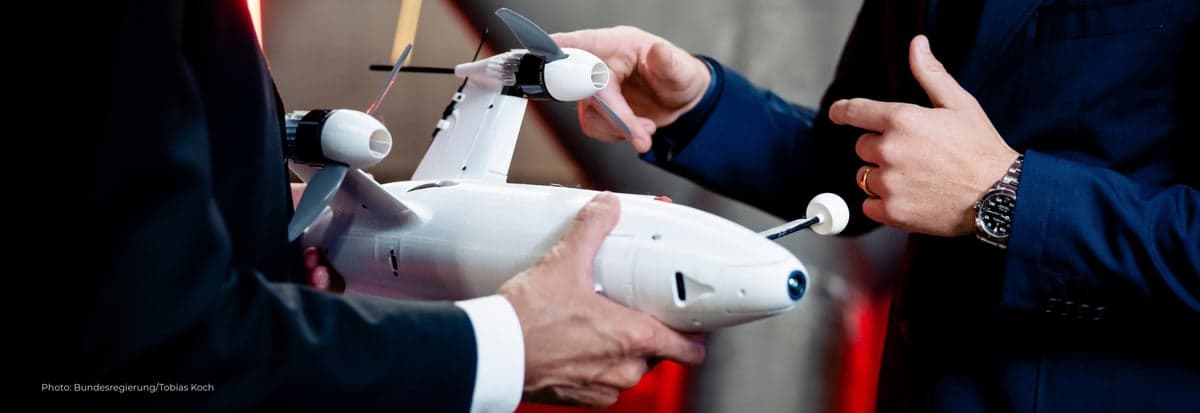
Quantum Systems contributes its Vector drones to the cooperation. These are electronic reconnaissance drones with the capability to take off and land vertically (eVTOL). The Vector can be deployed as either a fixed-wing aircraft or a multicopter. The drone achieves a flight duration of up to three hours and features built-in AI edge computing capabilities. Since Quantum-Systems has already supplied numerous Vector systems to Ukrainian armed forces, the drones are also considered battle-tested. Additionally, Quantum-Systems is currently working on a strategy for a system family whose smaller and larger platforms are to launch in the coming years.
How Airbus and Spleenlab complement Quantum-Systems’ drones
Airbus Defence and Space will supplement the Munich startup’s hardware with swarm algorithms and simulation environments. The defense contractor also contributes additional experimental hardware and the necessary AI components. Spleenlab, in turn, brings its expertise in AI edge software for swarms. This also includes object recognition and robust navigation methods in high-density communication environments.
The results of the KITU 2 research program are also intended to benefit other defense programs that also rely on swarm deployment. These include the Main Ground Combat System (MGCS), which has been advanced by Germany and France since 2018. Here, the defensive and offensive capabilities of main battle tanks on the battlefield are to be expanded through the integration of new technologies and multiple platforms. And the Future Combat Air System (FCAS), developed by Germany, France, and Spain, aims to link next-generation manned combat aircraft with unmanned aircraft as well as new weapons and communication systems.