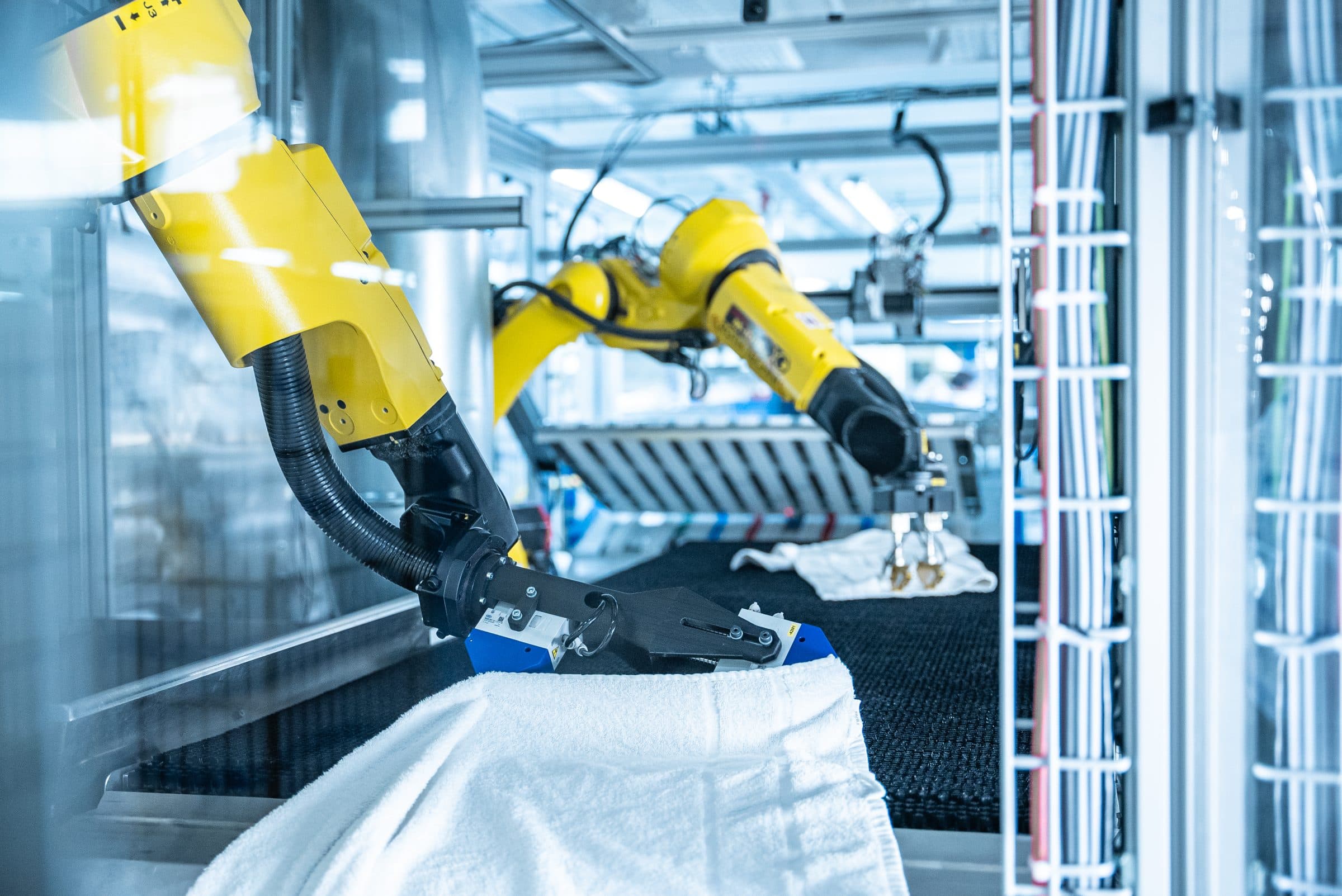

Since 2019, Sewts has been working on technologies for automated processing of deformable materials, such as textiles or films. Due to their complex material properties, these have so far been excluded from advances in automation technology. With its Velum system, the Munich robotics startup demonstrates that it is possible to automate the handling of shapeless materials in industrial processes in an economically profitable manner.
As Sewts has now announced, Velum was already operational in November at Greif Textile Mietsysteme in Wolfratshausen. With this, the startup celebrates its successful market entry and the introduction of robotics to industrial laundries. In addition, the commissioning of two additional systems is imminent. Overall, the company plans 16 deliveries for the current year.
For co-founder and CEO Alexander Bley, the delivery is an important milestone in Sewts’ development:
“With Velum, we have successfully launched an absolutely innovative product. We are delighted that we can also open a new chapter in our company’s history.”
Automation against labor shortage
Industrial laundries process large quantities of towels, bed linens, and work clothing. Their customers include hotels, hospitals, and care homes as well as laboratories and tradesmen. At Greif Textile Mietsysteme, around 100 tons of textiles come together at the 10 locations per day. This makes the company one of Europe’s largest laundries. However, Greif finds it difficult to find workers for the repetitive manual work involved. Velum is designed to solve this problem, with processing of currently 500-600 textiles per hour.
“The current performance of Velum is comparable to that of a human. Through over-the-air software updates – as with smartphones, for example – functionality is continuously expanded”,
emphasizes Till Rickert, co-founder and CPO at Sewts.
Of course, other industries also work with deformable materials that Sewts wants to support with its developments. In addition to further developing Velum, the startup has already scheduled the development of a second automation solution. In cooperation with major e-commerce companies, this is intended to significantly simplify the handling of clothing returns. Alexander Bley explains:
“The demand for automation will increase in all sectors in the coming years, as local capacity for manual labor is insufficient in many places, while at the same time dependence on fragile and climate-damaging supply chains should be avoided. Our technology is designed to be transferred to further applications and can make an enormous contribution to this.”