
Munich Startup: What does your startup do? What problem are you solving?
Gregor Langer, Talos: Talos designs and provides satellite-based IoT solutions to locate objects or small animals using miniature transmitters on the ground. We want to enable researchers and scientists to track migratory birds globally, for example, to follow their movements across continents. This allows us to determine, among other things, what impact climate change has on animal migration patterns when droughts or water scarcity force them to change their routes. Movement profiles also offer the possibility of detecting diseases early, for instance when a wild boar carries swine fever. Tracking data could also help “predict” natural disasters. It is known that animals react before scientific instruments register anything.
Besides tracking wildlife, our system is of course also suitable for tracking vehicles, containers, or tropical timber – to name just three examples – because the uses for such a system are limitless. However, our first customer groups are primarily scientists and researchers using wildlife tracking. In the long term, we want to offer Talos as a complete system as a service, that is, tracking-as-a-service.
Munich Startup: But that already exists!
Gregor Langer: Like other providers, we use GPS, but we initially store the data in the transmitter before sending it in aggregated form to a LEO satellite. At the moment, this happens on a daily basis, but it can be scaled through the number of satellites. This way, our transmitters consume very little energy, which makes them much smaller compared to other technologies – just the size of a small finger and extremely lightweight at under five grams. Another key feature of our transmitters is that they are configurable even during operation. In other words, the transmitter’s behavior can be changed depending on the situation. And that doesn’t actually exist yet. This allows Talos to address use cases that haven’t been possible even with larger transmitters until now.
Future as small as a fingertip
But we want to become significantly smaller. We’re continuing to work on our technology and want to go from the size of a small finger down to a fingertip. Following that comes our idea to track completely passively, which would give us an almost infinite lifespan for the transmitters.
Munich Startup: What’s your founding story?
Gregor Langer: We are 8 founders, some of us have known each other for years. We come from science and research and have engineers who have developed antennas and tracking systems, and so on. Ultimately, what brought us all together was a strong interest in the topic – and positive signals from the industry indicating a need for systems like ours. The consequence was our founding in July last year.
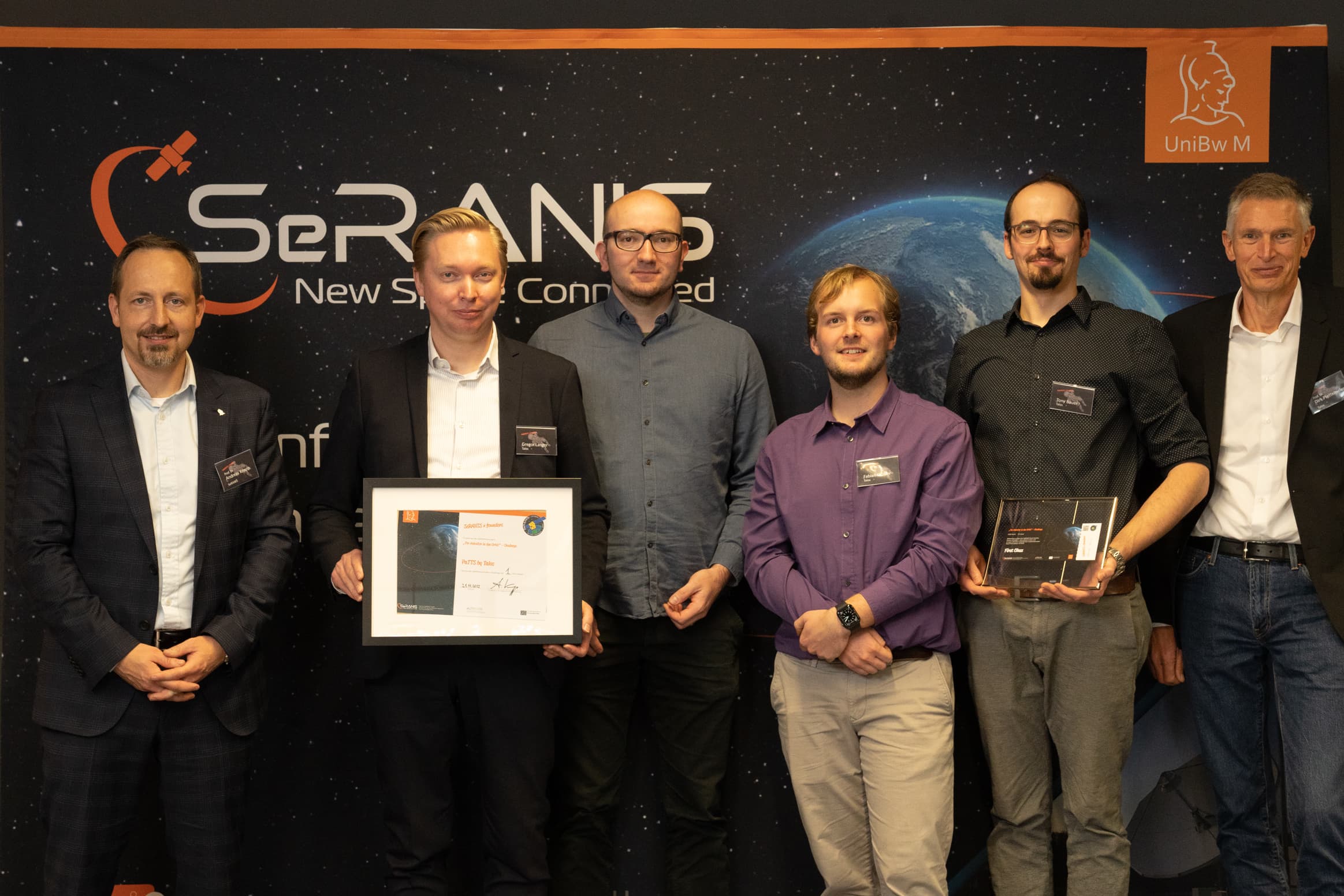
With our technology, we also won the SeRANIS Startup Challenge of the Universität der Bundeswehr München last year. This gives us the opportunity to bring a payload to a satellite funded by the university. That’s a huge success for us, and we’re very proud of it. We were also able to present our business model to a jury with a lot of experience, which was not only a reality check for us, but when jury members with all their experience think this will be a success, that’s very positive too.
Munich Startup: What have been your biggest challenges so far?
Gregor Langer: Besides the usual startup challenges like liquidity or general customer acquisition, the market is a special challenge for us. Because we want to address the global tracking market. Getting a foothold in such a gigantic market, establishing ourselves and not just occupying a niche – that’s a huge challenge.
Talos aims to offer tracking-as-a-service
Munich Startup: Where do you want to stand in one year, where in five years?
Gregor Langer: Within the next twelve months, we of course want to be on stable financial footing. That’s always the first and most important goal. We want to have landed our first contract and laid the groundwork for further orders.
Later, in three to five years, we want to be able to offer tracking-as-a-service with our own satellite. We also want to diversify our market segments by then, meaning not just being active in wildlife tracking, but also in fleet management and container tracking. And our passive system should also be ready by then and have its first orders with satisfied customers.
Munich Startup: How have you experienced Munich as a startup location?
Gregor Langer: Munich is a great location. We have established startups here that have already shown the way – Ororatech, Isar Aerospace, Lilium are names people know. There are excellent universities like TUM, which brings startups together through UnternehmerTUM, supports them, and makes them known. And of course there are many more who shape this community and ultimately lay the foundation for successful startups. Then there are events like the Bits & Pretzels in autumn or the DLD in early January. There’s a lot that clearly speaks in favor of Munich and we’re very satisfied with the location.
Munich Startup: Quick exit or long-term commitment?
Gregor Langer: We still have so many ideas we want to implement, and many hurdles we can overcome. Some companies are interested in our technology and every time I’m in customer conversations, I notice how the ideas just keep coming. So we can still invest a lot of time and effort here. That’s why I would clearly say long-term commitment.