
The high approval among founders demonstrates how great the need is for a unified legal form across Europe. While startups today often face different national company and administrative rules when expanding to other EU countries, EU Inc. is designed to break down exactly these barriers and facilitate cross-border growth.
EU Inc. to simplify expansion within Europe
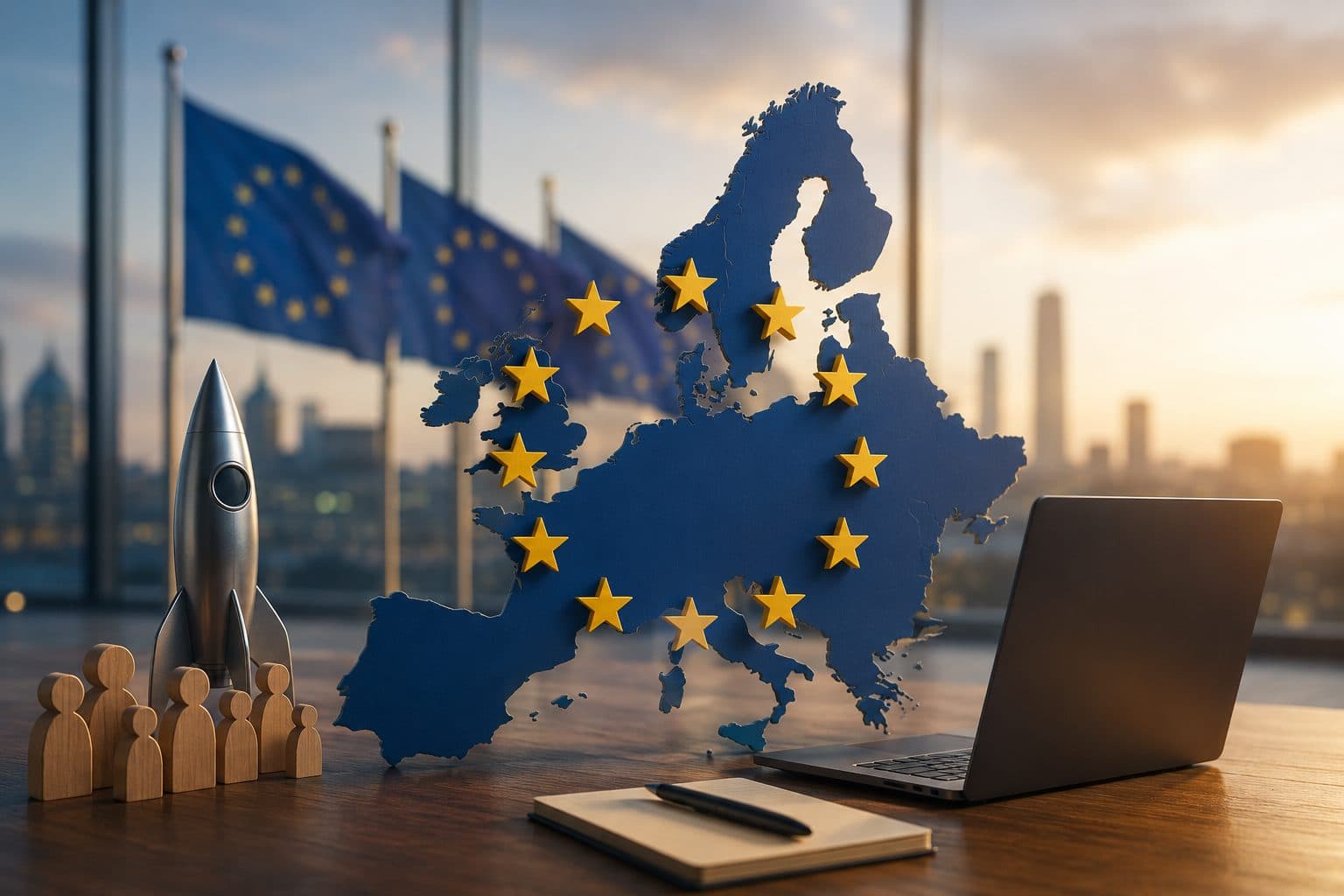
According to the vision of the European Union, the so-called EU Inc. – also referred to as the “28th Regime” – is to create a standardized corporate form for innovative companies. The goal is to simplify founding and provide startups with easier access to the European single market.
According to the current Bitkom survey, 62 percent of surveyed tech startups would establish their next company as EU Inc. 28 percent either did not want to or could not express an opinion. Only one in ten respondents rules out founding under the new legal form.
“Europe needs more tech startups. EU Inc. would greatly simplify founding and make growth beyond national borders easier,”
says Bitkom President Ralf Wintergerst. The broad support shows that the EU is “setting the right course” with its plans.
Cross-border expansion has highest priority
The expectations of startups regarding the practical benefits of the new legal form become particularly clear. Nearly all respondents cite uncomplicated expansion within the EU as a decisive success factor.
For EU Inc. to truly succeed and give the startup ecosystem a boost, it must, in the view of founders, above all enable expansion to other EU countries without local subsidiaries – 94 percent consider this very or rather important. Closely following is a purely digital and automated process via a one-stop-shop (91 percent), meaning a single point of contact with the responsible authorities.
82 percent consider digital share transfer without a notary or other additional offices and persons important, 78 percent consider the free choice of registered office within the EU important. For roughly two-thirds each, EU Inc. should offer an EU-wide uniform template contract for startup investments (69 percent), create uniform regulations for taxation of employee participation (67 percent), and harmonize labor and social policy rules (67 percent). Founding within 48 hours is also crucial for 67 percent for EU Inc. to succeed. The planned low costs of 100 euros for founding are mentioned least frequently – only 57 percent of founders consider this important.
The results show that for founders, the focus is less on the costs of founding a company than on reducing administrative and legal barriers to growth within Europe.
From the perspective of investors, the introduction of EU Inc. is also an important step. Katja Ruhnke, chair of Business Angels Deutschland e.V. (BAND) and CEO and co-founder of CK Venture Capital GmbH, sees urgent need for action:
“The introduction of EU Inc. is an important and long overdue step that must now be implemented quickly. Europe can only compete globally with the USA and Asia if we finally simplify the single market for innovative companies and investors. Today our systems are still too complex, especially in Germany, but also in many other European countries.”
Less bureaucracy to accelerate investments
A central concern from the perspective of business angels is the simplification of financing processes. Ruhnke particularly criticizes the current formal requirements for capital measures:
“From the perspective of Business Angels Deutschland e.V. (BAND), the abolition of the notary requirement for every capital increase is a decisive lever. The fact that every financing round is linked to a notarial procedure causes considerable costs for startups and investors and avoidable time losses.”
Cross-border financing within Europe must also become significantly easier.
“Currently, investments often fail or are delayed due to bureaucratic hurdles such as apostilles, different registration requirements, or formal requirements that vary from country to country. This is at odds with a functioning European capital market,”
says Ruhnke.
Beyond corporate law simplifications, she sees further need for action on regulatory framework conditions:
“Moreover, we need stronger harmonization in employee participation programs, labor law, and tax framework conditions. Only if Europe creates more uniform and competitive conditions here can we keep talent, capital, and innovation in Europe in the long term.”

Don’t miss out! Katja Ruhnke will be a guest on our podcast “Pitch & People” next week and talks about how she went from musical actress to investor and why she would advise everyone to buy a stake in a startup instead of the next expensive handbag.