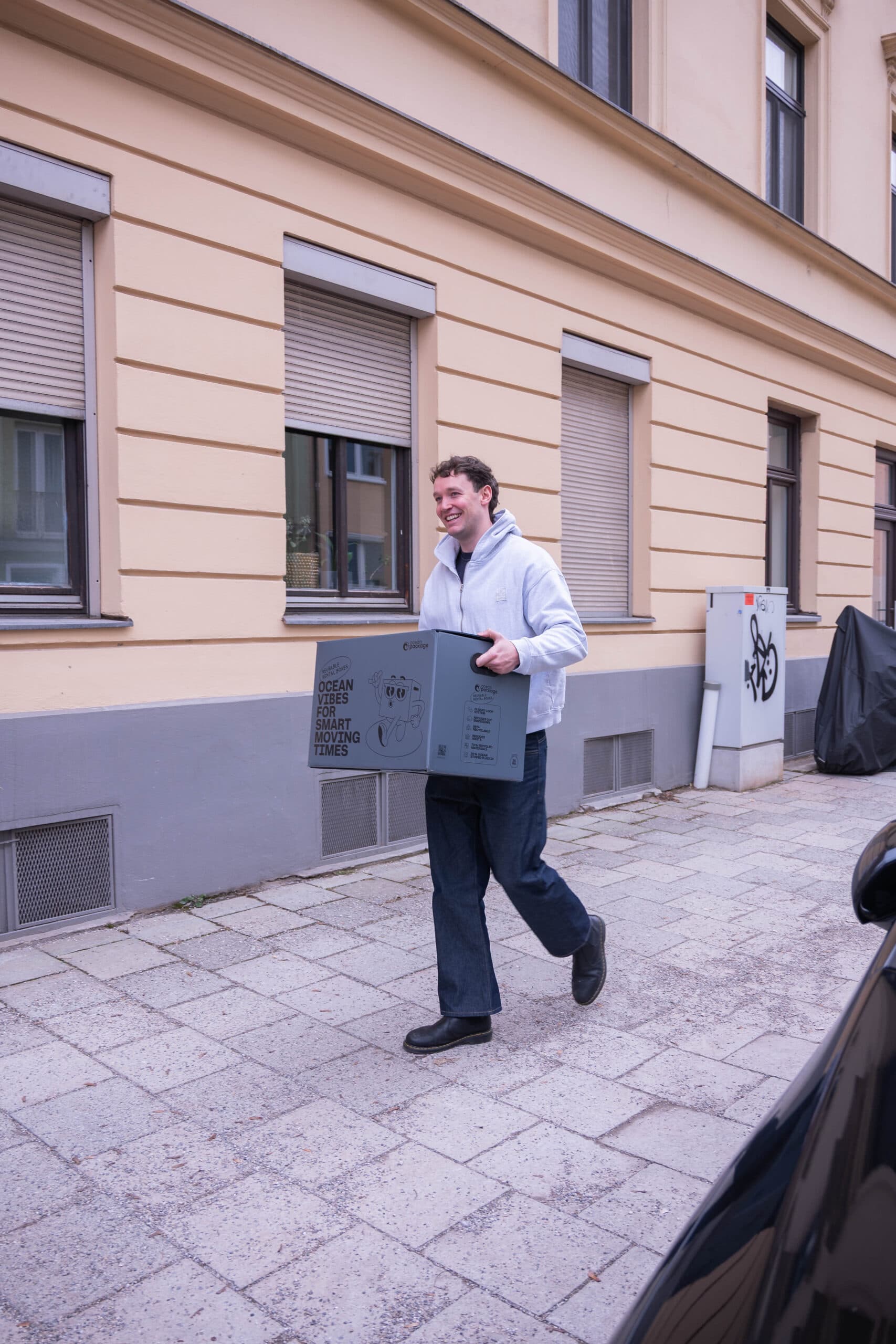

What stands out about Ocean Move is precisely how inconspicuous it is: for people planning a move, as little as possible should change. The box can be folded, stacked, and bundled just like conventional cardboard boxes, and is also designed not to require any fundamental process changes when it comes to storage space requirements.
“We simply wanted to create a moving box, we didn’t want to do anything complex,”
says Philip Mayer, co-founder of The Ocean Package.
70 Liters, 1.5 Kilograms: PP Replaces Traditional Corrugated Cardboard
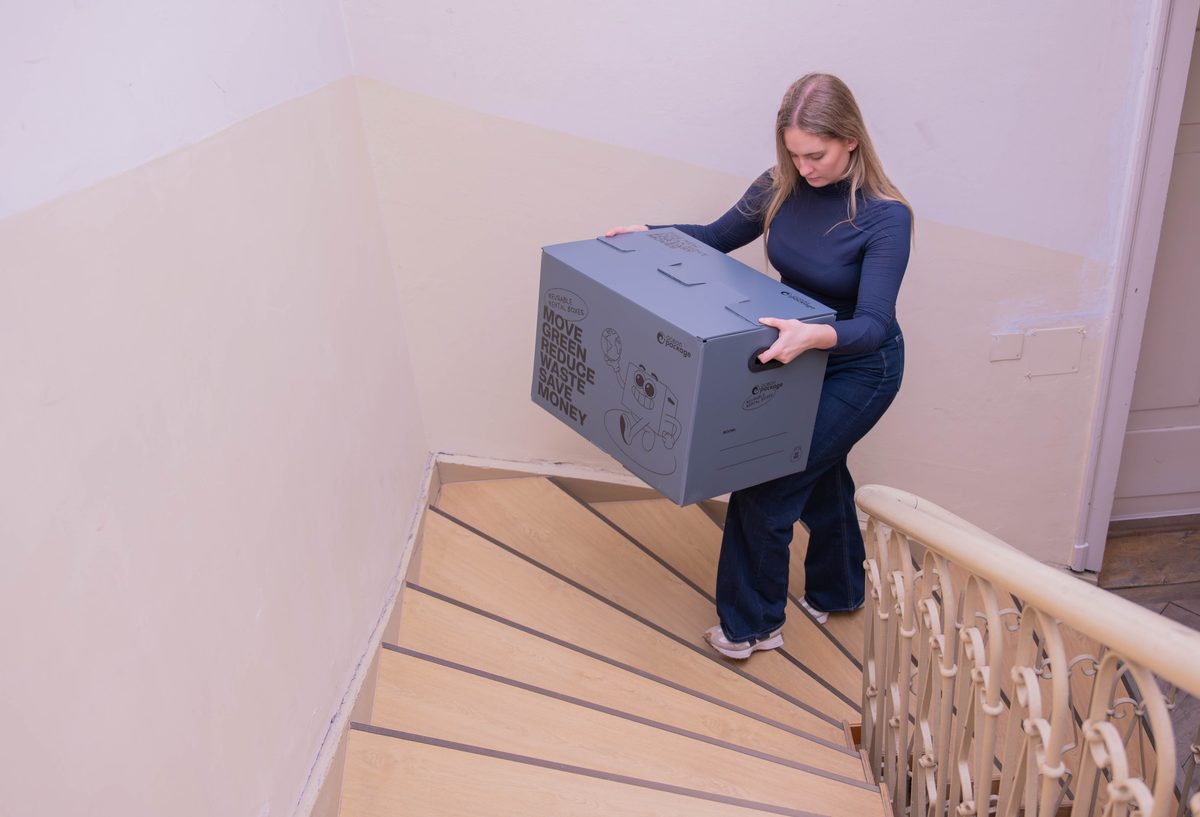
The reusable box measures 60×40×40 centimeters, holds 70 liters, and weighs 1.5 kilograms according to the startup. The Ocean Package uses polypropylene (PP) as the material; the box is manufactured as a mono-material and is designed to be shock-resistant and water-repellent. Customized designs are also available for business customers.
Mayer sees a practical advantage particularly in the material:
“The great thing about our boxes is that we actually work with PP, so it’s not cardboard.”
This is intended to prevent typical problems such as tearing handles, among other things. The packaging can also reportedly be used in the rain.
The Ocean Package explicitly distinguishes the product from hard-shell transport boxes. Instead, Ocean Move is designed to be folded and stored just like a classic cardboard box. The boxes are foldable, stackable, and bundleable, and according to the company, require a comparable amount of warehouse space as conventional cardboard boxes.
20 rentals expected to generate 50 euros in revenue per box
Behind the box lies not only a sustainability model, but also a business model. The Ocean Package aims to circulate Ocean Move repeatedly within a reusable rental system.
A sample calculation by the company illustrates the economic concept: An assumed total revenue of 4.50 euros for a single-use box is contrasted with 20 rentals of the reusable box at 2.50 euros each. This would bring a single box to 50 euros in revenue. Commercial prices are available from The Ocean Package upon request.
The company describes Ocean Move accordingly:
“A system that reduces ongoing box costs while simultaneously increasing efficiency and margin per move.”
Whether this calculation holds true in operational use, however, depends on other factors: such as actual lifespan, return rates, and capacity utilization, as well as the costs for logistics, handling, and, if necessary, cleaning.
Up to 20 cycles: The Ocean Package focuses on reusable systems
The Ocean Package states up to 20 cycles and a recycling rate of 99 percent for the moving box. In addition, the company advertises 80 percent lower CO₂ emissions and 70 percent cost efficiency. For the material, the startup relies largely on recycled plastic and so-called Ocean Stop material. This reportedly involves processing items such as old fishing nets.
For Mayer, it is crucial that sustainability does not become an additional obstacle in everyday life.
“You don’t always have to think in terms of good or bad, but in terms of real solutions.”
Practical test: Customers should barely notice the difference
How consistently The Ocean Package is pursuing this approach is demonstrated by its practical use so far. Mayer explains that customers sometimes receive the new boxes without having been explicitly informed about the alternative in advance. In this way, the company wants to find out how the packaging is received and whether employees can manage it in their usual day-to-day work.
“For customers, it doesn’t make much difference,”
is Mayer’s conclusion so far. The employees initially had to get used to the boxes. Although the handling is basically identical, there is a certain adjustment period, especially when it comes to carrying comfort.
It is precisely this everyday practicality that is likely to be crucial for scaling. Reusable packaging can save resources – but for professional users, it must work just as seamlessly as the established single-use solution.
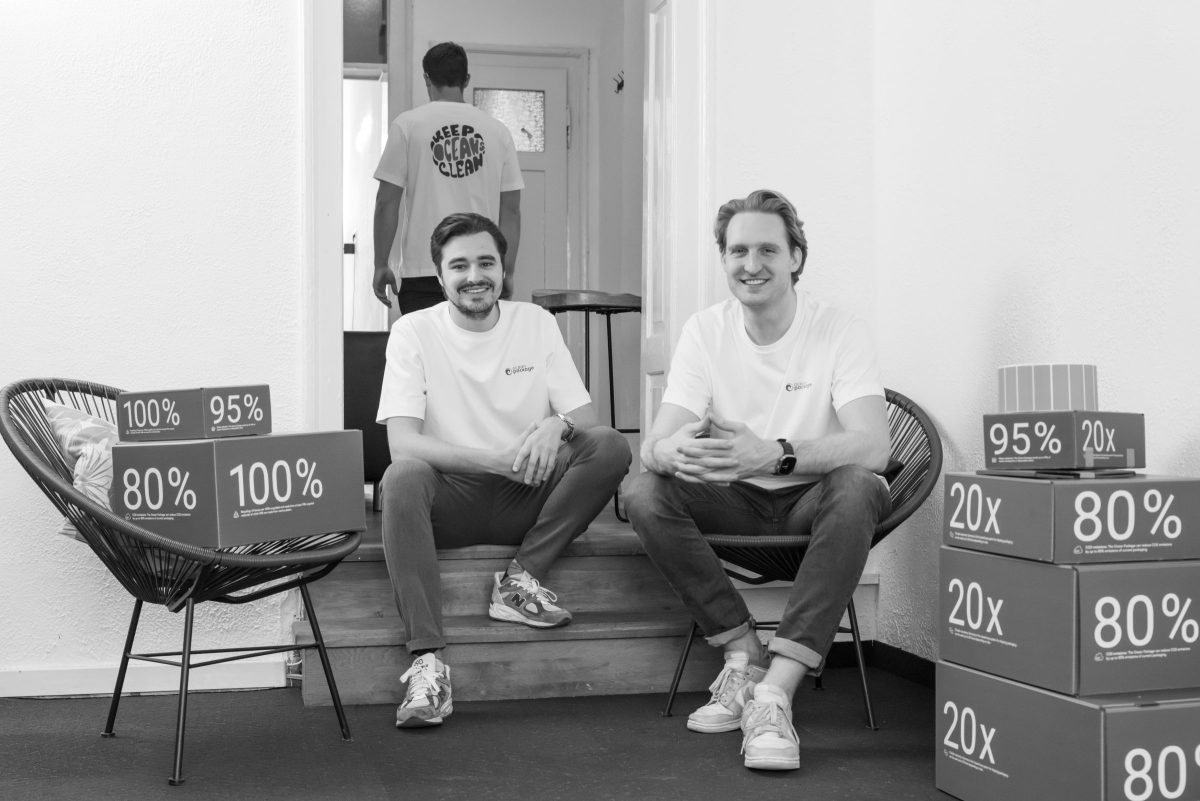
Behind The Ocean Package are Munich-based founders Joshua Linn and Philip Mayer. The two have known each other since childhood, grew up in Munich’s Lehel district, and attended elementary school together. The idea for the startup arose from the question of how to reduce the large volume of single-use packaging in e-commerce.
Today, the founders share operational responsibility: according to the company, Philip Mayer is primarily responsible for product development, HR, IT, and sales, while Joshua Linn oversees finance, marketing, project management, and partnerships. Founded in 2020, the company develops reusable packaging solutions and software for circular systems in logistics.
From Disposable Product to Circular Model
The moving market is fundamentally well-suited for a reusable model, as packaging is usually only needed for a limited period of time. Instead of storing, passing on, or disposing of the boxes afterwards, Ocean Move relies on returns and re-rentals. There is also an economic incentive for moving companies: if the boxes are indeed rented out multiple times, the same packaging can generate revenue repeatedly.