
Munich Startup: What does your startup Together do? What problem are you solving?
Christoph Kappes, Together: To this day, there is no tool that allows you to do what business needs: speak and write together in a way that is legally compliant, protects trade secrets, and produces traceable results. Providers like Microsoft face data protection concerns and have backdoors, others lack important features, and messengers and boards are not suitable for sustainable communication. That’s our starting point.
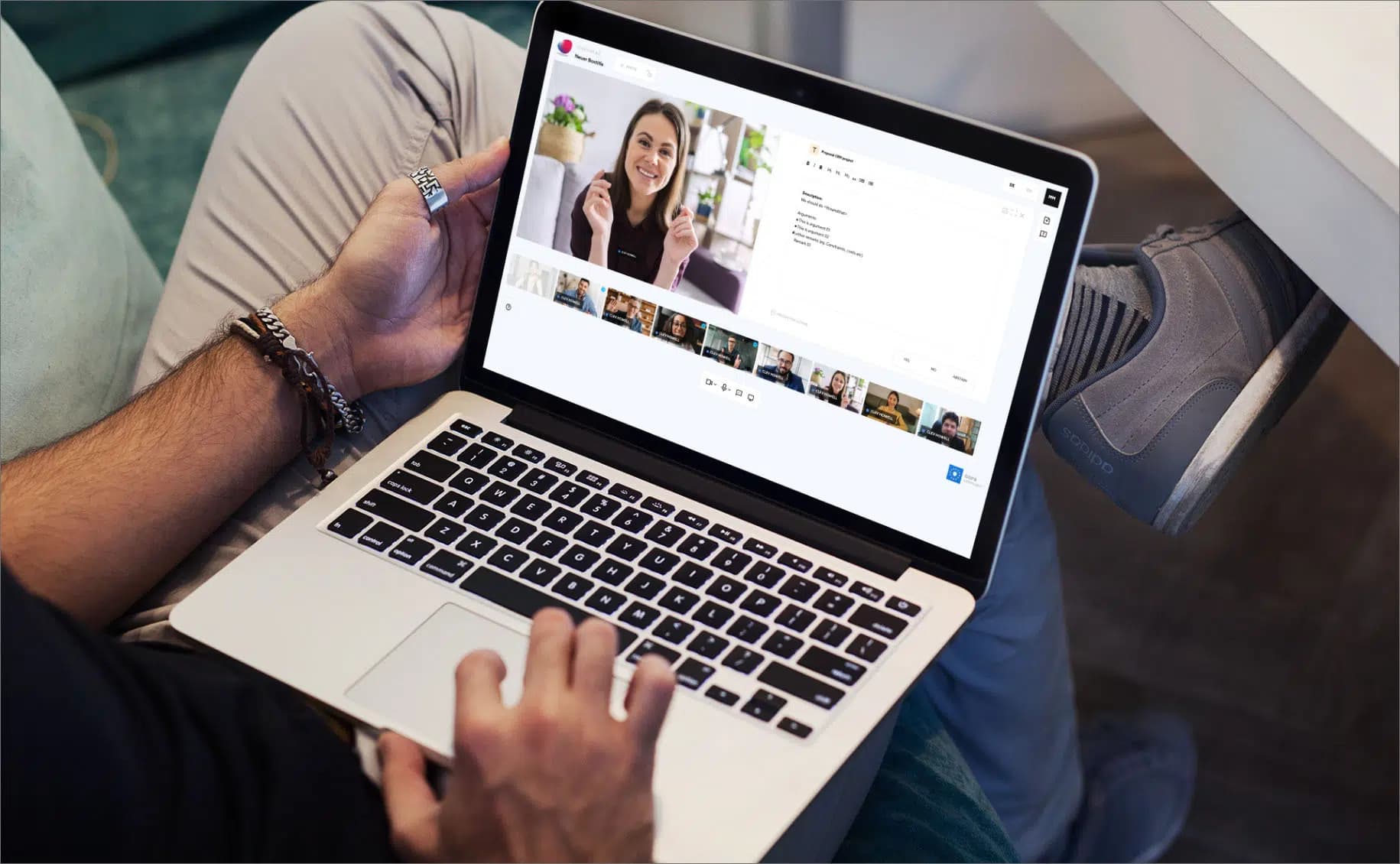
Together is an intelligent meeting hub where interactive collaboration is so central that you can achieve results in a legally compliant way:
- With collaborative writing, everyone can contribute – for example, on agendas, but also brainstormings and meeting minutes. This enables qualitatively better results. And it leads to coordinated and better-legitimized decisions.
- We improve collaboration with AI, for example, meeting minutes are corrected and you can prompt as a group. To ensure this happens 100% GDPR-compliant, we also rely on German AI from Aleph Alpha.
- We help in low-trust constellations. These occur in small groups, such as committees, healthcare, authorities, and consulting. But also in large constellations: cross-functional projects, working groups, residential associations, joint ventures, corporations. We support trust with identity checks via video ID, make documents verifiable (electronic signature), allow pseudonymous use via wallet, and enable staggered voting as with board or other committee submissions. And all of this is optional – you can also just chat away as Crocodile37.
- With us, everyone has an entire conference floor, so you can organize communication functionally (Project A, Client C, Café). And you know where your colleagues are and have short distances. This makes us interesting for distributed organizations with hundreds of people.
Together wants to put collaboration at the center
Munich Startup: But that already exists, doesn’t it!
Christoph Kappes: Video conferencing software has so far had a low maturity level. Physical speech is replaced by digital speech and a bit of “sharing” is bolted on. The concepts come from video telephony hardware. Writing as a cultural form is not integrated but bolted on – you can see this in MS Teams with the low use of collaborative Word in the cloud. And since collaboration requires a corresponding culture, development stalls. But speaking about what is written and writing down what has been discussed – these belong together! You formulate while thinking, and when you write, your thoughts become clearer. That’s why text collaboration can improve concepts, brainstormings, agendas, and meeting minutes. But there are infinitely many more cases where collaborative writing improves quality, is faster, and at the same time creates more legitimacy because everyone could participate. Learners can develop tasks and become teachers, lawyers work through paragraphs together.
All the individual parts already exist somewhere, but nowhere from one source and so well integrated, so well usable also in larger and/or low-trust constellations, and with benefits in seamless, elegant user journeys. Maybe you could say: we are the iPhone of meeting software. With us, you can introduce each other, then sign an NDA, and then jointly create a project description that you send to everyone with one click. And all at an attractive price: a seat with 5 rooms costs us a good 15 euros per month – that’s a bargain for a German solution.
“Many have resigned themselves to meetings producing too few results”
Munich Startup: What’s your founding story?
Christoph Kappes: As digital director in many companies, I saw that reality is not as fancy as you imagine as a digital person. Many have resigned themselves to meetings producing too few results, to calendars being full, and heads already aching by Monday evening. Everyone knows how bad meeting culture can be, especially when it comes to meeting minutes, and how much that costs in money and also productivity loss. As a crisis manager, I could even see how meetings as the “heart” of the company could be the cause of the crisis. And since I was able to learn in many companies how to improve management and meeting culture, I poured my little toolkit into a tool. The tool, of course, doesn’t replace people’s mindset, but it makes it much easier to achieve good results without hassle that are accepted.
Munich Startup: What have been your biggest challenges so far?
Christoph Kappes: We spent four years conceptualizing and developing. During this time, the concept developed logically and organically: first the core was collaborative work, then the “floor” and “trust” features were added, and a “soft” dimension also developed to help break out of silos and counteract isolation. That’s why we technically rebuilt after two years and have since also exchanged technology – for example, we replaced the video service. Now it’s about acquiring new customers and listening to them carefully.
Together: Profitable in one year
Munich Startup: Where do you want to stand in one year, where in five years?
Christoph Kappes: We want to be profitable in one year and then we will become a globally relevant player. But to be honest, given the state of the world, I’d rather think a bit smaller right now.
Munich Startup: How have you experienced the startup location Munich so far?
Christoph Kappes: Our core team is a German-speaking team of people who work well together – that’s very helpful for an innovative product. We’re spread across the whole country, not just in Munich. As a former Hamburg resident, I live here in Munich, but so far I only know the Munich location from interim mandates, but hardly know the startup scene. But I’m looking forward to it.
Munich Startup: Hidden champion or shooting star?
Christoph Kappes: Anyone who is successful is not hidden in their market. And if a star, then rising.