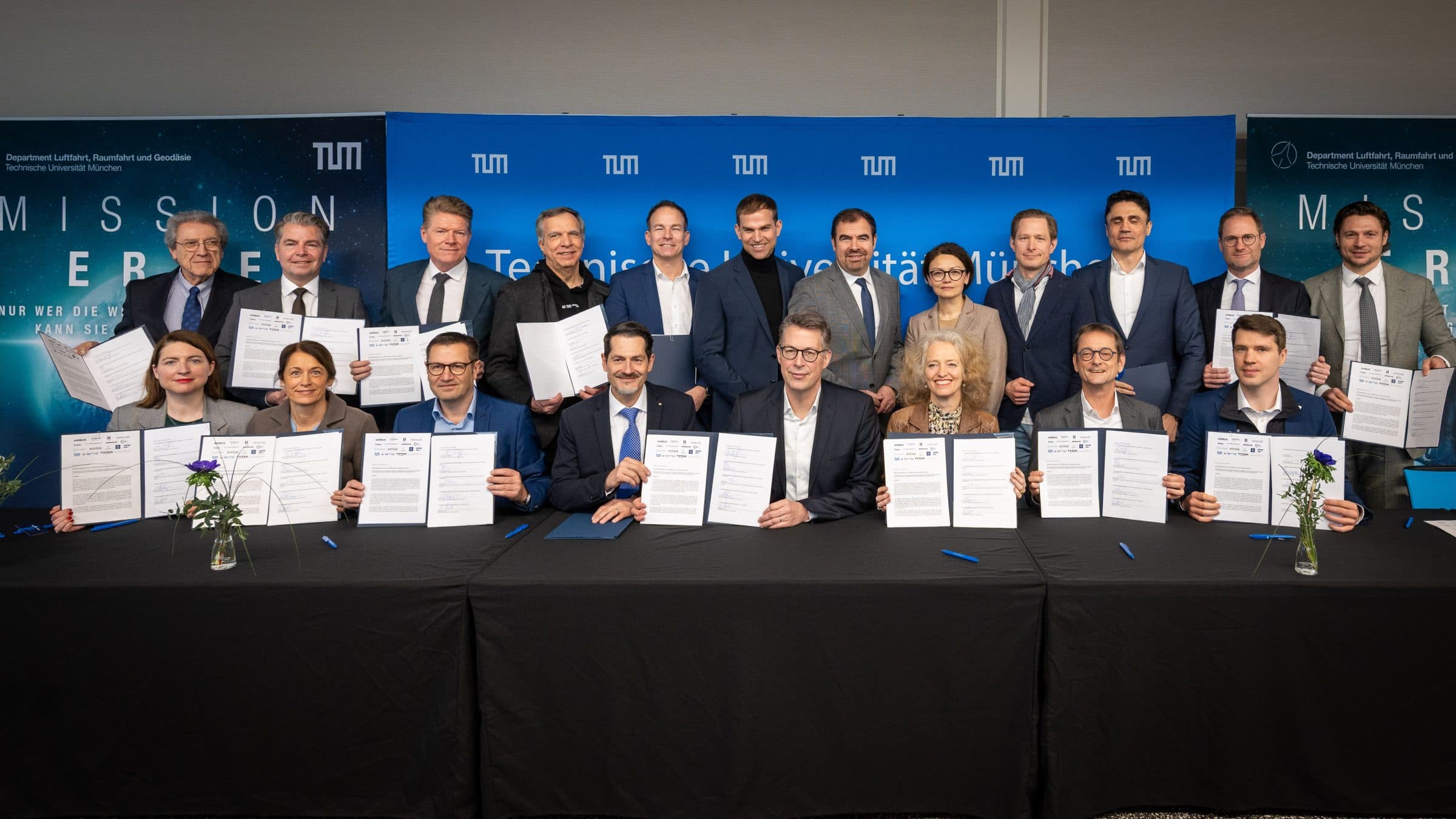

Technische Universität München has founded the “TUM Security and Defense Alliance” together with Universität der Bundeswehr München and 15 other partners. The innovation hub is being established at the TUM Campus Ottobrunn-Taufkirchen and combines activities in the areas of security and defence technologies.
The alliance particularly strengthens institutional anchoring of dual-use and defence-focused startups in the existing ecosystem. Young companies in the areas of aerospace, sensors, cybersecurity or unmanned systems gain more direct access to research infrastructure, industrial partners and potential fields of application through the new structure.
In addition to the Technical University of Munich and Universität der Bundeswehr München, established and younger companies are among the total of 17 partners from research, industry and the Munich startup ecosystem, including
- Airbus Defence and Space
- Diehl Defence
- Helsing
- Hensoldt
- Industrieanlagen-Betriebsgesellschaft
- Isar Aerospace
- MBDA Deutschland
- MTU Aero Engines
- Neuraspace
- Quantum-Systems
- Resaro Europe
- Rohde & Schwarz
- SAP SE
- TUM Venture Lab Aerospace / Defense
- Tytan Technologies
Focus on application-oriented research
The TUM Security and Defense Alliance covers the domains of air, space, land, sea as well as cyber and information space and aims to more strongly link fundamental research, application-oriented development and business implementation. The alliance is also intended to strengthen European security and defence capabilities as well as technological sovereignty.
Thomas F. Hofmann, President of TUM, says:
“Those who want to ensure peace must be able to defend it.”
With the alliance, an innovation ecosystem for greater European security is being created. The goal is to “responsibly and efficiently convert top-tier research and market-ready innovations into operational capabilities”.
Networking science, industry and startups
For startups, the focus on early validation, demonstrators and test infrastructures is particularly relevant. A key focus lies on supporting startups in the dual-use and defence sector. The alliance sees itself as a platform to support spin-offs from research and to more closely network existing young companies with established industry partners. The connection to TUM Venture Labs is intended to facilitate spin-offs and accelerate the transfer of research results into market-ready products.
Eva-Maria Kern, President of Universität der Bundeswehr München, also emphasizes the role of security and defence research for Europe:
“Through the TUM Security and Defense Alliance, we can pool expertise together with strong partners and put knowledge to effective use: for a free, secure and resilient Europe.”
Bavaria’s Science Minister Markus Blume also positions the initiative as a strategic step for the Bavaria location. From the perspective of the Munich startup scene, the political support underscores that security-relevant technologies are increasingly being perceived as an economic and innovation policy factor.
With its founding, the Munich startup ecosystem receives an institutional framework in the security and defence-relevant sector. For startups in the dual-use sector, the alliance can become a central access point for collaborations, infrastructure and visibility.