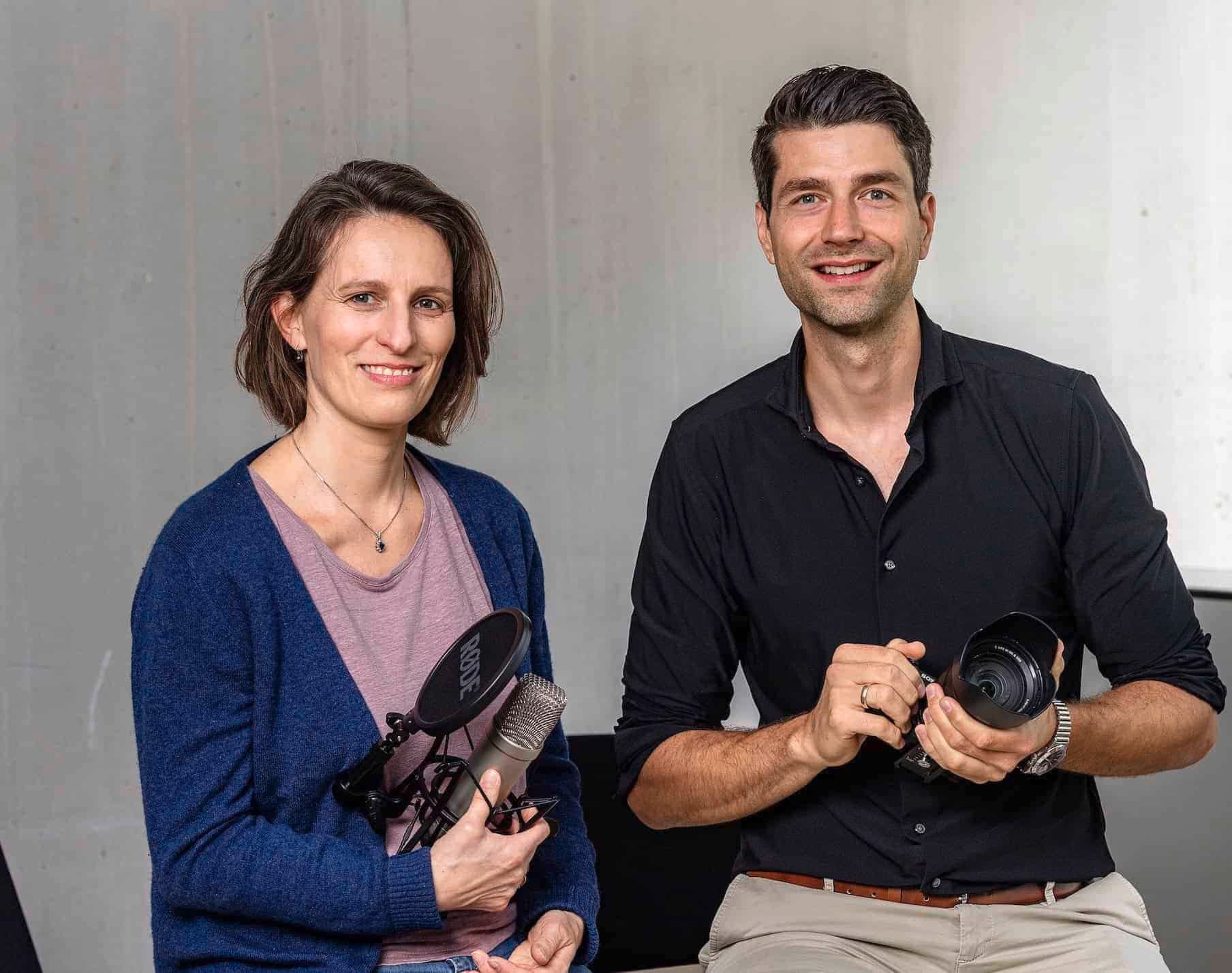

PITCH & PEOPLE Folge 25: Alina Nauen
Many startup founders keep a close eye on their figures – but not always the right ones. That’s what Alina Nauen, partner at Torq Partners, says in the video podcast Pitch & People. The finance expert supports high-growth startups as a fractional or interim CFO in building professional financial structures. Often precisely when investors take a closer look.


Torq Partners sees itself as a finance-as-a-service consulting firm for startups and scaleups. The team supports companies operationally in building their finance organization, from accounting processes to business case modeling to preparing for funding rounds. Alina Nauen, partner at Torq Partners and finance expert, explains in the video podcast Pitch & People:
“We help set up the finance department so that a startup is ready for the next funding round.”
The goal: build a financial structure that gives investors confidence. This includes reliable key figures, clean reporting, and clear processes. At the same time, the team also works on the investor side and supports venture capital funds in conducting financial due diligence on startups.
This dual perspective provides insights into typical weaknesses of young companies.
When reporting doesn’t match reality
One of the most common mistakes: founders build their own reporting, often based on bank transactions. Alina Nauen adds in our interview:
“But that often has nothing to do with the reality from the accounting data.”
Many startups look primarily at their bank movements and create reports from them. However, the connection between operational reporting and actual accounting – such as through monthly closings or accruals – is often missing. For investors, this can become critical, especially when a funding round is approaching.
The right time for professional financial structures often falls between the seed phase and Series A. Because by the time of Series A due diligence, investors want to see that management reporting matches accounting data.
Interim CFO on a temporary basis
In many cases, Nauen herself takes on an operational role in the company – for example as interim head of finance or CFO on a temporary basis. This often happens when a startup is approaching an important funding round or when the finance organization needs to be professionalized quickly.
Entry usually occurs through what’s called a Financial Health Check. Her team first analyzes the entire financial structure of the company. This includes accounting processes, monthly closing, invoicing and payment workflows, as well as the organizational structure of the finance team. The goal is to identify risks and determine which measures will have the greatest and fastest impact.
In a project with a B2B startup in the sustainability sector – shortly before Series A funding at the time – this analysis showed that the existing financial structure no longer matched the company’s growth. As a result, the finance leadership was restructured, and Nauen temporarily took on the role of interim CFO.
In this position, she not only handles strategic questions but also works operationally within the company. This includes leading the finance team, selecting and implementing appropriate tools for expense management or invoice processes, and setting up budgeting and planning processes together with the founders. At the same time, she ensures that key processes – such as the monthly accounting close – run significantly faster and more structured.
An important goal is to have reliable financial figures available early in the month so that founders and investors can make decisions on a solid foundation.
Such mandates typically last about six to seven months. During this time, structures are built, processes are improved, and the company is prepared for the next growth phase. In parallel, a permanent internal finance leader is usually sought to whom responsibility is then transferred. Nauen ensures that knowledge and processes are properly documented so that the transition runs smoothly.
Three finance KPIs every founder should know
Which metrics should founders definitely keep an eye on? For Nauen, there are three central KPIs that are relevant in practically every startup – regardless of business model.
Revenue is the first priority. However, it’s crucial that founders understand exactly how this revenue is generated. Especially in the B2B SaaS space, metrics like ARR or MRR are often used. But not every contract is automatically recurring revenue. For example, if a customer only has a short trial period or a project runs only temporarily, it’s not strictly recurring revenue. Anyone who calculates imprecisely here can quickly get a false picture of actual growth.
A second key metric is contribution margin. It shows how much of revenue remains after subtracting variable costs. This metric is particularly important because it shows whether the business model can fundamentally work. Especially in areas like e-commerce, contribution margin helps understand what prices must be charged at minimum so that marketing, sales, and other fixed costs can be covered at all.
The third crucial metric is cash. For startups, liquidity is often more important than traditional profitability metrics. Because even if a company appears profitable on paper, it can run into difficulties if liquidity is insufficient.

Alina Nauen is a partner at Torq Partners and supports high-growth startups and scaleups as an interim CFO in building professional financial structures. In this role, she works operationally with founder teams, develops financial processes, and supports companies on their path to funding rounds and sustainable growth. Previously, she held various finance leadership roles in the startup scene, including at Delivery Hero and at climatetech startup Planetly, where she was co-responsible for building and scaling the finance organization. Today, she brings this experience to different growth phases of young companies. (Photo: Torq Partners)
From hypergrowth to realism
The role of financial management is more important than ever today. While growth at any cost was the focus in 2021 and funding rounds were completed at high valuations, the market environment has changed significantly. Investors now pay closer attention to when a startup becomes profitable and how sustainably it grows. The focus is therefore shifting from “growth at all costs” to profitable growth paths.
Nauen also sees significant changes in the German startup ecosystem right now. While the scene was long heavily concentrated in Berlin, founding activities and investments are increasingly spreading across multiple locations.
Munich in particular is gaining in importance. This is evident not only in the rising number of startups, but also in the growing density of events, accelerators, and networks that support the ecosystem.
“When you attend events here, you simply notice that the willingness to exchange and support within the ecosystem is very strong.”
For Torq Partners, this was one of the reasons to take the next step: in addition to its Berlin office, the company has now opened an office in Munich. With this move, the team wants to work even closer with high-growth startups in southern Germany.