
At the ESA DACH Space Investor Forum on October 29 and 30, 2026, at the IHK for Munich and Upper Bavaria, Munich-based space startups Vyoma and Talos presented their expansion plans. While Vyoma is already delivering space surveillance data with its first satellite and aims to build a satellite-based monitoring network by 2028, Talos plans to expand its IoT satellite constellation to a prospective 90 to 100 satellites.
Vyoma: First satellite Flamingo-1 already fully operational
Europe’s space industry faces a dual challenge: it must build independent infrastructure in orbit while simultaneously developing commercially competitive business models. How different the approaches to this can look was demonstrated by two Munich startups at the ESA DACH Space Investor Forum.
The Munich spacetech startup Vyoma focuses on monitoring satellites and other objects in Earth orbit. This is not only about collision avoidance, but increasingly also about the security of critical infrastructure in space.
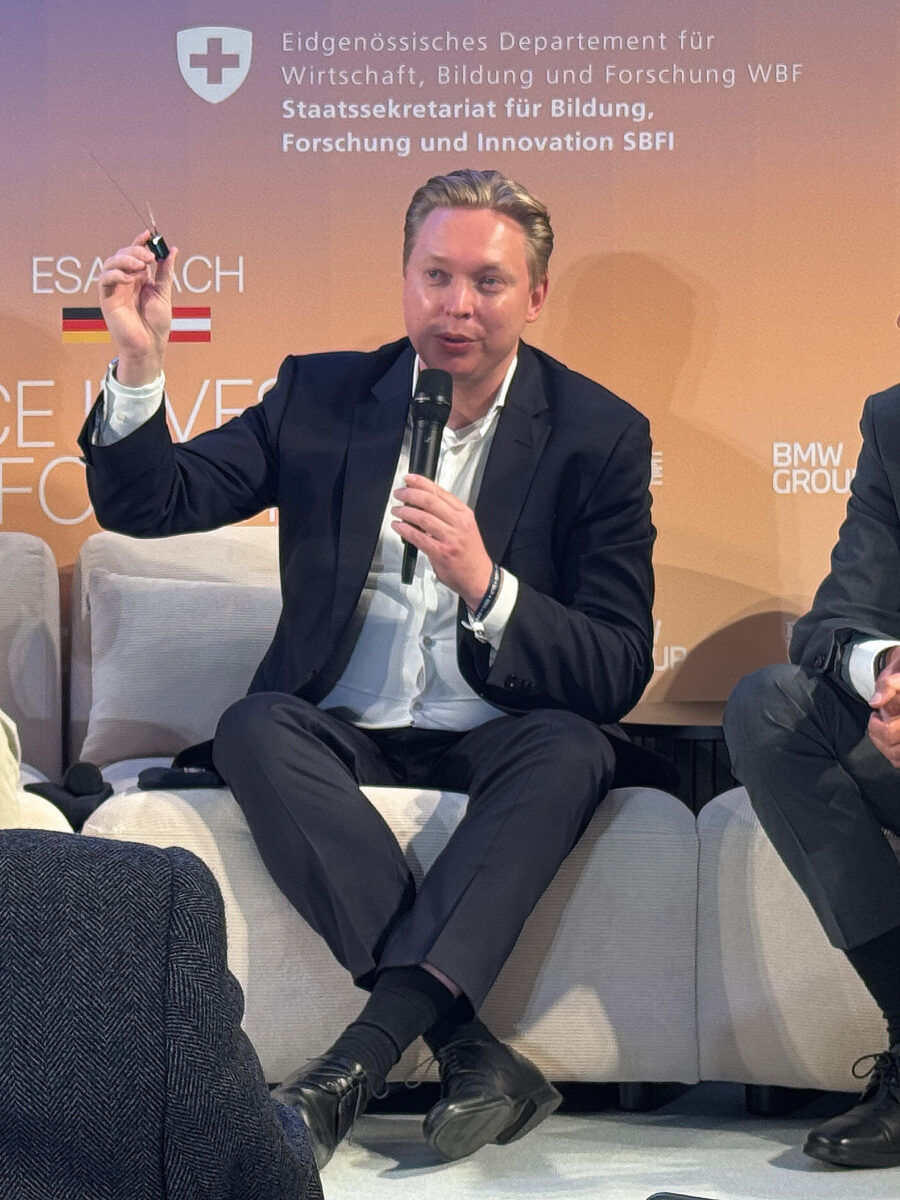
With Flamingo-1, Vyoma has now fully commissioned its first satellite. This was confirmed by Vyoma CEO Stefan Frey on a panel on Space Domain Awareness (SDA). The satellite is already generating its own observation data, which Vyoma processes and provides to its customers as space situational awareness information.
For Frey, operational capability is a decisive competitive advantage. Government and military customers in particular need readily available data and cannot wait for national solutions to be developed first.
The startup therefore aims to expand its infrastructure significantly. According to Frey, the second satellite launch is already booked, and another twelve sensors are planned. A complete satellite-based surveillance network, a so-called “space fence,” is slated to be in place before 2028.
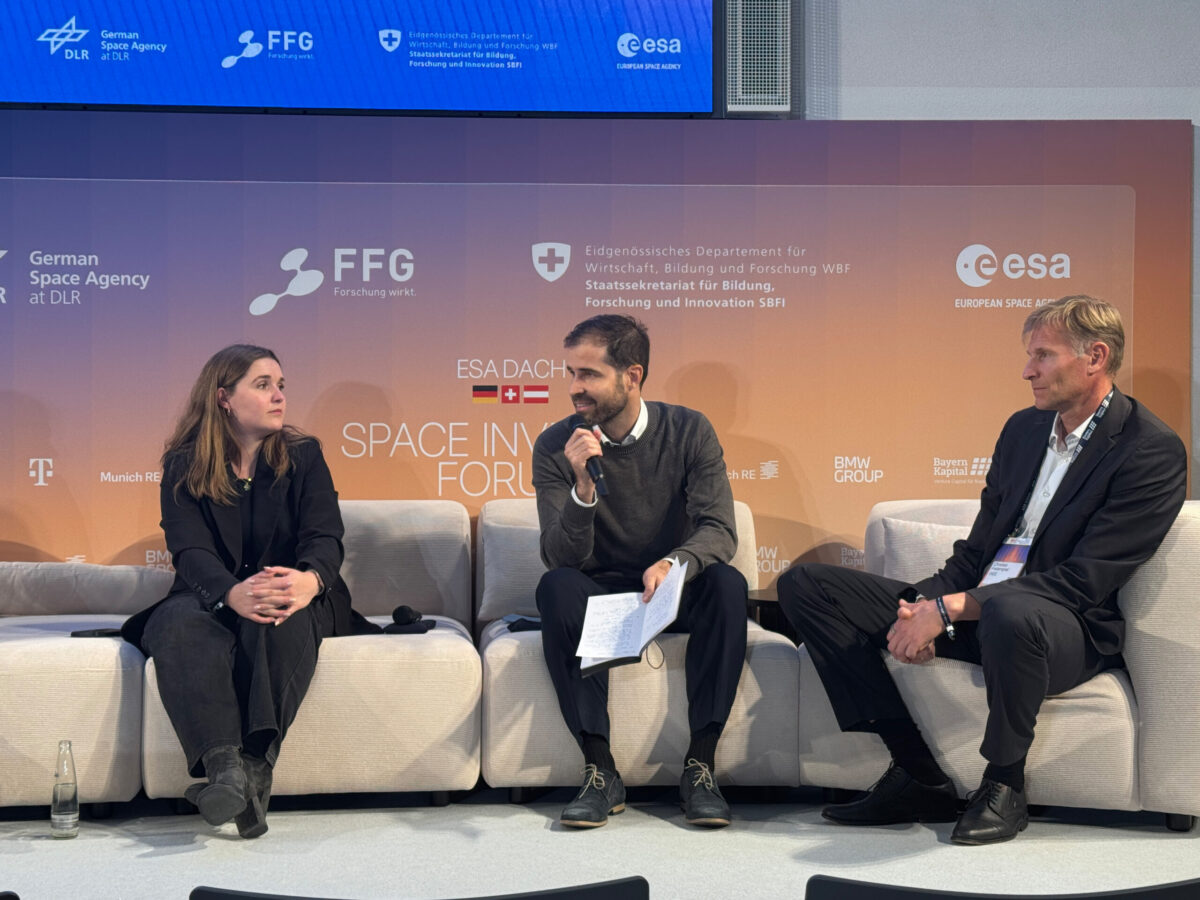
Photo: Bernd Heppel / Munich Startup
European Space Security: Vyoma Relies on Shared Infrastructure
A central topic of the discussion was how European nations can build their own space surveillance capabilities without creating isolated systems.
Frey advocated for closer cooperation. While national space commands want to possess their own sovereign capabilities, these could still be interconnected through shared standards and partnerships.
Vyoma could also offer turnkey solutions for this, such as satellites modeled on its own Flamingo series. It is conceivable that individual countries operate their own satellites while sharing the acquired data and capacities at the European level or within NATO.
Another challenge remains access to space. Despite falling launch costs, European space companies continue to depend on limited launch capacities to transport their satellites.
Frey emphasized that Vyoma has secured its launches through existing partnerships and does not rely exclusively on SpaceX. However, European launch providers can only become competitive in the long run if public-sector clients are willing to procure corresponding services, even at initially higher prices.
In addition to military applications, further business opportunities are opening up. The panel specifically discussed the use of SDA data for insurance companies. More accurate information about collision risks and the state of orbit could help insurers better assess satellite risks in the future and develop new insurance models.
Talos: IoT Satellites with Devices Weighing Just 4.4 Grams
While Vyoma collects data about space, Munich-based startup Talos aims to enable communication between devices on Earth – even in areas where traditional mobile networks are unavailable.
On a panel addressing satellite-based connectivity, CEO Gregor Langer explained how the company plans to gradually expand its satellite infrastructure. According to the company, Talos currently operates one satellite. Four more are scheduled to be added over the next twelve months. In the long term, however, the startup is thinking much bigger: Langer spoke of a constellation of 90 to 100 satellites in the coming years.
A key component of the business model is exceptionally small and cost-effective end devices. According to Langer, the satellite terminals used by Talos weigh just 4.4 grams and include sensors for position, temperature, humidity, and acceleration, among other parameters.
In doing so, the company addresses applications where conventional communication solutions are too expensive, too heavy, or not available with comprehensive coverage.
One example is wildlife tracking. Small transmitters can help track bird movements and gather scientific data. Talos sees further potential applications in agriculture, industry, and the monitoring of critical infrastructure, such as energy grids.
Talos’s 4.4-Gram Satellite Sensor
Integrated sensors: Positioning (tracking), temperature measurement, humidity measurement, acceleration measurement
Areas of application:
- Wildlife research: Tracking bird movements and studying flight paths
- Agriculture: Monitoring animals, machinery, or environmental conditions
- Industry: Collecting condition and environmental data
- Critical infrastructure: Monitoring power grids and loads, such as from snow
From one satellite to 100: Talos relies on proprietary technology
For the planned expansion of its satellite constellation, Talos has also shifted its development strategy. In the initial phase, the company purchased essential components and services externally, including software-defined radios. While this allowed for a comparatively quick entry into satellite development, it also incurred high costs.
For a larger satellite constellation, this approach is not economically scalable, Langer explained. That is why Talos already began developing core technologies in-house and bringing more of the value creation into the company during the development of its first satellite.
“To do that, we can’t just buy components off the shelf. We have to make them cost-effective, scalable, and affordable. And that’s exactly what we did,”
says Gregor Langer, CEO of Talos.
The move toward in-house development is intended to reduce unit costs and enable the production of larger numbers of satellites.
The financing to date is also remarkable: according to the CEO, Talos has not raised any venture capital so far. Instead, development has been supported by the German Space Agency, the Free State of Bavaria, and ESA, among others. That could change for the next growth stage. Building a constellation of up to 100 satellites requires significantly more capital than developing individual satellites. In addition to funding, Langer cited a qualified team and the ability to reliably develop and qualify space technology as crucial prerequisites.
The Moon Walker Night: Free Space Event on October 30 in Munich
To conclude the two-day forum, there is also an event focused on space exploration for spontaneous attendees.
The Moon Walker Night will take place on Friday, October 30, 2026, starting at 8:00 pm at Bergson Munich. Attendance is free of charge, but prior online registration is required. All further information can be found here.