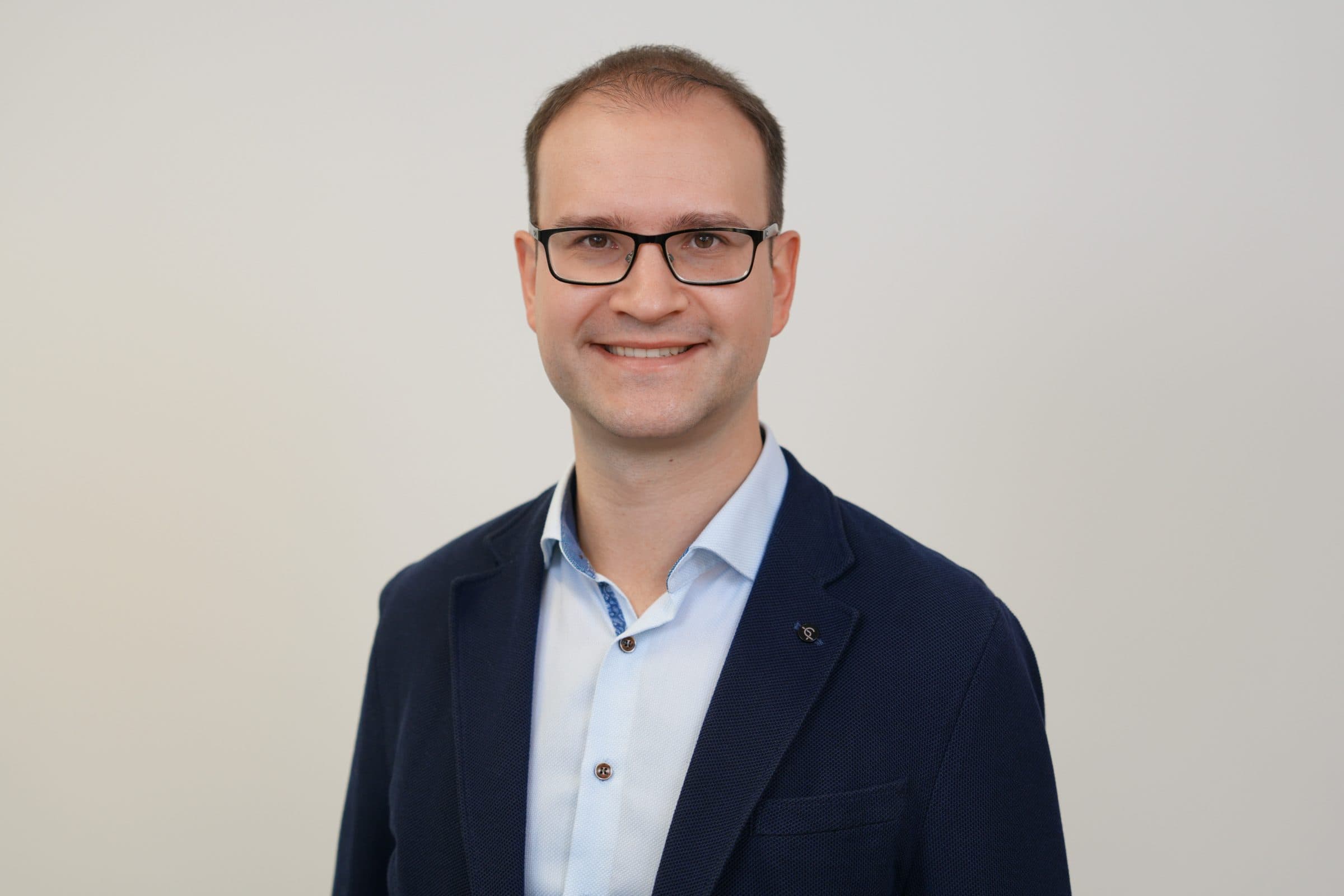

Munich Startup: What does your startup do? What problem do you solve?
Dr. Robert Macsics, CEO & Co-Founder: We develop new antibiotics against multidrug-resistant bacteria. These are increasingly becoming a real threat to our society and could lead to more than eight million deaths worldwide annually by 2050. Additionally, our entire modern healthcare system is at risk, as all healthcare sectors depend on functioning antibiotics—for example, in transplantations or chemotherapy for cancer. However, this is no longer guaranteed due to growing resistance to existing antibiotics. At the same time, there have been hardly any innovative developments in recent decades that have produced new antibiotics—which is why it’s all the more important that we counteract this dangerous trend with our approaches.
Munich Startup: But hasn’t that existed for a long time already!
Robert Macsics: We work exclusively on mechanisms of action that fundamentally differ from already approved antibiotics. This way, we avoid cross-resistance and ensure that bacteria cannot easily adapt to our active substances. A special approach that makes Smartbax unique is our concept of enzyme activation instead of classical inhibition. While typical antibiotics work by shutting down an essential process in bacteria, we’re trying to achieve the opposite: we look at processes that are very tightly upregulated in bacteria and overstimulate them, causing a kind of self-destruction in the bacteria. This unconventional approach offers a range of advantages and opens up entirely new treatment options in certain situations where classical antibiotics often fail.
Spin-off without prior experience
Munich Startup: What’s your founding story?
Robert Macsics: The background knowledge on which Smartbax is built was gained through many years of academic research at TU München. My doctoral advisor and co-founder Prof. Dr. Stephan Sieber recognized the application potential of our work early on and was able to acquire corresponding translational funding to take important steps toward a spin-off. This was originally called the “aBacter” project. Since my own doctoral work was related to these efforts, I began working on “aBacter” toward the end of my PhD. It was precisely at this time that we came into contact with our first investor, the Boehringer Ingelheim Venture Fund (BIVF).
When we realized that this investor had a serious interest in investing in our technology, the real scenario of a spin-off suddenly came into play. I still remember very clearly how green I was behind the ears when it came to startup founding—I hadn’t even finished my PhD yet. On top of that, it was just the beginning of the Corona pandemic, which made everything much more complicated and unpredictable. Nevertheless, both Stephan and I recognized the special, perhaps unique opportunity that presented itself to us at that moment, and together with our third co-founder Marco Janezic, who has always supported us as an entrepreneurial advisor, we simply went for it. In April 2021, Smartbax GmbH officially came into existence.
High development costs and skeptical investors
Munich Startup: What have been your biggest challenges so far?
Robert Macsics: Antibiotic development is an area with its own unique economic challenges. This is because high development costs are often not matched by high revenues, as doctors typically reserve novel antibiotics for particularly critical cases to prevent new resistance from developing too quickly. This has led many large pharmaceutical companies to completely lose interest in antibiotic research—a main reason for the current resistance crisis.
In turn, this leads to two core challenges for startups like us: first, developing a product that is so good and offers so much real added value that it can succeed even in this challenging market. With the extraordinary mechanisms of action we’re working on, we feel very well positioned here. Second, convincing investors that an investment in a new antibiotic can actually pay off. What has helped us enormously is having the BIVF as a very strong and renowned anchor investor with strategic foresight from the start, which lent credibility to our approach and helped us acquire additional funders. Nevertheless, many investors in this field are rather cautious because the commercial risk is currently too high for them. While I’m convinced that an investment in us is definitely worthwhile because market conditions will eventually develop in our favor, what we urgently need here are political initiatives so that this doesn’t only happen when death tolls are correspondingly high and it’s already too late.
Finally, I should note that in addition to these very industry-specific challenges, we’ve of course also had to deal with the same hurdles that affect almost all startups in Germany: excessive bureaucracy, over-regulation, and a lack of risk appetite from government agencies. We absolutely must do something about this if we want to remain competitive internationally.
On the path to clinical development
Munich Startup: Where do you want to be in one year, and where in five years?
Robert Macsics: With our lead program, we’re currently in lead development and expect to be ready for clinical trials in two to three years. Accordingly, we want to lay the groundwork next year by further optimizing the structure of our development candidate and sufficiently demonstrating its efficacy and added value in animal studies. In five years, if all goes well, we could be just at the end of our clinical Phase I and thus preparing for the start of Phase II—the first demonstration of efficacy in humans. So that should be quite an exciting few years ahead of us.
Munich Startup: How have you experienced Munich as a startup location so far?
Robert Macsics: Munich is undoubtedly the best location for biotechs in Germany. Biotech startups almost always emerge from academic research, and in Munich we have not only Germany’s two best universities with LMU and TU, but also numerous research institutes like the MPI and Helmholtz Center. This gives us an unparalleled concentration of top-tier research and thus also tremendous potential for spin-offs. This has created an outstanding ecosystem from which we benefit greatly. Networking meetings and pitching events take place regularly, whether through Bio-M, UnternehmerTUM, TUM Venture Labs, or other organizers, where you can come into contact with potential investors and get to know other founders with whom you can exchange ideas about shared challenges.
The good educational landscape and high quality of life in the city are also a major advantage when searching for skilled workers. Of course, not everything is perfect in Munich either, but at least you have the sense that the Bavarian state government has recognized the importance of a strong startup scene for Germany’s economy and is accordingly working to improve general location conditions.
Socially important, but still a biotech insider tip
Munich Startup: Hidden champion or shooting star?
Robert Macsics: Since we’re still very early in product development and it will take an estimated at least eight more years before one of our antibiotics is approved, I’m struggling with both terms right now. In a direct comparison, we would certainly be more of a hidden champion, since we’re active in a little-known area within the biotech sector, which is not least due to the challenges mentioned above, while our efforts simultaneously have very high overall societal value. Depending on how dramatically the resistance crisis develops in the future, we could also quickly turn into a shooting star, though in the interest of the general public, one would not want to hope that it comes to that.