
Francesco Sciortino, CEO of Proxima Fusion, worked in the field of so-called tokamaks until 2022. This is the most widespread design for fusion reactors to date. A tokamak is, in simplified terms, a ring-shaped magnetic field system that confines extremely hot plasma, ionized gas, so that atomic nuclei can fuse together.
But for Sciortino, 2022 marked a turning point. New research findings showed that an alternative concept, the so-called stellarator, was suddenly far more calculable and optimizable than previously thought. Sciortino explains in a conversation with Munich Startup during the Münchner Sicherheitskonferenz at the MSC Startup Hub:
“In 2022, we realized that tokamaks cannot be scaled to power plants. At the same time, it became clear that stellarators can be optimized numerically – further than I myself had ever thought possible.”
What is a stellarator?
A stellarator is also a fusion reactor that confines plasma with magnetic fields. The difference: while tokamaks rely on relatively symmetrical ring structures, stellarators are extremely complex in shape, with their magnetic coils wound three-dimensionally around each other. For a long time, this was considered too complicated.
But new simulation methods enable these geometries to be optimized numerically in such a way that there are no obvious technical showstoppers.
From simulation to industrial reality
Sciortino emphasizes in the interview: mere feasibility is not enough.
“Feasibility is a prerequisite, but not sufficient. We actually need to build things so we can iterate and turn that into industrialization of fusion components.”
This is exactly what Proxima Fusion is doing. The company is not only developing the reactor design, but also wants to industrialize the key components itself. This includes particularly complex magnetic structures. Its own magnet factory is planned.
The momentum is further accelerated by advances in high-temperature superconductors. These materials enable stronger magnetic fields, a central factor for stable fusion processes. In the long term, a stellarator with net energy gain will be created. Proxima is targeting its first power plant for the mid-2030s.
100 billion valuation
But how do you convince investors of an idea that seems to be at the limit of what is possible? Sciortino makes it clear:
“As long as the valuation continues to grow strongly and there is a multiplier ahead of us, it is financeable. VCs only get scared when there is no further value growth. But in fusion, we are just at the beginning.”
He goes even further: before humanity benefits from clean energy, an economic ecosystem is first created. In the 2030s, companies building the first fusion power plants could reach valuations close to one hundred billion. And even that is not an endpoint; energy markets are significantly larger. Yet Sciortino cannot promise to deliver cheap energy in abundance within five or ten years.
Startup culture instead of bureaucratic logic
Fusion long remained the domain of state mega-projects. But Proxima deliberately pursues a startup culture.
“We are not a physics company, we are an engineering company.”
On board are experts from aerospace, automotive, and software. Academic excellence is complemented, not copied. But Europe has a problem: the so-called scaleup gap. Large financing rounds in the billions are more difficult here than in the United States. That’s why Proxima speaks with investors globally and brings international capital to Germany.

Proxima Fusion is a deeptech startup founded in Munich in 2022 with the goal of making fusion energy commercially viable. The company is committed to the stellarator concept – a particularly complex, magnetic-based design for fusion reactors – and develops the high-performance magnets and simulation software required for it. As a spin-out from the Max Planck Society environment, Proxima Fusion combines scientific excellence with industrial engineering and pursues the goal of realizing the first fusion power plant with net energy gain in the 2030s.
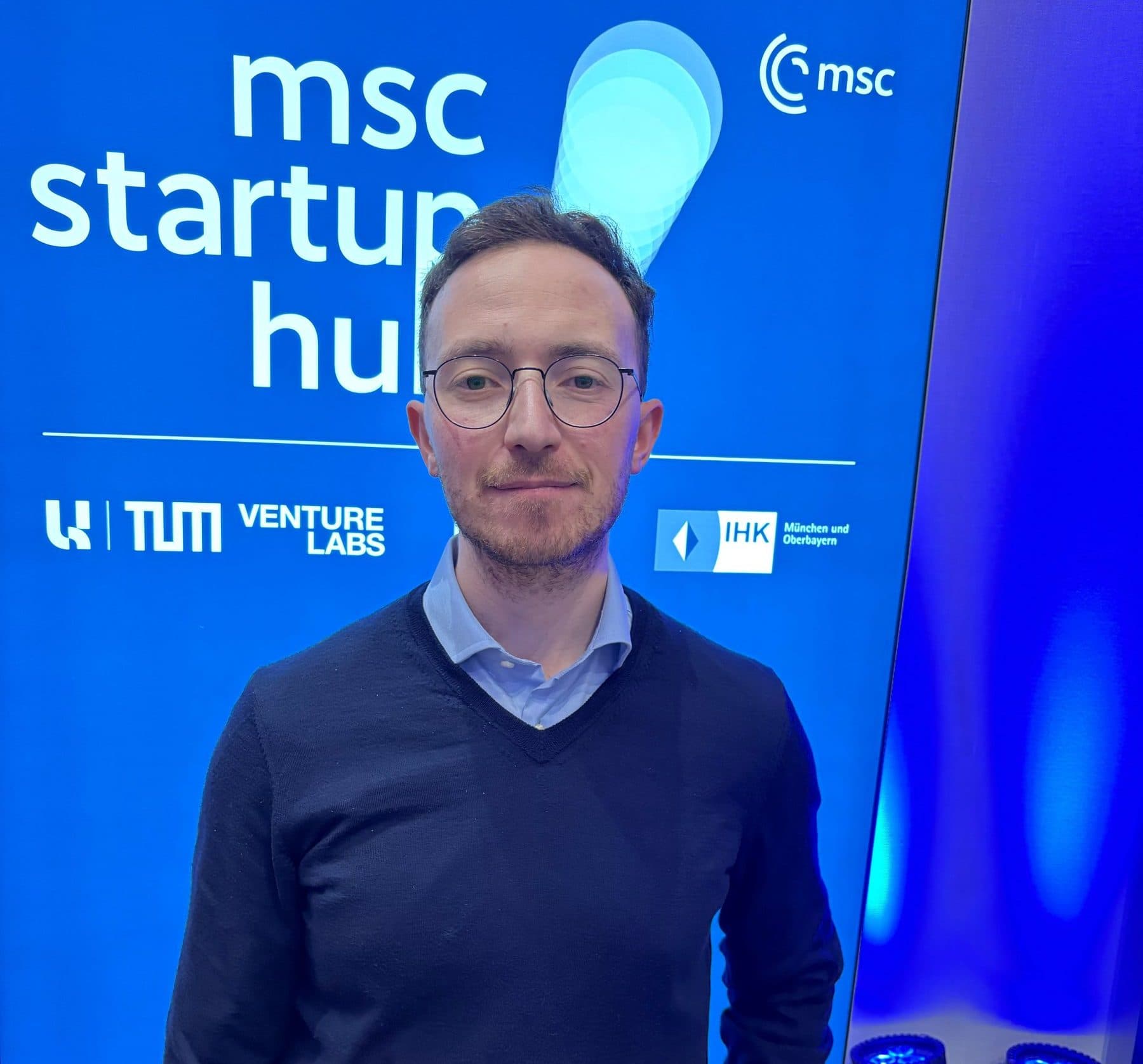
Photo: Munich Startup editor Kyrill Ring and Proxima Fusion CEO Francesco Sciortino at the MSC Startup Hub
Why all this was discussed at the MSC Startup Hub
The MSC Startup Hub brings together founders, investors, industry, and politics in the context of the Münchner Sicherheitskonferenz. The aim is to make security-relevant innovations visible – from dual-use technologies to strategic energy infrastructure. Because energy means security.
A stable, clean, and geopolitically independent energy supply is one of the central security policy issues of our time. Whoever controls tomorrow’s energy shapes geopolitical power dynamics anew. Fusion is therefore not just a climate issue, but a strategic one.
The MSC Startup Hub creates the stage for exactly that: it brings together capital, technology, and political decision-makers on the international stage. Startups like Proxima Fusion are exemplary of a new generation of European deeptech champions that could change not just markets, but geopolitical dynamics.