
Munich Startup: When we last spoke, you wanted to have the first vehicle platforms on the road in customer projects soon. Were you able to achieve this goal?
Felix Poernbacher, Deepdrive: Back then, vehicle platforms were so exciting for us because we had developed a highly innovative, revolutionary electric motor that is so small and compact that it fits inside the wheel. And that enables very flat, scalable, and modular vehicle platforms that we had planned for many of the small new vehicle manufacturers. But as we continued to refine our motor technology, our customers – including many of the major automakers – asked if they could just buy the motor. Suddenly they had enormous interest in our modern technology, which has the potential to truly change the market. That’s why we decided to focus our development work even more on the drive system itself. Now, almost two years later, we’re working with eight of the ten largest automakers in the world and selling our motors to them.
Deepdrive stands by the platform – but is putting it on hold
Munich Startup: What prompted this pivot?
Felix Poernbacher: It has always been our overarching goal to rethink electrification and electric vehicles. That hasn’t fundamentally changed, and our core technology has always been the same. And we still believe in the platform just as much as we did before – there’s huge potential in the market. But for now we’ve put it on hold because the motor technology we’ve developed has such a huge impact on the automotive industry and so much traction that we have to focus on that. We don’t see ourselves as a platform startup, and not as a motor startup either, but as a company that brings highly innovative, revolutionary technologies to market. And our core technology is a new e-drive that our major automotive customers say could become the standard for e-motors over the next ten years.
Munich Startup: How has your technology itself evolved?
Felix Poernbacher: We’ve been able to validate our core technology and demonstrate the three major advantages of our motor technology. First, extremely high efficiency: with our drives, a vehicle can travel 20 percent further or needs 20 percent smaller batteries for the same range. We can produce cost-effectively and simply, and our motor is so compact that it fits inside the vehicle’s wheel. We’ve set up test stands and sold motors to customers who have tested them themselves. Over the past two years, we’ve not only been able to show that what we claim is true and that this technology will work this way, but we’ve also made the first major steps toward series production.
“We will soon raise new capital”
Munich Startup: And how are things looking financially for you?
Felix Poernbacher: We still have sufficient funds from our last funding round, where we raised 4.3 million euros. Additionally, we won 1.5 million euros in funding projects from the Free State of Bavaria. So we’re well funded, but now we have the big problem – which is a good problem – that we need to grow. We have enormous demand and need to scale, especially in our team. This means we will soon raise new capital again because we need to grow faster than originally planned.
But this also presents us with challenges. We have a great location here: a total of 800 square meters with prototype workshop, production line, our own test stands, our own e-labs, and enough office space. But if we build a larger prototype facility in the next phase, it will be extremely tight here. We now have over 30 employees, but we want to grow to around 80, and we’ll have to accommodate them here as well.
Munich Startup: What learnings have you taken away as a founding team so far?
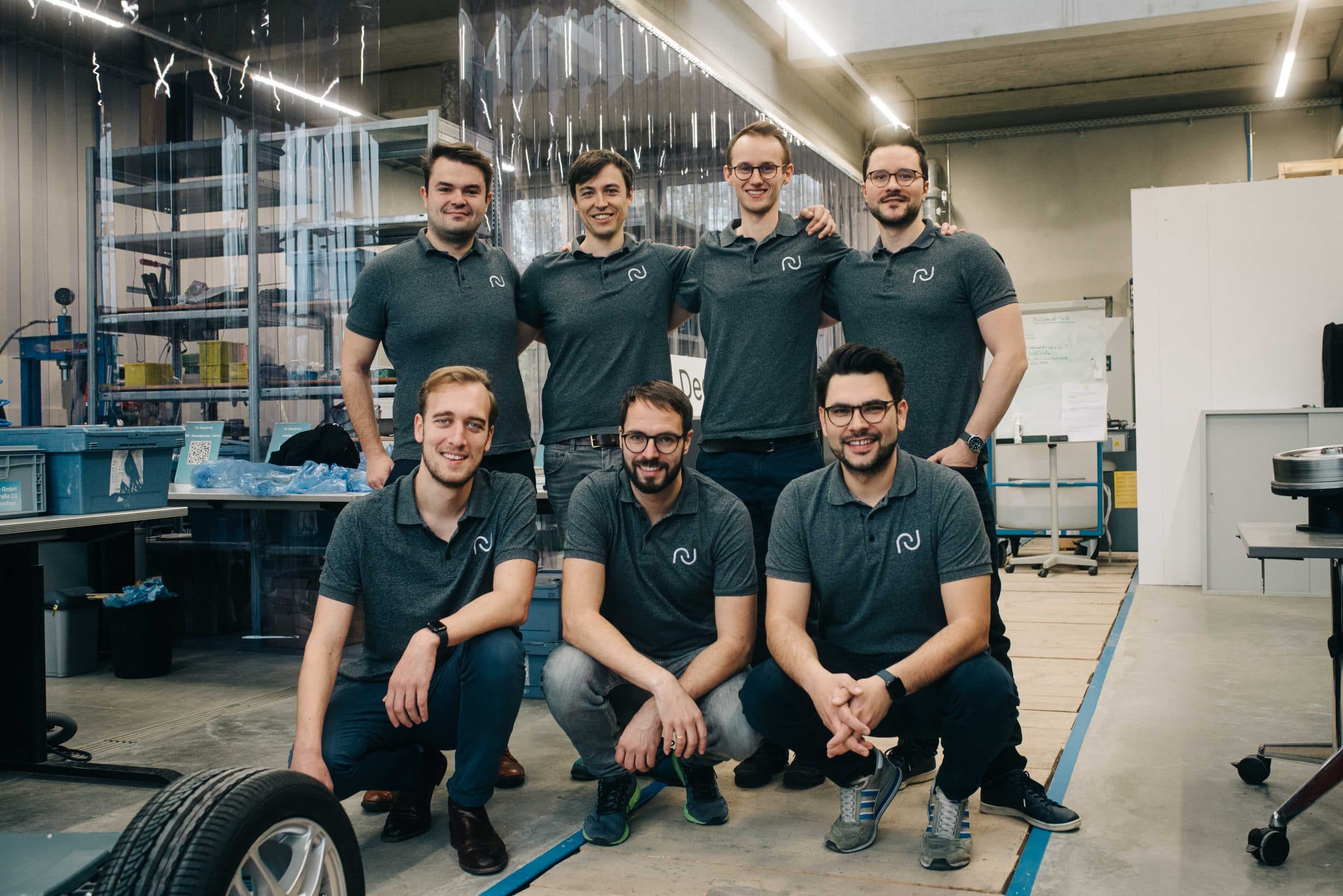
Felix Poernbacher: We are seven founders, and at the beginning everyone told us it wouldn’t work. So our biggest learning was: it does work. What certainly helps us is that we have very clear responsibilities and areas of responsibility, and people can decide relatively autonomously within their areas. And this applies not only to the founding team, but to the entire extended team. It’s important to us that decisions are made as decentrally as possible by the experts in those areas.
“We would always choose to start up in Munich again”
Munich Startup: What role has the Munich ecosystem played in your journey so far?
Felix Poernbacher: The Munich ecosystem has brought us an enormous amount, it was a real kickstart. On the one hand, of course, because many of us come from the TU München and we have a good network. But on the other hand, because the environment is incredibly startup-friendly: the UnternehmerTUM with its very close, strong network and exciting people, many large companies that are very startup-affine, the city offers great support – we would always choose to start up in Munich again.
In the coming years, however, we’ll enter a phase where we, especially as it comes to funding, will look beyond Munich. Because large tickets are simply written outside Germany across the pond. But we will continue to have our home and headquarters in Munich. A large part of our supply chain and many of our partners are based in Bavaria and Germany. In the development phase it’s tremendously important for us to have short distances, and we also want to keep our series production in the region. At the same time, as an automotive supplier, it’s important for us to be as close to the customer as possible. So if we have a German customer, we’ll produce in Germany, and if we have an American customer, we’ll produce at least largely in America.
Deepdrive begins series production
Munich Startup: What milestones is Deepdrive working toward next?
Felix Poernbacher: Our next major milestone is to win a large-scale series contract and sell our motors to major automakers. We’re on a good path here. We’re talking to many customers, have extremely good traction, and have made the first major steps toward industrialization on the technology side. We have a strong partnership with a major manufacturing partner, which we’ll also be able to announce in the coming months. This partner will initially produce the motors in series for us. Additionally, we will build the first test vehicles in 2023. But of course, secrecy is always a very big issue in the automotive industry, which is why we can’t reveal more here.