
The Technology Pioneers are a group of early-stage startups from around the world that develop and implement new technologies and innovations. The World Economic Forum selects 100 companies each year that collaborate with leading representatives from politics, business, and culture to address the challenges facing people and the planet.
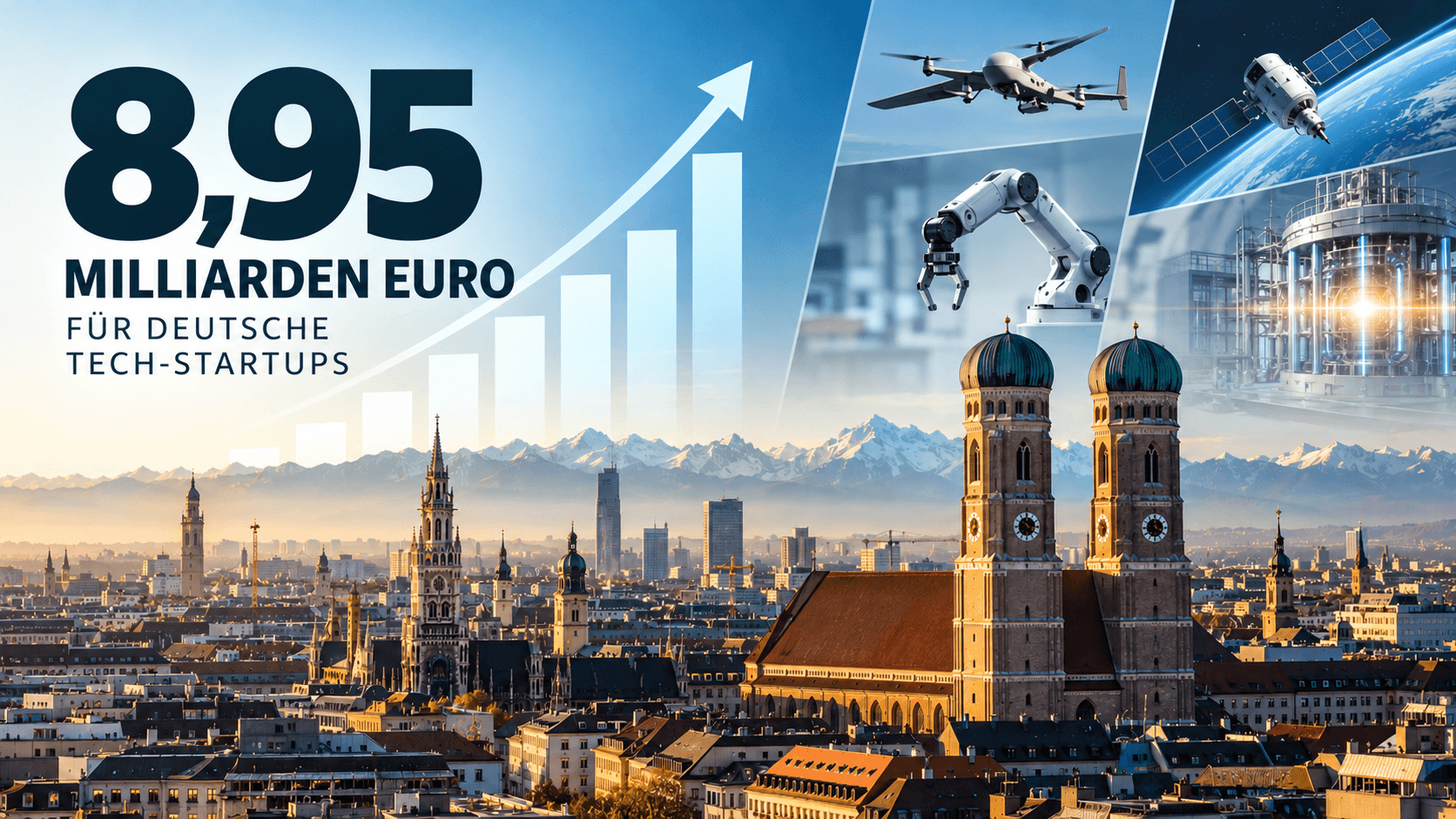
This year, 101 startups are on the list, with 38 of them from the USA. Ten more startups come from China, followed by India with nine and Germany with seven startups. In total, 20 startups are from Europe. The African continent is represented with five companies on the list, and South America with four. Of the seven German startups, four are based in Munich.
The four Munich startups among the Technology Pioneers
Marvel Fusion: The Munich startup is working on a laser-based fusion technology for energy generation. Marvel Fusion’s technology is designed to enable fusion reactions and energy generation to be triggered much more efficiently compared to the current standard. To achieve this, the startup relies on a special nanostructuring of its fuel targets to precisely control the conversion of laser energy into fusion-relevant particles. In this way, less energy would need to be expended than before to heat the fuel plasma to the temperatures required for the fusion process.
Planqc aims to scale quantum computers to thousands of qubits and beyond. To do this, the startup builds its technology on research and technology development from the Munich Max Planck Institute for Quantum Optics (MPQ). At its core is the optical lattice technology developed in the state capital. With it, thousands of atoms can be trapped in a crystal of light formed by a single laser beam. The quantum information is stored in electronic states of strontium atoms. In this combination of quantum technologies, Planqc sees the potential to scale fastest to thousands of qubits with superior gate fidelity, a prerequisite for industrially relevant quantum advantage.
With Proxima Fusion, a second Munich fusion startup makes the list. The spin-off from the Max Planck Institute for Plasma Physics (IPP) pursues the magnetic-based fusion approach and works on the principle of optimized quasi-isodynamic (QI) stellarators and high-temperature superconductors. The startup utilizes the results of the Wendelstein 7-X (W7-X) experiment, the world’s largest stellarator at the Max Planck Institute for Plasma Physics.
Unio Enterprise was founded in 2022 as a joint venture of Isar Aerospace, Reflex Aerospace, Mynaric, and Ses. The goal of the Munich startup is to build Europe’s first sovereign, commercial satellite constellation for fast, powerful, and secure connectivity. The focus of the spacetech company is on the mobility and logistics sector. Other potential application areas could include direct communication between companies (B2B) or between companies and public administrations (B2G).