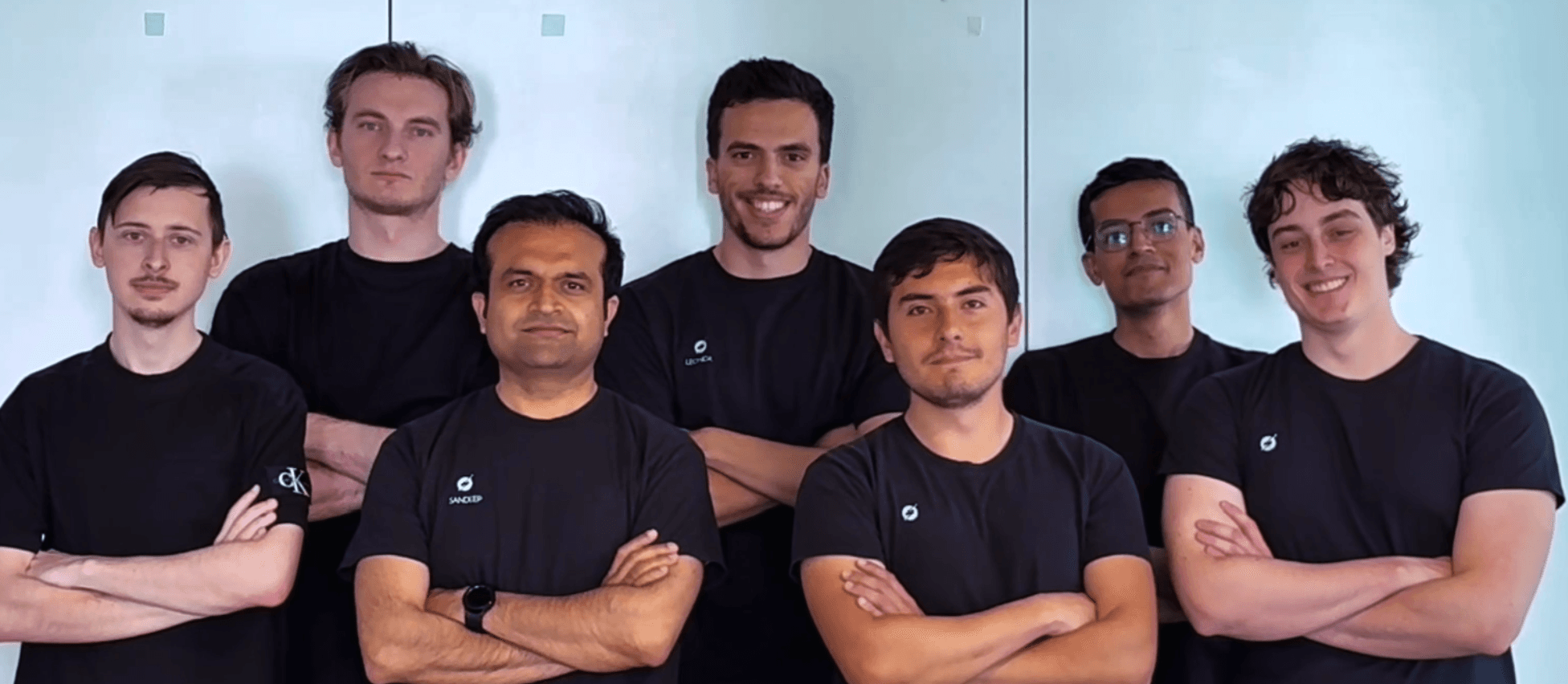

Munich-based startup Dcubed develops deployable structures for satellites that fully expand only in space, enabling significantly larger solar arrays and antennas. Founder and CEO Thomas Sinn announced at the Munich Space Summit 2026 in an interview with Munich Startup his own demonstration mission with a 15-meter solar array and in-space manufacturing technology, as you can see in the video below.
Origami meets space exploration: Why Dcubed sets new standards
What distinguishes Dcubed from classic aerospace suppliers is its consistent focus on structures designed not for rocket launches, but for optimal performance in space. Inspiration comes not only from engineering science, but also from nature and origami.
“I thought: Why don’t I look at nature? Because nature has already invested billions in optimization over time, and then it was the combination of origami and what you see in biology, like how leaves unfold, how a dragonfly deploys its wings,”
says Thomas Sinn in conversation at the Munich Space Summit.
While rockets offer only limited space, the demand for large structures in orbit is rising rapidly. Dcubed uses foldable designs and new manufacturing methods to resolve this conflict.
The company emerged from Sinn’s research on deployable structures during his doctoral work, as well as from practical experience in the aerospace industry – including a mission where key components were simply unavailable on the market.
Growing energy demand in space drives development forward
The relevance of such technologies is increasing significantly. New applications in space are changing requirements for satellites:
- Communication constellations require more power
- Space-based data centers are emerging
- Orbital applications are scaling toward kilowatts and megawatts
“There are many communication constellations that don’t just need a few hundred watts, but kilowatts or megawatts, and you can’t launch all of that. So you really have to fold it and then unfold it once you’re in space,”
Sinn told Munich Startup.
In-space manufacturing: Production shifts to orbit
A central technological approach by Dcubed is manufacturing directly in space. A kind of “3D printing” is used, where UV-hardening resin is applied to previously deployed structures and then hardened by sunlight. In this way, particularly large and extremely lightweight structures can be achieved. The decisive advantage here is that components no longer need to be fully designed for the enormous stresses of a rocket launch, since part of the structure is created in orbit.
Off-the-shelf space hardware
Another core problem in the aerospace industry is the limited availability of standardized components. Dcubed deliberately adopts a platform approach in which products are no longer developed individually for each mission, but are available as standardized solutions. These can be produced scalably and sourced easily by customers – eventually even directly online. In this way, the startup transfers established principles from other industries to aerospace and creates the foundation for faster development cycles and more efficient supply chains.
The trigger was a concrete experience: a crucial release mechanism was missing for a mission – despite tight timelines.
“I couldn’t believe that such a release mechanism wasn’t available anywhere,”
Sinn says.
This approach makes it possible to reduce costs while increasing quality. High production volumes significantly lower manufacturing costs, while repeated qualification of standardized products increases reliability. At the same time, many individual development cycles that previously slowed down and made every mission more expensive are eliminated. Overall, this leads to more efficient processes in aerospace.
The aerospace industry has traditionally been conservative and is dominated by large, state-influenced actors. But with SpaceX’s market entry, the dynamics have fundamentally changed: commercial business models in space are now reality, which has sparked a wave of new aerospace companies – also in Europe. These so-called new-space players drive innovation forward. They are also open to new technologies to secure competitive advantages. For Dcubed, this opens precisely the market access: initially through agile, innovation-driven companies and increasingly through established corporations, once initial deployments and flight experience have created the necessary foundation of trust.
Technical risk: When nothing deploys
One of the greatest risks in aerospace remains the failed deployment of structures, particularly solar panels, as failure in this area often renders the entire satellite non-functional. Dcubed addresses this challenge with redundant systems, thermal backup mechanisms, and close collaboration with customers already in the design process. This makes it possible to minimize potential sources of error early on. At the same time, even extensive ground tests – such as under vibration, vacuum, or temperature conditions – have their limits, as they can only partially represent the real conditions in space.