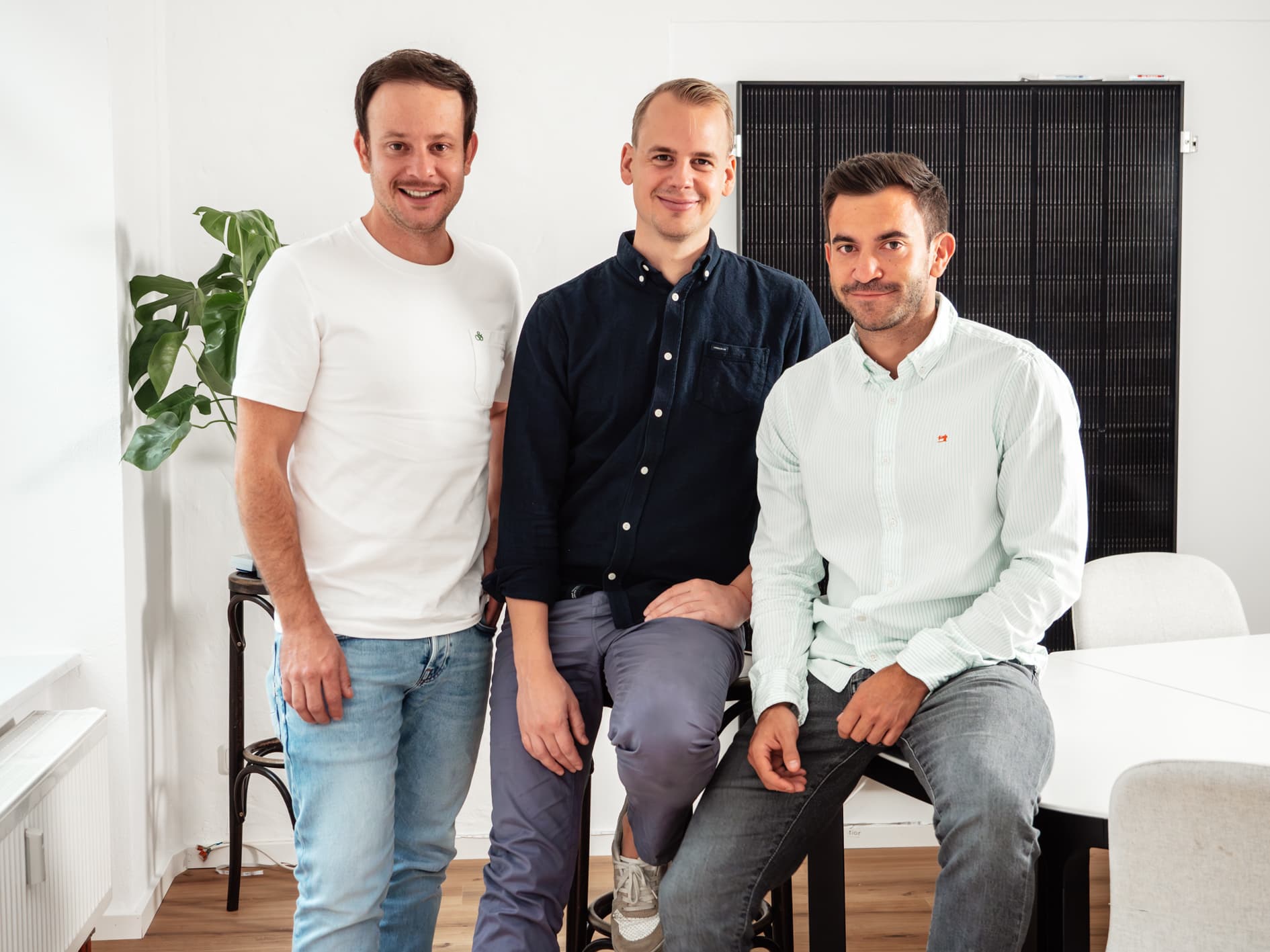

Munich Startup: Solation enables tenants to get electricity directly from their own roof – how exactly does that work?
Sebastian Hugl, Solation: A good example is our current installation in Munich’s city center. A traditional family business with several rental properties commissioned us to provide their tenants with affordable solar electricity. For this, we use Solation Energy. The electricity produced on the building’s roof can be used directly by the residents. Each tenant automatically has the app and can see in real time how much locally produced energy they are currently using. The residents have one more reason to be happy about the high number of sunshine hours in Munich, because it means cheaper green electricity for them.
The landlords don’t have to deal with the issue; instead, they receive the values for the electricity billing at the end of the year. This is handled through the operating cost statement and integrated into that process. Through the sale of electricity to their landlords, the installation gradually pays for itself. A win-win for both sides.
Munich Startup: This way, you can also give tenant electricity a social component – for example for subsidized housing, or so-called social housing. Are you already seeing interest from providers here? Are you approaching them directly?
Sebastian Hugl: Yes, we’re already seeing initial interest from social organizations and are in talks about first projects in this area. I’m incredibly pleased that we’re on track to make green electricity available to financially disadvantaged populations and thus counter the trend in renewable energy.
That’s why tenant electricity makes so much sense: financially weaker individuals can become more independent from large energy companies and save money in the process.
“For families, retirees, or students with limited financial means, this makes a huge difference”
In Germany, an average of eight percent of a household’s income goes to energy and electricity costs. With 3,500 kWh of annual electricity consumption, a household without solar electricity pays approximately 1,141 euros. With Solation Energy, costs could drop to 770 to 875 euros. Particularly for families, retirees, or students with limited financial means, this makes a huge difference. I can still remember well how important it was in our student apartment to keep operating costs low.
Munich Startup: Do you see other ways to create social impact?
Sebastian Hugl: Yes, we see several approaches and have been researching for a while how we can make electricity donatable. Technically, it’s simple, but regulatorily it’s super complicated – tax law meets energy law. All very fun topics.
Currently, the biggest social lever is that with our business model we can provide tenants with electricity that’s up to 30 percent cheaper in the long term while landlords still achieve a good return. This is thus one of the rare situations where there’s a real intersection of ecology, economics, and social benefit. At the end of the day, money has to be made with it, otherwise nothing moves and the impact will always remain limited.
Munich Startup: What prompted you to take this path?
Sebastian Hugl: Our drive is to make green electricity possible for everyone – including tenants. We’ve set ourselves the ambitious goal of supplying one million tenants in Germany with locally produced green electricity by 2030. The emissions saved would be equivalent to approximately those from 400,000 cars!
The supply of electricity from landlords to tenants has only been possible since the passage of Solar Package 1, without landlords having to act as energy suppliers. The new legislation makes it much simpler.
Solation puts its employees at the center
Munich Startup: And how does that look at Solation itself?
Sebastian Hugl: Basically, with Solation we pursue a management approach that puts our employees at the center. I believe: companies exist for people, not the other way around. That’s why we’ve introduced several measures at Solation to make us a healthy and fair workplace. I’ve already written a lot about this on LinkedIn, which you can read here and are welcome to comment on. But in short: our employees are people and not cogs – and we want to respect that.
Munich Startup: What are your next steps for even more social impact?
Sebastian Hugl: We hope that as pioneers, we can supply a multitude of tenants with green and affordable electricity in the future, so that access is not limited to wealthy homeowners. This helps not only tenants but also the environment.