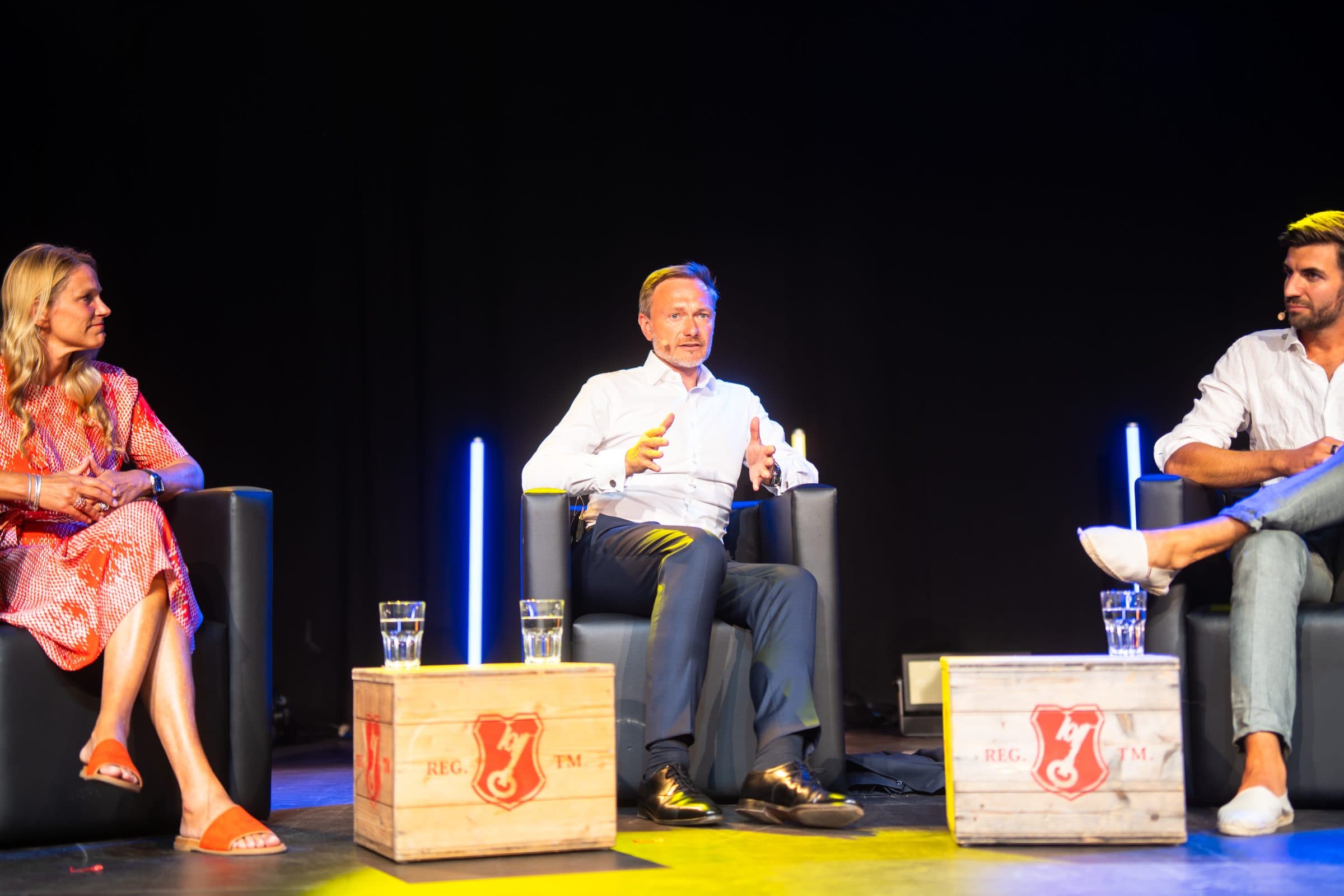

To introduce the discussion about more political support for startups in Germany, Christian Lindner painted a sobering picture. While there are many good founders with top-notch ideas in the country, the framework conditions are not optimal. The VC market is too small and the current economic situation is putting additional pressure on young companies.
However, the Future Financing Act is intended to change this. According to the minister, the law will go to the Bundestag for a vote after the summer recess and is designed to improve financing conditions for startups by, for example, reducing the minimum capital required for an IPO or making it easier for institutional investors to invest in startups. Another important point for Lindner: he wants to abolish the sales tax obligation for fund companies. This is a competitive disadvantage for Germany in international competition, leading fund companies to establish themselves primarily abroad – and then invest there, sometimes even with money from the Federal Republic.
The question of equity pensions
For Hanno Renner, who sat on stage not only as Personio CEO but also as a member of the “Advisory Board of the Young Digital Economy” around Vice Chancellor Robert Habeck and part of the extended board of the German Startup Association, this was an important point. After all, while the Canadian Pension Fund can invest in German startups, German pensions are separated from the capital market. He would like more access here, as Renner said.
A concern the minister could certainly share. However, he pointed out that direct investments are difficult for regulatory reasons. With the Future Fund Germany managed by KfW and the European Tech Champion Initiative, however, there are two funds of funds that make insurers’ money more accessible. For him, it was above all important that more people engage in the capital market.
“Equity pensions are coming,”
said the finance minister.
On a completely different financing gap, Svenja Lassen, Managing Director Germany of startup investor network Gateway Ventures and founder of the Female Investors Network (FIN), weighed in. There are still too few women in the startup ecosystem, both among founders and among investors. She is actively countering this trend. With the FIN Academy, she has launched a 6-week online training program that enables women to start as business angels.
How Christian Lindner wants to support female founders
For Lindner too, it is clear that female founders do not have worse ideas; they are simply implemented less often. He identifies male networks as responsible, networks that already form at universities and ensure that investors are more likely to invest in startups of their former classmates. The minister wants to use the funds mentioned to remedy this. These have “a window exclusively for projects by female founders who don’t make it through the normal capital market route.” There are also binding diversity requirements for the investment committee here.
Digitalization and bureaucratic reduction were two other important topics that Svenja Lassen brought up. Christian Lindner assured her that both topics are one and the same for him – and he is committed to simplifying processes at BaFin, introducing the e-share, equipping the financial administration with digital tools, and more. He also addressed the topic of data protection. He would like to see a paradigm shift here, because the prevailing goal of data minimization hinders the work of AI and algorithms. After all, these require sufficient data to function. Therefore, the finance minister advocated replacing data minimization with anonymization and pseudonymization to make data available. He is also working on this.
The end of the journey: Which exchange does a startup go public on?
Another point the finance minister wanted to discuss was the topic of exits. He views it critically that many startups are potentially founded and grow in Germany, only to eventually go public on exchanges abroad, relocate their headquarters, and ultimately pay taxes there. This happens mainly because Germany does not have enough capital to handle 2- or even 3-digit million rounds.
An analysis that Hanno Renner clearly agreed with, and he also spoke to his own experiences with Personio. For his company too, the topic of an IPO will become interesting in one to three years, and he is already considering where his company might eventually go public. However, he also noted that as a “European patriot,” he would naturally prefer a location in Europe. German solutions for questions such as the implementation of multiple voting rights, SPACs, or direct listings would make his decision easier.