
Munich Startup: What problem do you solve?
Thomas Goldhofer, Co-Founder: Companies often have to calculate packaging volume, weight, and freight costs even when a component only exists as a CAD model. At that stage, it is still unclear how it can be packaged sensibly, what risks exist, and where optimization potential lies. Physical packaging trials are time-consuming and can only take place once the parts are available. 3D-printed parts are often not available in sufficient quantities to run packaging tests either. At the same time, information is scattered across different people, departments, Excel spreadsheets, emails, and various systems. As a result, numerous interfaces and complex coordination efforts arise between development, purchasing, quality, logistics, work preparation, production planning, customers, and suppliers. On top of that, regulatory documentation requirements are on the rise, such as in connection with the EU Packaging and Packaging Waste Regulation (PPWR 2025/40). What is missing is an end-to-end digital process that brings these tasks together efficiently.
Simulate, optimize & compare packaging concepts
Munich Startup: What can only you do as of today?
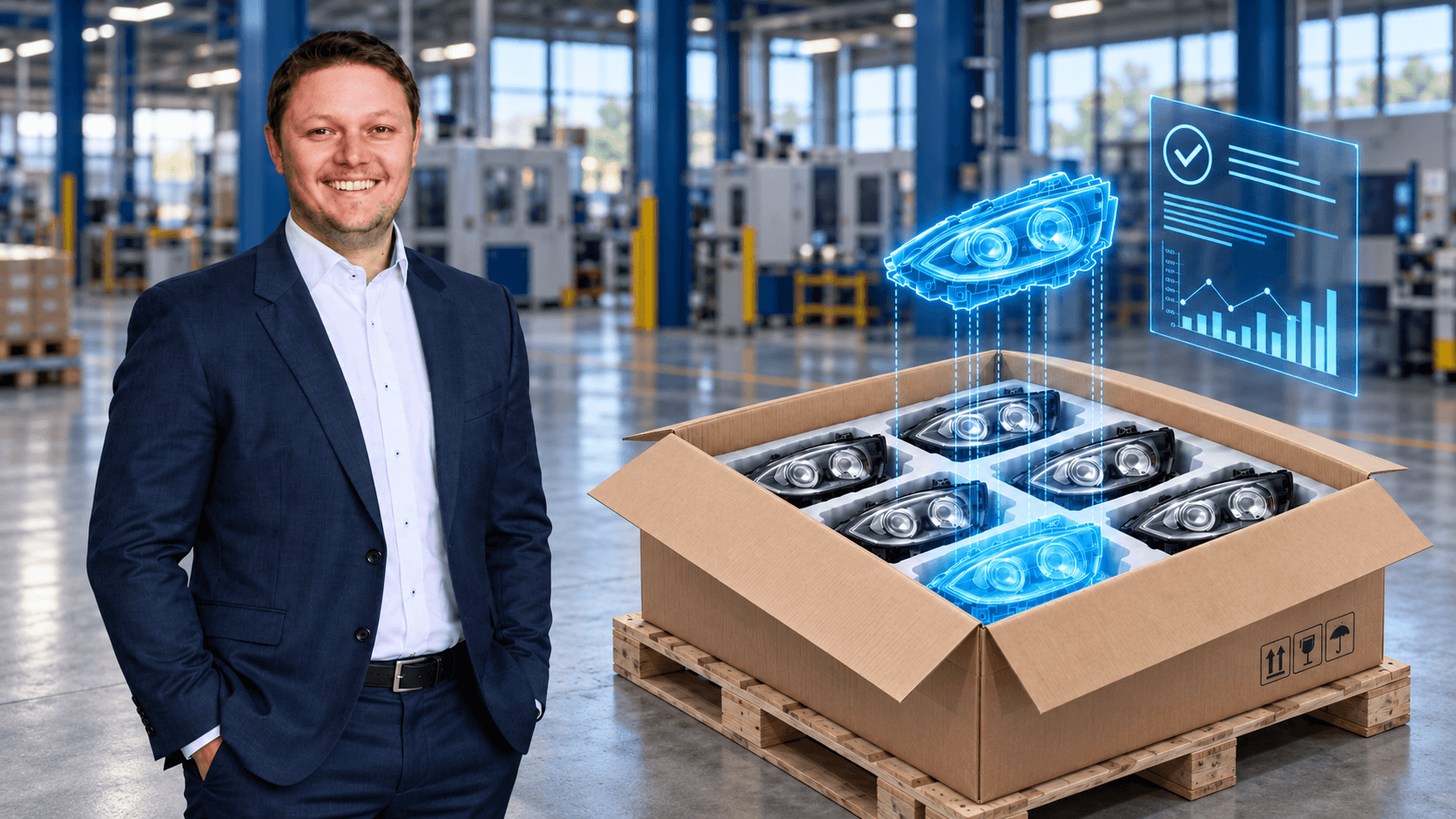
Thomas Goldhofer: For one thing, Pakera enables digital packaging trials based on CAD data before the first physical component even exists. To achieve this, we developed three packing modes that address different requirements:
- Smart Fill calculates how many parts fit into a selected container under specified conditions based on the CAD component geometry.
- Smart Select determines suitable packaging solutions for a specified quantity, taking into account the CAD component geometry as well as other logistical constraints.
- Smart Stack optimizes the arrangement of boxes and containers on pallets or in larger loading units. No CAD data is required for this.
This allows companies to digitally simulate, optimize, and compare packaging concepts, evaluate container utilization, and identify risks as well as potential savings early on. The simulation takes practical specifications into account, such as packaging method, component orientation and stability, as well as component weight, container load capacity, and required intermediate layers.
Building on these simulation results, Pakera can now also be used to calculate packaging and freight costs, and create packing instructions and technical documentation for the PPWR. From 2030, companies will also have to verify the empty space ratio in packaging under the Packaging and Packaging Waste Regulation (PPWR) EU 2025/40—something that is already possible today with Pakera, and for which, to my knowledge, many providers of PPWR software do not yet have a workable solution.
Coordinating and approving packaging concepts with internal and external stakeholders can also be done via Pakera. This creates a transparent, traceable, and globally unique workflow from the initial packaging concept all the way to the approved packing instruction – and all of this starting right from the product development stage.
Each company can decide for itself which of these steps to use. Thanks to the integrated API of our cooperation partner EcoTransIT World, the expected transport emissions can now also be calculated based on the simulation results. This makes emissions a plannable factor as early as product development, allowing companies to factor them into their decision-making.
It was important to us to make onboarding as easy as possible: Pakera runs directly in the browser, requires no installation, and is designed so that users without prior CAD knowledge or extensive training can work with it without any issues. Our experience so far has shown that new users can run their first simulations after just a few minutes.
Reliable Cost Calculation in Just a Few Moments
Munich Startup: What triggered the founding of the company?
Thomas Goldhofer: The idea for Pakera emerged from the daily challenges at Coop Systems. Time and again, we had to calculate packaging and freight costs for components that existed only as CAD data. I wanted to use this data to know early on how the parts could be packaged sensibly and what costs would result from that. With Pakera, we can now estimate freight and storage costs very accurately in just a few moments, offering our customers a reliable cost calculation. For us at Coop, creating the necessary technical documentation for the PPWR and declarations of conformity involves a major effort. With Pakera, that is now also a thing of the past, as PPWR documentation can be generated in just a few minutes with Pakera.
Munich Startup: Was there ever a moment when you thought about giving up?
Thomas Goldhofer: No, we’ve never thought about that. We know that the need exists, and we see that from user feedback and registrations.
There have been isolated solutions for specific individual areas, but a holistic approach has been missing until now, which we now offer with Pakera.
Pakera aims to become the standard solution in packaging planning
Munich Startup: How would you know in a year’s time that you’re on the right track?
Thomas Goldhofer: Our long-term goal is clear: we want to become the “Datev of logistics.” Pakera aims to establish itself as the standard for end-to-end digital packaging planning that hardly any industrial company can get around.
In a year, we would know we’re on the right track if customers have firmly integrated Pakera into their daily workflows and are expanding its use to additional projects, departments, or locations. If customers also bring their suppliers and partners on board, we will take a major step closer to our goal.
Munich Startup: Would you start up in Munich again, and why?
Thomas Goldhofer: Yes, definitely in the Munich region again. As a Munich native, I’m especially pleased to see how much entrepreneurial momentum there is here. For us, the combination of industry, technology, and a strong founder network is particularly valuable. You meet potential customers, find people with technical know-how, and can exchange ideas with other founders. For a company like Pakera, those are very good conditions for growth.
Munich Startup: Bootstrapping or venture capital?
Thomas Goldhofer: Currently, we are bootstrapping Pakera and have no need for external financing. For the future, we could imagine bringing a strategic investor on board at the right time. For us, the key factor would be that they bring industry expertise, a relevant network, and access to new markets alongside capital. If that allows us to accelerate our growth in a targeted way and our visions for Pakera’s development align, that would be a conceivable step.