
Munich Startup: What problem do you solve?
Jens Hoppe, founder of PanelWave: Graphic novels and comics have been read digitally the same way since 2012: the printed page is forced onto the screen as an image, you zoom from panel to panel, the images blur, and the speech bubbles become absurdly large. The alternative pushed by social media—motion comic videos—takes away all control over pacing from the reader.
On top of that comes the business model of the major platforms: Webtoon and others take 30 to 50 percent of revenues, don’t allow exports, and make translations unaffordable—the work is locked in there. And even though Europe has the richest comic tradition in the world, there is no open standard for interactive visual stories. The market is right where e-books were before EPUB.
Munich Startup: What can only you do as of today?
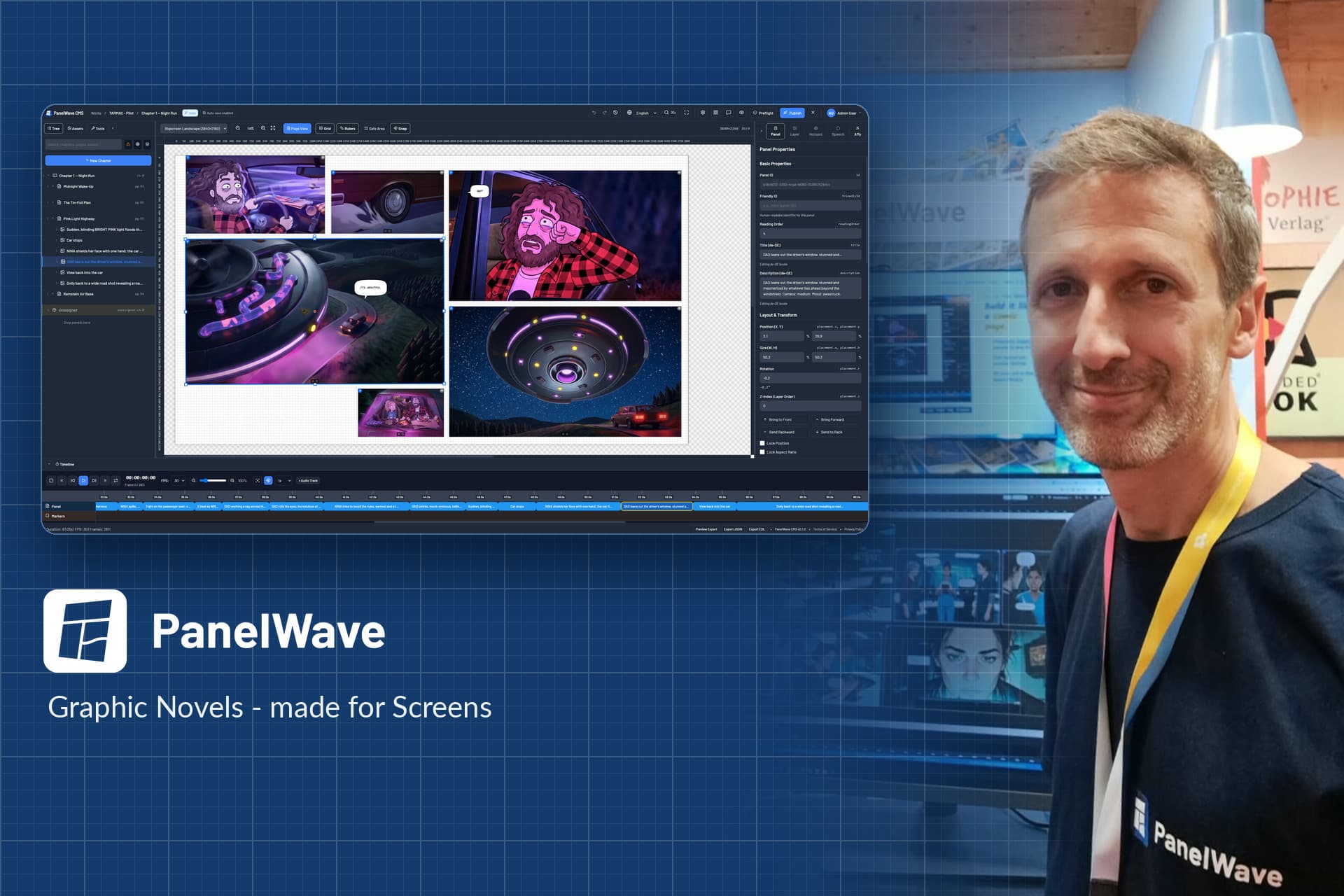
Jens Hoppe: The combination of three layers designed to work together: an open JSON format (CC BY 4.0), an open-source player (MIT license, on npm), and on top of that, the Studio—a specialized CMS for graphic novel and comic writers and illustrators that allows you to work without writing code. Specifically, today only PanelWave can:
Panels can be videos, complete with music and sound effects. Speech bubbles are live text instead of graphics, making them translatable with translation memory and text-to-speech. Panels can be rearranged for any screen size, and a story graph enables choices, detours, and alternate endings. There are panel-level variations controlled by variables—such as a fight scene with different levels of intensity depending on the reader’s age. Accessibility is built in. Plus, export from a single source as a dynamic in-browser work, print-ready PDF, video, and presentation.
The studio also supports the Model Context Protocol: AI agents like Claude or ChatGPT take care of busywork directly in the CMS. Creators keep 100 percent of their revenue and their work, as a file in an open format.
Munich Startup: What sparked the idea for founding the company?
Jens Hoppe: As a teenager, I devoured graphic novels from Europe and the US—first from the municipal library, then later as a collection spanning several bookshelves, including secondary literature like Scott McCloud. At some point, I wanted to produce a series myself. That never happened.
I have several dozen comics in my Kindle account, and on every device they are nothing more than a photographed book page. Digital devices could do so much more. What if panels could be videos? What if speech bubbles were text instead of graphics? What if, as an author, you could rearrange the panels for any screen size? And why does a narrative have to be linear at all?
In the fall of 2025, I sat down and got started. The fact that several clients had to cut costs in 2026 unintentionally gave the developer in me more time to experiment. The result is over 370,000 lines of code, 2,900 commits, a website, and extensive documentation.
Munich Startup: Was there ever a moment when you thought about giving up?
Jens Hoppe: Giving up, no, but there was a harsh reality check. In early 2026, I wanted to apply for EU funding from the Creative Europe program. The consultation with the Creative Europe Desk Munich was candid: without solid partnerships with publishers or the audiovisual industry, such an application has no chance. I dropped the application and decided to finish building the first version on my own dime instead.
And then there are those evenings when a minor change to the format cascades through the schema, player, and CMS all at once, and you wonder whether a single person can handle such an ecosystem. What brought me back every time: the moment a page “breathes” for the first time with motion, rain, and music. That’s when you remember why.
Munich Startup: How would you know in a year’s time that you’re on the right track?
Jens Hoppe: Our most important metric is actively published works. If by spring 2027 the 50 Founding Creators have their first interactive stories online, the PanelWave Anthology Vol. 1 has been published, and readers are paying for it, then we’re on the right track.
On top of that, three things: initial pilot projects with publishers, a successfully funded crowdfunding campaign, and—which would be the ultimate proof—someone building something with the open format that I hadn’t anticipated. A standard only truly becomes one when others use it.
Munich Startup: Would you found a company in Munich again and why?
Jens Hoppe: Yes. PanelWave originated at the Ruffini Creative Hub on Sendlinger Straße, a building housing around 25 creative businesses right in the heart of the old town. It’s home to agencies, designers, and filmmakers whom you can ask for feedback over coffee. With the Comicfestival, Munich hosts one of Germany’s most important comic events, alongside a strong publishing, film, and gaming scene, plus XPLR: MEDIA in Bavaria—a program that brings media innovation from Bavaria to stages like the Frankfurt Book Fair. Without that joint booth, a solo founder wouldn’t have been able to present there for five days.
And on a personal level: I’ve been living here since studying at LMU; my family and network are here. While the major comic publishers might be based elsewhere, the tools for European comics and graphic novels are more than welcome to come from Munich.
Munich Startup: Bootstrapping or venture capital?
Jens Hoppe: Bootstrapped to date, and deliberately so. PanelWave is self-funded with a burn rate that an AI-supported solo founder can sustain. Because there’s no VC-driven team with the corresponding pressure behind it, we can afford to take zero percent revenue share and keep the format and player open. That’s precisely what sets us apart from platforms whose business model relies on taking a cut.
The next steps are community funding—a Startnext campaign—and, in 2027, applying for EU funding from Creative Europe, backed by partners and users.