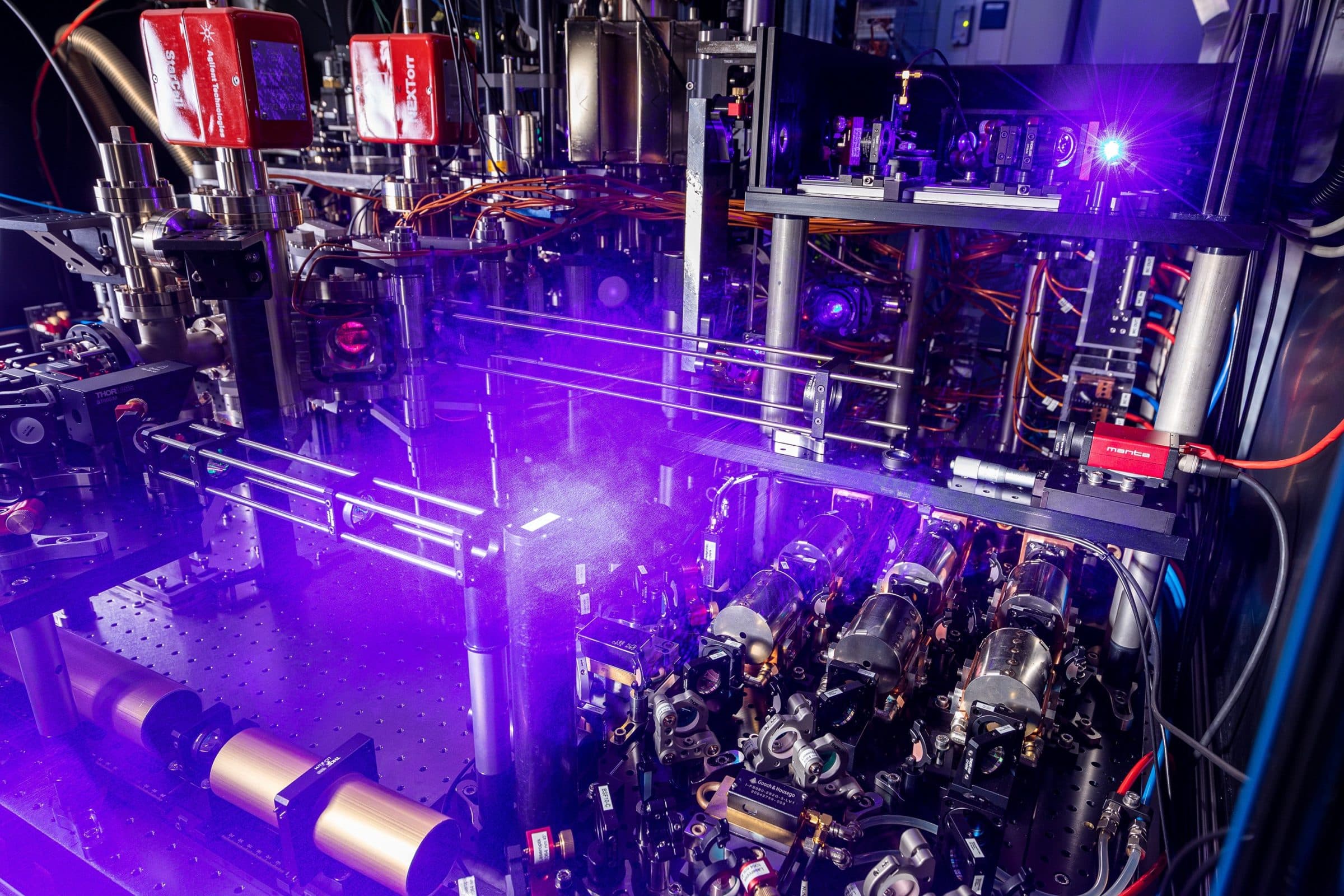

The goal of the new project is to establish a unified platform for managing quantum algorithms and executing them. It is also intended to enable other DLR institutes and external partners to access the DLR quantum computers. The hardware backends are the DLR’s new quantum computers, one of which is provided by Planqc based on neutral atoms. The project is part of the DLR Quantum Computing Initiative (DLR QCI).
Planqc is implementing the new project together with consulting firm D-Fine. Both companies were selected based on their expertise in software programming and their deep understanding of compilation strategies. For D-Fine, this is already the third contract within the DLR QCI. Specifically, they are to integrate quantum compilers into the DLR’s quantum computer architecture to enable efficient and user-friendly access to this advanced technology.
Planqc relies on optical lattices
For Planqc and D-Fine, the project underscores the necessity of close co-design of hardware and software for quantum computing. It is crucial to incorporate hardware metrics and error models into the algorithms and ensure that the hardware supports efficient execution of the algorithms. The DLR project ALQU (Algorithms for Quantum Computer Development in Hardware-Software Codesign) aims to close this gap by focusing on efficient compilation for quantum computers.
Martin Kiffner, Head of Algorithms at Planqc, explains via LinkedIn:
“We are delighted to be able to support the German Aerospace Center in developing compiler software for quantum computers. Together with D-Fine, we will join the ALQU project to build a bridge between hardware and software.”
Planqc bases its technology on research and technology development from the Munich Max Planck Institute for Quantum Optics (MPQ). At its core is the optical lattice technology developed in the state capital. With it, thousands of atoms can be trapped in a crystal made of light, formed by a single laser beam. The quantum information is stored in electronic states of strontium atoms. In this combination of quantum technologies, Planqc sees the potential to scale fastest to thousands of qubits with superior gate fidelity, a prerequisite for industry-relevant quantum advantage.