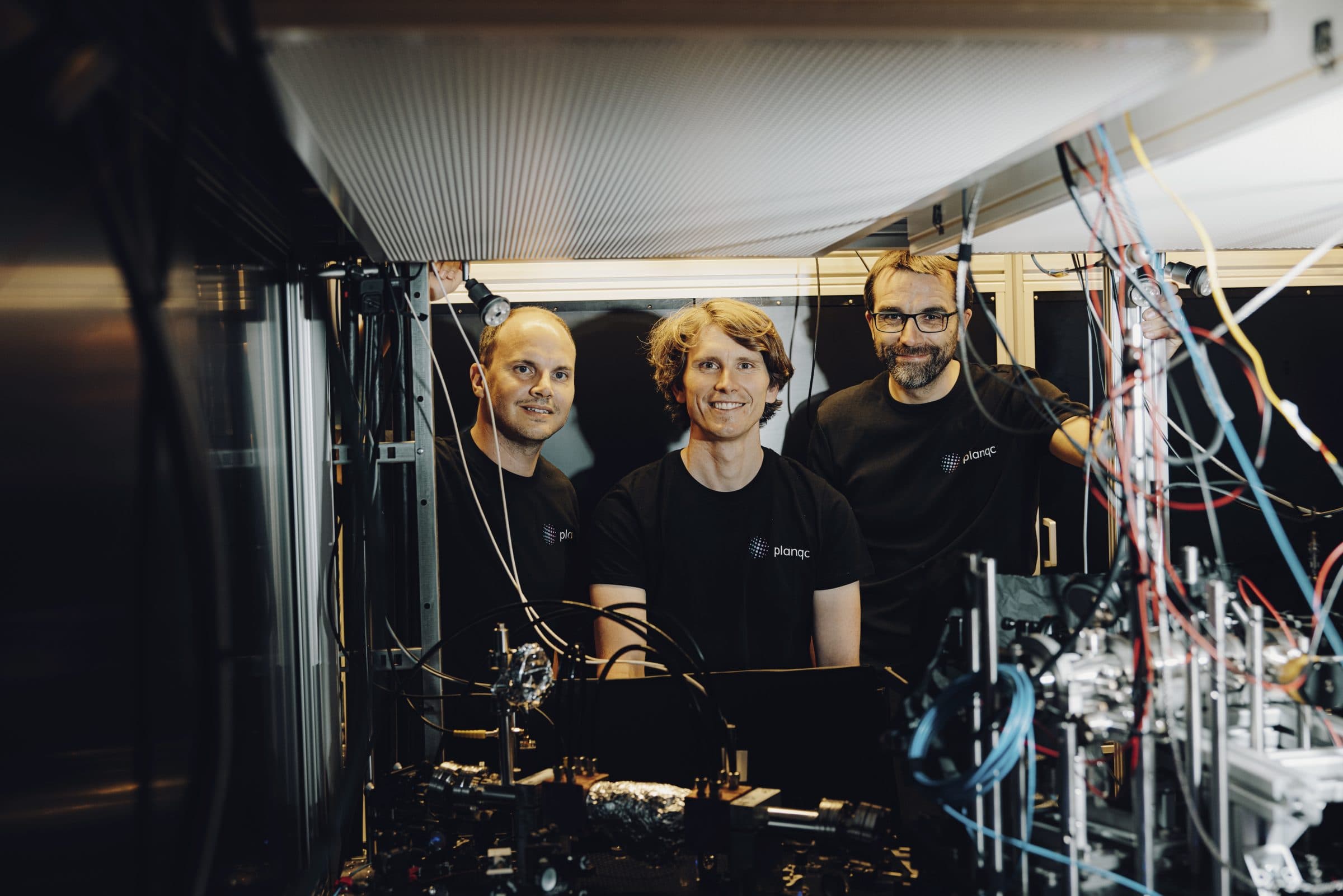

Planqc builds quantum computers and stores quantum information in individual atoms. The technology of the Munich startup is based on award-winning research from the Max Planck Institute for Quantum Optics (MPQ). Planqc aims for rapid progress in developing industry-ready quantum computers and has already demonstrated, in collaboration with the MPQ, scaling the number of neutral atoms used as qubits to 1,200. Further scaling to 10,000 or even 100,000 qubits is expected in the coming years.
Sebastian Blatt, CTO of Planqc, explains:
“Unlike most other companies, including Big Tech, we use individual atoms – trapped in crystals of light – as qubits. This approach enables rapid scaling of the qubit count and improvement of their quality, which is the prerequisite for being the first company to deliver fault-tolerant quantum computers.”
€50 million for the development of quantum software
Planqc has now raised €50 million in its Series A funding round. The investment is led by European family office Catron Holding and the DeepTech & Climate Fund (DTCF). Additional financial support comes from Bayern Kapital, the Max Planck Foundation, and other private investors. Existing investors UVC Partners and Speedinvest are also participating in the round. There is also a grant from the German Federal Ministry of Education and Research (BMBF).
Alexander Glätzle, CEO and co-founder of Planqc, says:
“This latest funding round represents an important validation of our technology as a leading platform for quantum applications. The substantial support enables us to successfully position our ‘Made in Germany’ quantum computers in competition and tap into an emerging market with a volume of several billion euros.”
The startup plans to use the new funds primarily to build a quantum computing cloud service and develop quantum software for applications in industries such as chemistry, pharmaceuticals, climate technology, automotive, and finance. Today, Planqc already uses quantum machine learning to work on climate simulations and more efficient batteries for electric vehicles.
Planqc is “a pioneer in the quantum computing sector, both in Europe and globally”
Torsten Löffler, Investment Director at DTCF, comments on the investment:
“We are pleased to invest in a startup that is not only leading in highly effective technology but also enables further breakthroughs in the most pressing global computing challenges across various industries by providing access to this technology in the form of a quantum cloud computing service. Planqc’s impressive success in securing contracts – particularly the DLR tender – and public funding within just 18 months of founding underscores the company’s role as a pioneer in the quantum computing sector, both in Europe and globally.”
And Immanuel Bloch, Director at the Max Planck Institute for Quantum Optics, adds:
“At MPQ, we have a strong tradition of supporting spinoffs from our institute and translating basic research into industry. Planqc is the latest example and is based on our expertise in trapping, cooling, and manipulating cold atoms and molecules. We look forward to expanding this collaboration in the future.”
Monika Steger, Managing Director of Bayern Kapital, is also enthusiastic about Planqc’s technology:
“Quantum computers can provide immense added value by facilitating or even enabling the discovery, exploration, and development of other future technologies. Examples include new medicines, sustainable battery technology, and climate simulations. Planqc’s promising technological approach combined with the existing technological maturity convinced us.”