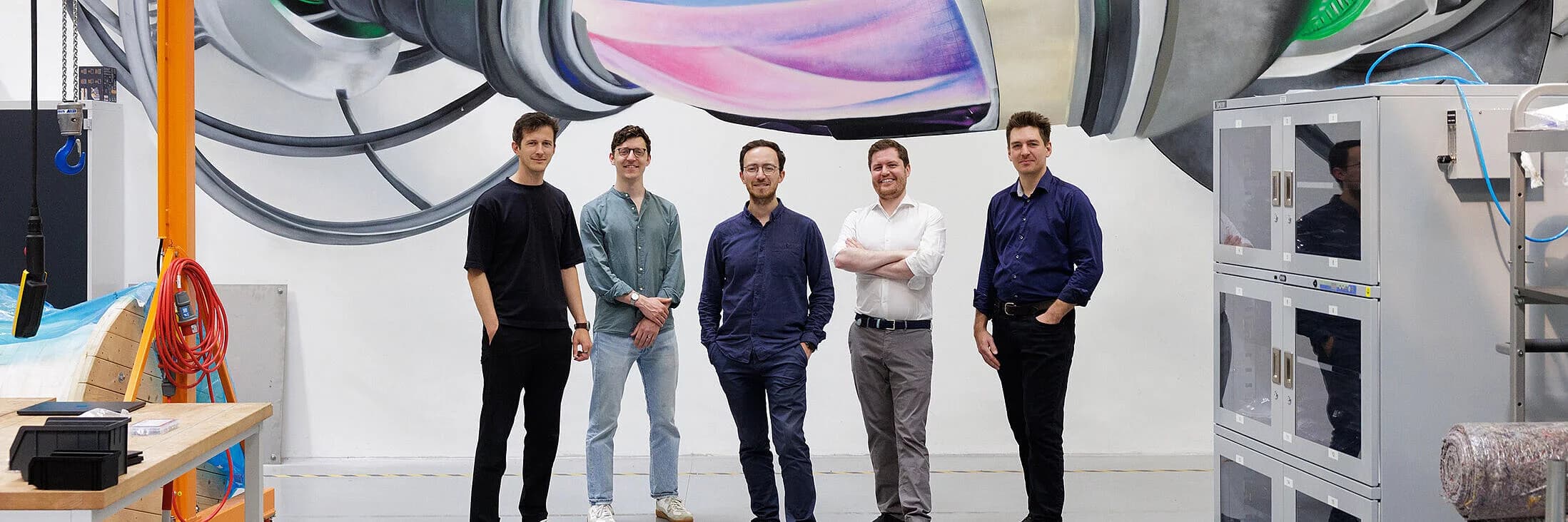

On September 8, Proxima Fusion won the German Founder Award 2026. The Munich startup prevailed over the other two nominees in the “Startup” category, AdaptX Systems from Berlin and Flybaby from Berlin.
This makes Proxima Fusion one of Germany’s most prominent deep tech companies just over three years after its founding. The company, which spun out of the Max Planck Institute for Plasma Physics, develops fusion power plants based on stellarator technology. The goal is to turn decades of basic research into a carbon-free, baseload-capable energy source.
Proxima Fusion bets on stellarators for nuclear fusion
This technological approach represents a key differentiator compared to many other companies in the international fusion market, as Proxima focuses on stellarators. In this approach, extremely hot plasma is confined using complex-shaped magnetic fields.
Proxima is building on research surrounding the IPP’s Wendelstein 7-X stellarator. Using computer simulations, new engineering methods, and high-temperature superconductors, the startup aims to advance the technology toward a commercial power plant.
411 million euros turn Proxima into a European fusion heavyweight
The Founder Award comes at a time of rapid growth. In July 2026, Proxima Fusion announced a 411 million euro financing round. According to the company, this brought its valuation to 2.4 billion euros. Strategic investors in the round include Google and energy group RWE, with XTX Ventures and East X Ventures co-leading the round.
Back in 2025, Proxima had closed a Series A financing round initially totaling 130 million euros. An extension of the round in September 2025 brought the total private and public funding raised up to that point to 200 million euros.
This makes the Munich-based startup one of the most well-funded European players in the international race for commercial nuclear fusion. According to the company, the financing round in July 2026 was the largest private investment in a European fusion company to date.
Alpha to Pave the Way for a Fusion Power Plant in Garching
Proxima is currently planning the Alpha demonstration stellarator in Garching. The facility is intended to validate key technologies for a future commercial power plant.
To achieve this, Proxima has established an industrial alliance comprising more than 30 companies. Together with the Max Planck Institute for Plasma Physics, the aim is, among other things, to demonstrate that the required components, materials, and systems for stellarator power plants can be produced on an industrial scale.
The long-term plan extends even further: In February 2026, Proxima Fusion, the Free State of Bavaria, RWE, and the IPP agreed to collaborate on the development of a commercial stellarator fusion power plant. While Alpha is initially set to be built in Garching, the Gundremmingen site is planned for the subsequent power plant project, Stellaris.
This could pave the way for an industrial value chain for fusion energy to emerge around Munich and other locations in Bavaria. However, whether and when electricity from a commercial fusion power plant will actually flow into the grid depends on substantial technological, regulatory, and economic progress.
German Founder Award: Garching-based DeepDrive also wins
Proxima is not the only company from the Munich ecosystem to be honored at the German Founder Award 2026. In the “Rising Star” category, DeepDrive from Garching took the win. The company is developing a dual-rotor technology for electric motors designed to reduce material requirements and make electric powertrains more efficient and cost-effective.
Dirk Roßmann won the Lifetime Achievement Award. OHB entrepreneur Christa Fuchs received a special award, while in the student category, the team “IceGreen” from Würselen prevailed with an alternative to conventional road salt.
The German Founder Award (Deutscher Gründerpreis) is supported by the Sparkassen, ZDF, Porsche, and the Frankfurter Allgemeine Zeitung, and was presented this year for the 24th time.