
In a pre-seed round, 4 million euros flow to Munich-based startup Sitegeist. The financing is intended to accelerate the further development of the technology and the deployment of automated systems under real-world conditions.
The round is led by b2venture and Open Ocean. Other investors include Alexander Schwörer and Mario Wettengel as well as angel investors Verena Pausder, Lea-Sophie Cramer, Andreas Kupke, Sven Degener, Inga vom Holtz and Paolo Oppelt.
Concrete repair with AI and robotics
Sitegeist develops automated, AI-powered robots for concrete repair. With this, the startup addresses an area of infrastructure maintenance that, according to the company, suffers from capacity constraints. In Germany, according to KfW, the backlog of infrastructure repairs amounts to a three-digit billion-euro figure in 2025. At the same time, there is a shortage of qualified workers, particularly for physically demanding tasks such as concrete repair.
Lena-Marie Pätzmann, co-founder and CEO of Sitegeist, says:
“Infrastructure maintenance is reaching its limits, particularly when it comes to concrete repair.”
Damaged concrete is still removed using manual processes that are difficult to scale, according to Pätzmann. Sitegeist develops specialized, modular robots for this purpose that can work directly on existing structures.
Unlike classical automation solutions, Sitegeist’s systems do not require pre-created 3D models or standardized construction site conditions. According to the company, the robots independently perceive their environment and adapt their control to different geometries and material conditions. The goal is to precisely remove damaged concrete without damaging the underlying steel reinforcement.
Collaboration with construction companies
According to the startup, Sitegeist works directly with concrete renovation companies. The modular platform is expected to be expanded to cover additional steps in the renovation value chain. With the current financing, the Munich-based startup wants to acquire additional test sites, involve co-development partners and hire new employees.
Florian Schweitzer, partner at b2venture, describes manual concrete removal as “extremely tedious,” which is why the use of robotics is predestined for it.
Sam Hields, partner at OpenOcean, points to the skilled labor shortage in the construction industry and sees automation as an approach to make infrastructure projects more efficient in the future:
“This is exactly the kind of task we want to automate with AI: a manual, expensive process with low availability of skilled workers. Given an aging population and a skilled labor shortage in physical industries like construction, robotics will help us reshape our infrastructure for the future (…)”
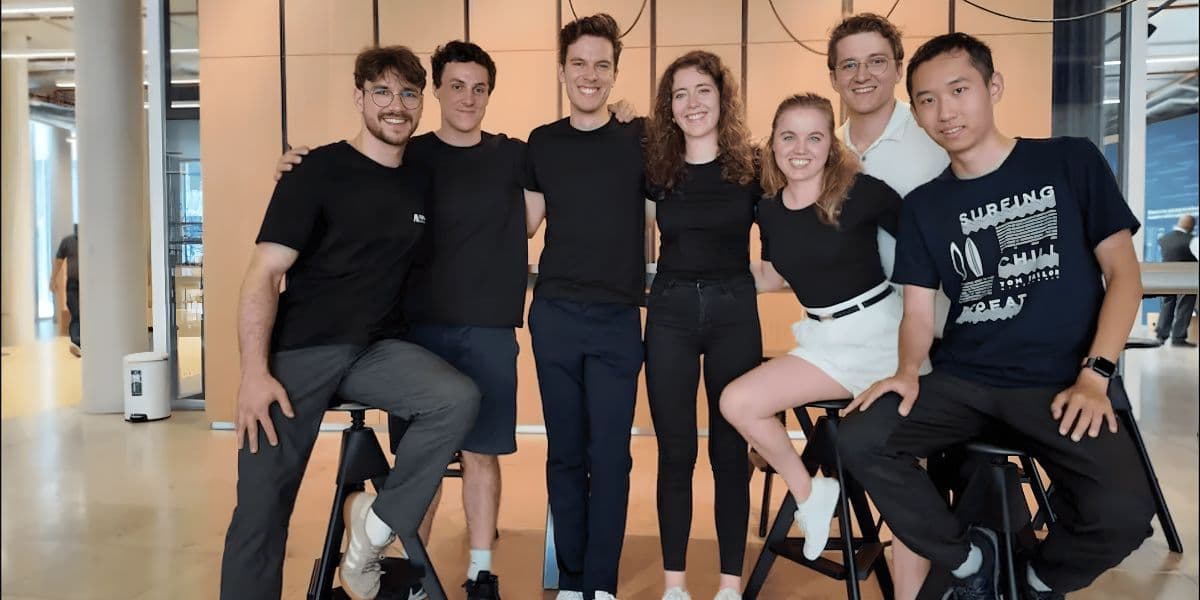
Sitegeist is a spin-off from the Technical University of Munich. The company emerged from a robotics research environment under the direction of Prof. Matthias Althoff and won the Munich Startup Special Prize in 2025, among other awards. Sitegeist was founded by Dr. Lena-Marie Pätzmann from the University of St. Gallen as well as Claus Carste, Julian Hoffmann and Nicola Kolb. The founders met during their studies at the Technical University of Munich and in the Munich startup ecosystem.
With the pre-seed financing, Sitegeist now wants to take the next development step and further validate its technology under real-world conditions. In the long term, the Munich-based startup aims to establish its robot platform broadly in infrastructure maintenance and to develop additional applications in the field of automated concrete repair.