It was meant to be an electric car for everyone. Affordable, featuring solar cells integrated into the bodywork, and the ability to use self-generated electricity for other applications. With this concept, Munich-based Sono Motors captured international attention. Thousands of people reserved the Sion, investors poured millions into the company, and in 2021, an IPO in the US followed.
Yet the solar car never entered series production. In February 2023, Sono Motors halted development of the Sion. A few months later, the company filed for protective shield proceedings. Following a restructuring, Sono Motors attempted to pivot as a solar technology supplier. This fresh start also ended in insolvency in 2026.
Three Founders Want to Transform the Automotive Industry
The story of Sono Motors begins in a garage. Laurin Hahn, Jona Christians, and Navina Pernsteiner work on the idea of an electric car that can generate part of its own energy. In 2016, they found Sono Motors in Munich.
Their planned vehicle is called Sion. Solar cells integrated into the body are designed to provide additional charge to the battery. In addition, the concept envisions bidirectional charging and sharing features. As a result, the Sion is intended not only to be an electric car, but also able to supply power to external devices.
In 2017, Sono Motors presents its first drivable prototypes. The founders rely on community involvement early on. Interested buyers can reserve the Sion and support further development with down payments.
The concept attracts attention. By May 2019, Sono Motors already reports 10,000 reservations, but financing the planned series production remains a challenge.
53 Million Euros from the Community Save the Sion
At the end of 2019, Sono Motors finds itself in a difficult situation. The company breaks off talks with potential investors and launches a major community funding campaign instead. The goal is 50 million euros.
In an announcement in December 2019, Sono Motors explains that its long-term corporate strategy could not be reconciled with the interests of potential traditional financial investors. The founders therefore want to involve their supporters once again.
Initially, the funding target is missed. Sono Motors extends the campaign until January 20, 2020. In the end, the company reports commitments totaling 53.3 million euros. According to the company, around 75 percent came from Sion reservation holders, 19 percent from existing and new investors, and six percent from loans and donations.
Another financing round of 45 million euros follows in December 2020, with participation from Swedbank Robur and DNCA Invest, among others.
Things continue for the founders. But the planned start of production is pushed back. The Sion was originally slated to hit the market as early as 2019. Later, Sono Motors names 2021 first and ultimately 2024 as the target date for the first production vehicles.
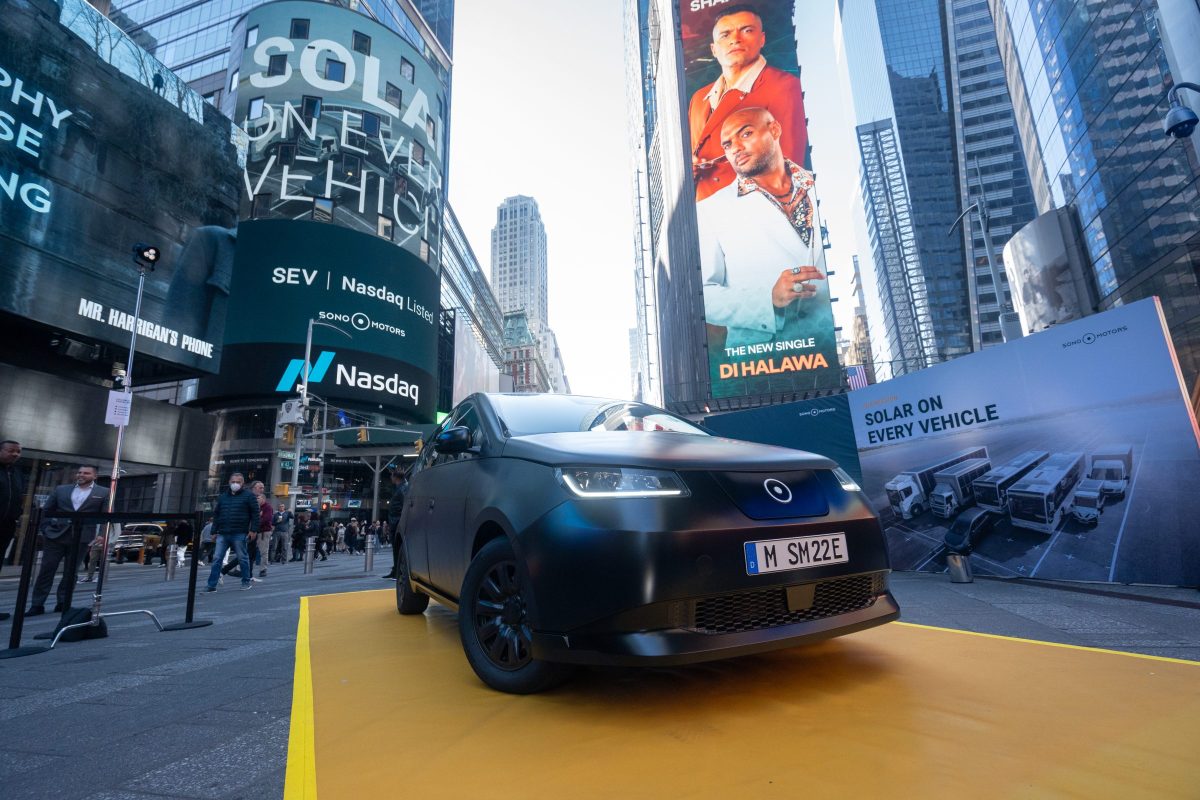
The IPO: Sono Motors raises 156 million dollars
On November 17, 2021, Sono Motors reaches an important milestone. The Dutch parent company Sono Group N.V. goes public on the US tech exchange Nasdaq.
The IPO attracted major attention. On the first day of trading, the share price briefly climbed well above the issue price of $15. At times, the market capitalization surpassed $2 billion. According to the 2021 annual report, Sono Motors took in roughly $156.1 million through the IPO after deducting issuance costs.
In the same annual report, the company put its expected financing needs for the period from January 2022 to the second half of 2023 at at least €440 million. The funds were intended to go toward further development, the launch of series production, and ongoing operational costs, among other things.
While the IPO was a major financing success, it did not cover the full capital requirements projected by Sono Motors.
Why did Sono Motors fail despite the IPO?
In December 2022, founders Laurin Hahn and Jona Christians went public with the financing issues. In a statement regarding the #savesion campaign, they admitted that they had not succeeded in raising enough capital and convincing investors of the Sion’s potential.
Sono Motors therefore launches another financing campaign. The goal is to raise around 100 million euros within 50 days through reservations for 3,500 vehicles.
The target is not reached. According to media reports, commitments stood at around 40 million euros by the end of January 2023. Sono Motors extends the campaign. By the end, the amount rises to roughly 50 million euros. According to Gründerszene, the company does not collect the payments pledged during this campaign because the funding target was missed.
On February 24, 2023, Sono Motors announces the end of the Sion program.
In the official announcement, the company attributes the decision to difficult capital market conditions and the vehicle’s high financing requirements. According to its own calculations, the Sion program accounted for around 90 percent of the financing needs projected for 2023.
Sono Motors also acknowledges its own shortcomings. A company spokesperson told Gründerszene that both external and self-inflicted factors contributed to the failure. In the face of unstable financial markets, the company was unable to convince investors to invest in the capital-intensive vehicle project.
The decision also affects the workforce. Sono Motors announces planned layoffs of around 300 jobs.
The more than 44,000 reservations and pre-orders that the company reports at this point do not change the decision. The Sion is discontinued before a single production vehicle can be delivered to customers.
Millions in customer funds and the first insolvency
With the end of the Sion, questions also arise regarding customer down payments. According to research by the business magazine Capital, which was also reported on by Business Insider, around 21,000 individuals had advanced a total of around 44 million euros for the vehicle.
Sono Motors announces a repayment plan. At the same time, Capital reports on potential legal issues surrounding previous community financing. Several legal experts interviewed by the magazine question whether Sono Motors would have required approval from financial regulator BaFin for parts of this financing. The company defends its approach, explaining that the Sion reservations were not intended as an investment or yield product.
In May 2023, Sono Motors ultimately filed for protective shield proceedings (Schutzschirmverfahren) at the Munich Local Court.
In its 2022 annual report published later, the company explained that further financing options had failed to materialize. As a result, the management determined that the company was over-indebted and facing impending insolvency.
On September 1, 2023, insolvency proceedings under self-administration were opened.
Sono Motors makes a fresh start – the founders have to leave
Despite the insolvency, Sono Motors is not abandoning its solar technology business. In the future, the company intends to develop and offer solar solutions for vehicles from other manufacturers. Already at the time the Sion was discontinued, Sono Motors stated that it had 23 B2B customers testing its technology in various vehicle types.
In November 2023, Sono Motors announces a financing agreement with US investor Yorkville Advisors Global. The agreement is intended to enable the continuation of the company and its exit from insolvency proceedings.
In February 2024, the Munich District Court approves the insolvency plan. The insolvency proceedings are terminated on February 29. According to stock exchange filings analyzed by Business Insider, Yorkville provides a convertible loan of up to nine million dollars.
For the two founders Laurin Hahn and Jona Christians, however, the restructuring means saying goodbye to Sono Motors. They lose their management positions and their former majority stakes. According to research by Capital, reported by Business Insider, they receive a combined total of around 100,000 euros for their shares.
From then on, Sono Motors works on solar solutions for buses, vans, and other commercial vehicles. The Sion is no longer part of operational business.
2026: The second insolvency seals the end
However, the new business model also runs into financial difficulties.
In March 2026, the publicly listed parent company Sono Group N.V. decides to withdraw completely from the solar business. In early May, it transfers its stake in Sono Motors GmbH to companies controlled by Managing Directors Denis Azhar and Jan Schiermeister.
Sono Group subsequently focuses on a new business strategy centered around Bitcoin as a treasury asset.
For Sono Motors GmbH, the search for capital begins anew. However, according to the company, even intensive talks with potential investors fail to secure viable financing.
On May 29, 2026, the Munich District Court orders provisional insolvency administration. On July 31, the court opens insolvency proceedings due to illiquidity and over-indebtedness. Sono Motors ceases its business operations.
The technology portfolio is up for sale. This includes solutions for vehicle-integrated photovoltaics, power electronics, and digital services, among others.
Ten years after its founding, the attempt to continue Sono Motors as an independent solar supplier has also failed.
What remains of Sono Motors?
The story of Sono Motors spans ten years, two insolvencies, multiple major financing rounds, and an electric car that never went into series production.
The Munich-based company raised more than 53 million euros through its community funding campaign in 2020, received another 45 million euros from investors in the same year, and generated around 156 million dollars in net proceeds from its IPO in 2021. Nevertheless, funding was lacking in early 2023 to continue the Sion program.
Following the end of the solar car and the initial insolvency, Sono Motors attempted to market its solar technology as a supplier. This business, too, could no longer be financed in 2026.
The Sion thus remains a vehicle that thousands reserved and that made it as far as pre-production prototypes, but was never delivered to customers. Whether the developed solar technology will be continued under new ownership remains to be seen.