
Munich Startup: What problem do you offer a solution for?
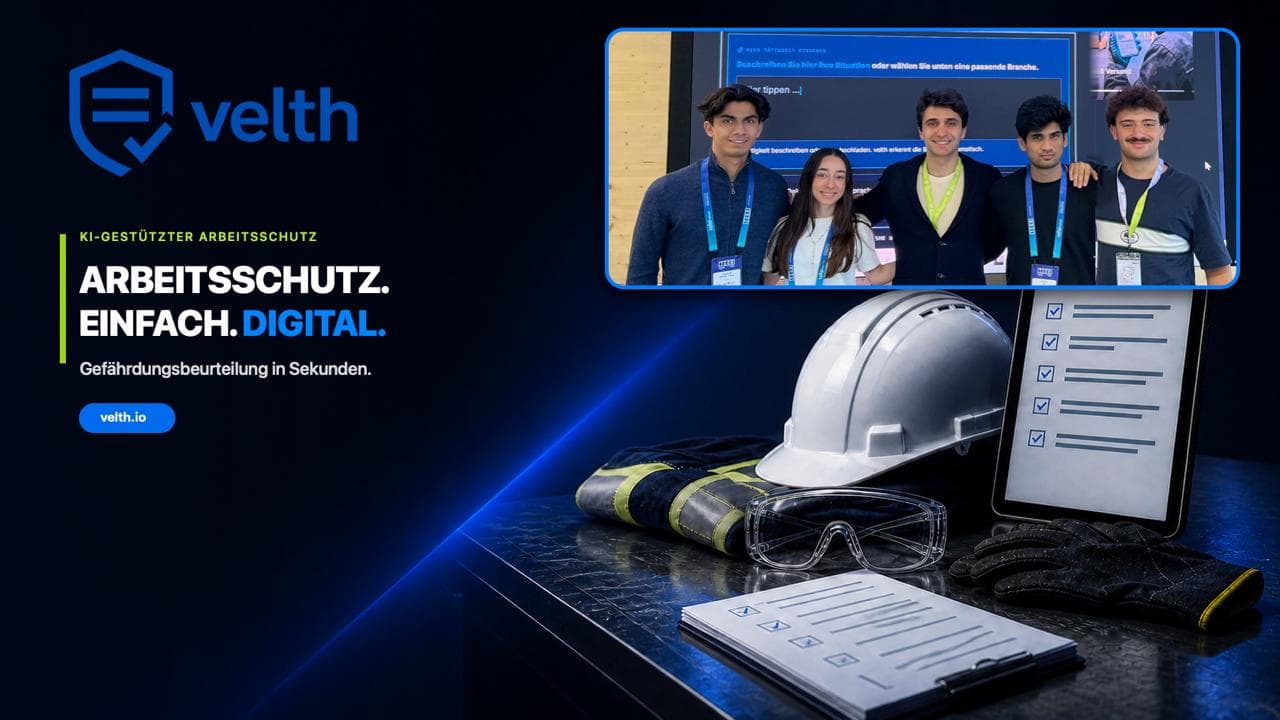
Frederik Tress, Co-Founder: Every employer in Germany must assess the workplace hazards and document the results, starting from their very first employee. According to the GDA company survey, however, only just over half of all companies carry out a risk assessment at all, and of these, only a minority go through all the prescribed process steps. That’s rarely due to a lack of expertise. It’s because a risk assessment is tied to half a dozen other documents: safety data sheets, hazardous substance registers, operating instructions, training records. If something changes in the company, all of that needs to be updated, usually in Word and on a shared network drive. For most managing directors, it’s a tedious topic that gets put on the back burner. Velth brings these documents together in one place and generates a structured draft for each one. A competent person still has to sign it off, and the employer remains legally responsible.
Munich Startup: What can only you do as of today?
Frederik Tress: Software for risk assessments has been around for years, and in the hazardous substances sector, several providers automatically read safety data sheets to generate registers and operating instructions. What is missing beforehand is the entry point. These tools assume that someone in the company knows which activities need to be assessed and which catalog fits. That is precisely where companies without their own occupational safety department fail.
With us, the company describes its activity in its own words, Velth identifies the industry and the associated hazards, and all follow-up documents are linked to the same data. If something changes, the risk assessment, action plan, operating instructions, and training records all adapt accordingly—not just the hazardous substances section. That sounds unspectacular, but it is precisely the reason why documentation in small businesses is no longer up to date after two years.
Velth targets the Mittelstand
Munich Startup: What triggered the founding of your company?
Frederik Tress: We met at Muniquant, TUM’s quantitative finance club. We had all worked in or with startups before, but the actual trigger was something completely different: through the family background of one of our co-founders in occupational health and safety, we saw firsthand the hurdles companies face in practice. Every company has the same legal obligation here, but the necessary knowledge is often scattered across Word files, ring binders, and the heads of individual people. I joined in April because this pain point is absolutely real and I saw how much time it takes up in day-to-day operations.
When it comes to software, the German Mittelstand usually gets one of two options: a solution built for corporations that is three sizes too big, or none at all. Occupational health and safety is the best example of this. The obligation applies from the very first employee, but the tools are designed for companies with their own dedicated occupational safety department. We wanted to work on something that brings genuine relief and is truly built for SMEs in Germany.
Munich Startup: Was there a moment when you thought about giving up?
Frederik Tress: Not giving up, but there was a point when we realized how much work still lay ahead of us. A draft that looks good at first glance isn’t enough when it comes to occupational health and safety. An occupational safety specialist notices within two minutes whether a risk assessment is technically sound or just sounds plausible. The first time someone from the field tore our work apart line by line, it was clear: either we go all the way down the rabbit hole on quality, or we drop it entirely. We chose the long path and have been working closely with occupational safety specialists ever since, who tell us frankly what still doesn’t fit. That takes time, but it’s the only way in a field where, in the end, people are supposed to be protected.
Long-Term Use of the Tool Is Crucial
Munich Startup: How would you know in a year’s time that you’re on the right track?
Frederik Tress: If really all companies that use and will use Velth actually maintain their documents in it, instead of exporting them once and then going back to working in Word. The number of new customers interests us less than the question of whether someone is still working in the tool after six months. Occupational safety isn’t a topic you tick off once, and if we manage to get companies to come back on their own when something changes, then the product works and that’s precisely when we are successful in our mission.
Munich Startup: Would you found in Munich again, and why?
Frederik Tress: Yes, but not solely because of the startup ecosystem. For us, proximity to the businesses we sell to is what counts: associations, guilds, and SMEs in the surrounding area. We are not only based in Munich; we are also strongly connected in Heilbronn through Heilbronn University and the Campus Founders. For a product sold to the skilled trades, construction, and logistics sectors, this proximity in Bavaria and Baden-Württemberg is extremely valuable. In addition, LMU München and TU München give us easy access to valuable and supportive connections.
Munich Startup: Focus or diversification?
Frederik Tress: Focus, because we provide occupational health and safety documentation for SMEs and nothing else. The fact that we cover multiple industries is not a contradiction, but rather a prerequisite: a painting company and a freight forwarding agency face completely different hazards, yet they share the same obligation and the same process. The temptation to also offer training, time tracking, or quality management on the side is great because users ask for it, but as long as the quality of our documents isn’t consistently top-tier across the board, that would currently be the wrong path.