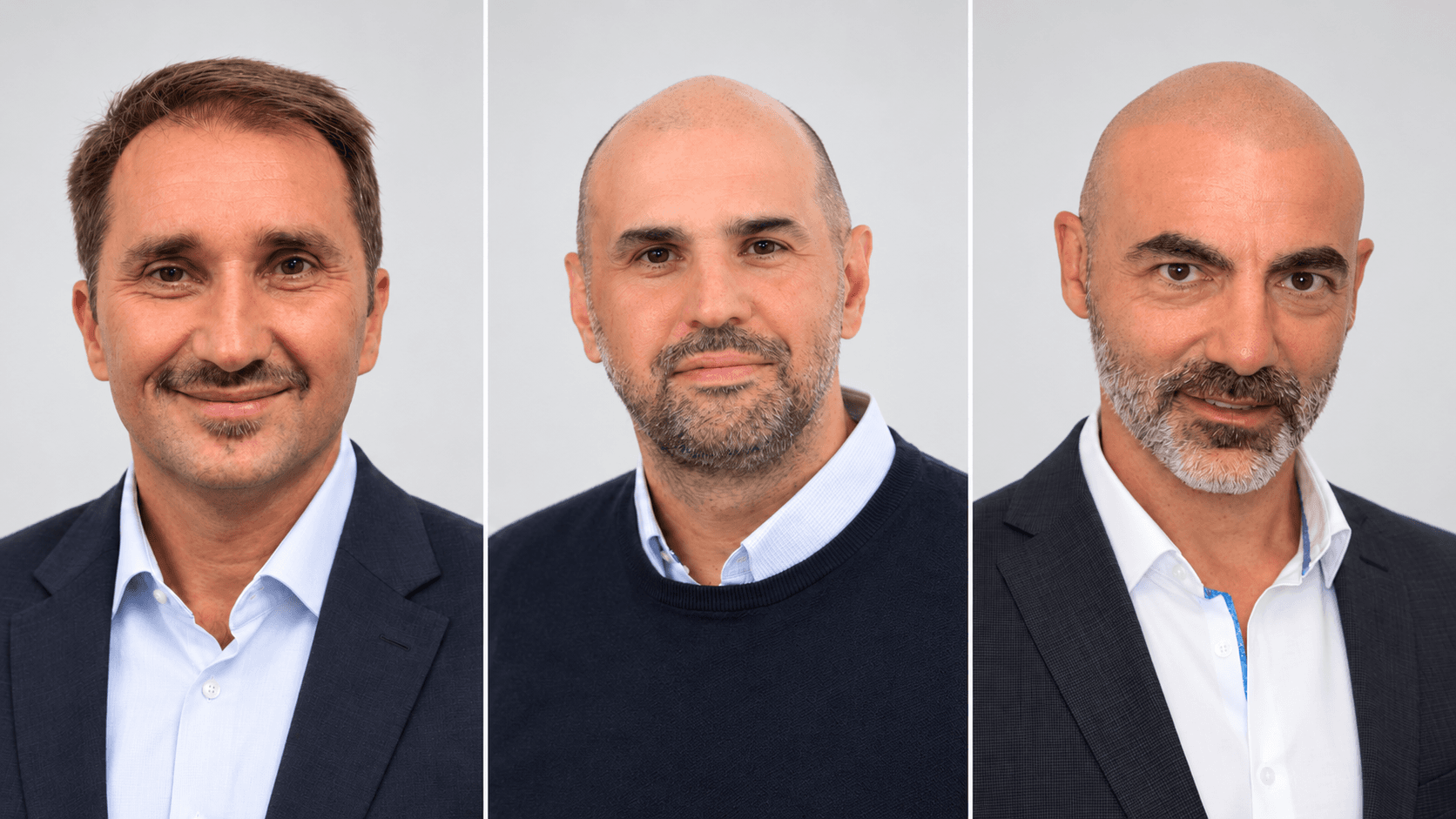

Munich Startup: What was the main motivation for founding Vyoma? What made you decide to say: “Let’s tackle space traffic management”?
Stefan Frey, Vyoma: The motivation for founding Vyoma was growing concern about increasing overcrowding in space. Today there are ten thousand active satellites and hundreds of thousands of small space debris pieces orbiting the Earth. Even tiny fragments can cause massive damage due to high orbital velocities. We saw a major gap in how the industry was handling these risks and knew we had to close it. Space traffic management is not just a technical challenge – it’s crucial for the future of space exploration and satellite operations. Without an appropriate solution, the sustainability of space activities is at risk.
Vyoma doesn’t just focus on monitoring space – we go a few steps further: we want to fully automate satellite operations. It’s not just about avoiding collisions, but also about ensuring the long-term viability of space as a resource for everyone.
Munich Startup: So the response to your ideas was positive from the start? Where did you find support?
Stefan Frey: From the very beginning, Vyoma received enormous support from Europe’s dynamic space community. The company quickly became involved in important European initiatives, including projects funded by the European Commission, the European Defense Fund, and the European Space Agency (ESA). Our commitment to space sustainability resonated with organizations that share concerns about growing space debris dangers. This alignment with EU strategic goals helped us build momentum and solidify our role in developing solutions for one of the biggest challenges in space exploration.
Vyoma relies on ground-based sensors and future space-based satellites
It was inspiring to see how many people share our vision for a safer and more sustainable space environment. The relationships we’ve built within the ecosystem have not only driven our growth but also underscored the urgency of our work. They’ve also helped us bring on board the great talent that is now taking our solution development to the next level.
Munich Startup: How exactly does your solution work? Where do you get your data?
Stefan Frey: Vyoma uses a combination of ground-based and (in the future) space-based sensors to closely monitor the space environment. Our satellites – with the first launching in 2025 – are equipped with optical sensors that provide real-time Space Situational Awareness (SSA), allowing us to track and map objects in orbit. We process the data into a catalog of space objects that can be used to forecast space traffic in the coming days. This enables satellite operators to make quick and informed decisions to avoid potential collisions and adjust orbits as needed.
Better data is also why fewer avoidance maneuvers will be needed in the future, because better data means we can predict collision probability with greater confidence. When we know exactly where two objects are, we can plan for a small separation. By making such decisions automatically, along with others, we can make satellite operations much more efficient than is possible today.
Additional satellites for a crowded orbit?
Munich Startup: As you mentioned, you’re also working on your own constellation in space to enhance your services with space-based data. At first glance, it may seem contradictory to bring more objects into an already crowded orbit to monitor objects in that same orbit. Can you explain why this is necessary?
Stefan Frey: At first glance, putting more satellites into an already crowded orbit seems counterintuitive, but for Vyoma it’s a crucial step toward improving space safety. Today, only about 40,000 objects larger than 10 cm are regularly tracked from the ground. The 1,000,000 objects larger than 1 cm – which can still cause significant damage if they collide with satellites – are not tracked because they can’t be observed from great distances without consuming enormous amounts of energy. Our satellite constellation provides comprehensive, highly available, and yet affordable data on space debris just a few centimeters in size.
This is because there’s no weather or atmospheric effects in space that could interfere with our measurements. We use large apertures that block scattered light, giving us highly sensitive instruments. Thanks to passive optical technology, we don’t need to consume large amounts of energy. And by cleverly choosing the orbit, we can achieve constant sun illumination angles. All of this results in a highly sensitive, highly efficient observation system.
Furthermore, our planned constellation consists of just twelve satellites. We don’t plan to launch hundreds or thousands of satellites.
Challenges in the NewSpace industry
Munich Startup: When you put your own satellites into space, will you then become a hardware startup too? Did you plan this from the beginning or did you add it to your business plan later?
Stefan Frey: We recognized early on that owning and operating our own sensors is crucial. To be able to offer guaranteed latencies and contractually agreed priorities, there’s no way around it. However, we don’t build our own hardware. Instead, we specify the exact requirements for the sensors we need to provide our customers with an effective service, and then we source the telescopes and satellite buses from the appropriate specialists. This approach helps us get a 100 kg satellite with a large telescope operational in just a few years.
Munich Startup: What other challenges have you encountered on your journey so far? And how did you overcome them?
Stefan Frey: The NewSpace economy is still young. There’s a trend toward more standardization, but we still have to work with components that aren’t off-the-shelf. A major challenge, therefore, is having a reliable supply chain. We’re addressing this by diversifying our supply chain and ensuring we always have at least one alternative in case there’s a problem with the first supplier.
Munich Startup: Who are your customers today? What role do public and private customers play for you?
Stefan Frey: Our primary customers are satellite operators, both commercial and institutional entities. They naturally have an interest in protecting their satellites and using them efficiently. They’re informed about upcoming conjunction events and can use our services to optimize avoidance maneuvers.
Vyoma wants to develop a fully automated system for satellite operators
However, safety is only part of our operational capabilities; another is threat mitigation. Space is increasingly becoming a domain for military operations. Intercepting satellite-to-satellite communications is no longer fiction. Our services are therefore also of interest to the various European space military forces, where our data and intelligence can help prevent loss of space resources through malicious attacks.
Munich Startup: What future do you envision for Vyoma in the space industry?
Stefan Frey: Our vision at Vyoma is to develop a fully automated system for satellite operators. We’re taking this path step by step. Currently, we offer Space Situational Awareness (SSA) and Space Traffic Management services that help satellite operators navigate an increasingly crowded and complex space environment. Our solutions aim to ensure that space operations remain safe, sustainable, and efficient.
Looking to the future, we want to expand our capabilities in satellite operations and pursue stronger automation. This way, we’ll help reduce operational costs and risks for satellite operators worldwide and make satellites more economically viable. Our goal is to provide the necessary tools to streamline satellite operations and enable more efficient and secure space traffic management.
Munich Startup: Vyoma was founded in Darmstadt, in close proximity to some of ESA’s most important facilities. What prompted you to relocate your headquarters to Munich?
Stefan Frey: Munich offers a vibrant ecosystem for space technology and innovation with proximity to research institutions and other space companies. The move enabled Vyoma to tap into a broader network of talent and resources and position itself in a city that is becoming increasingly important for the European space industry.