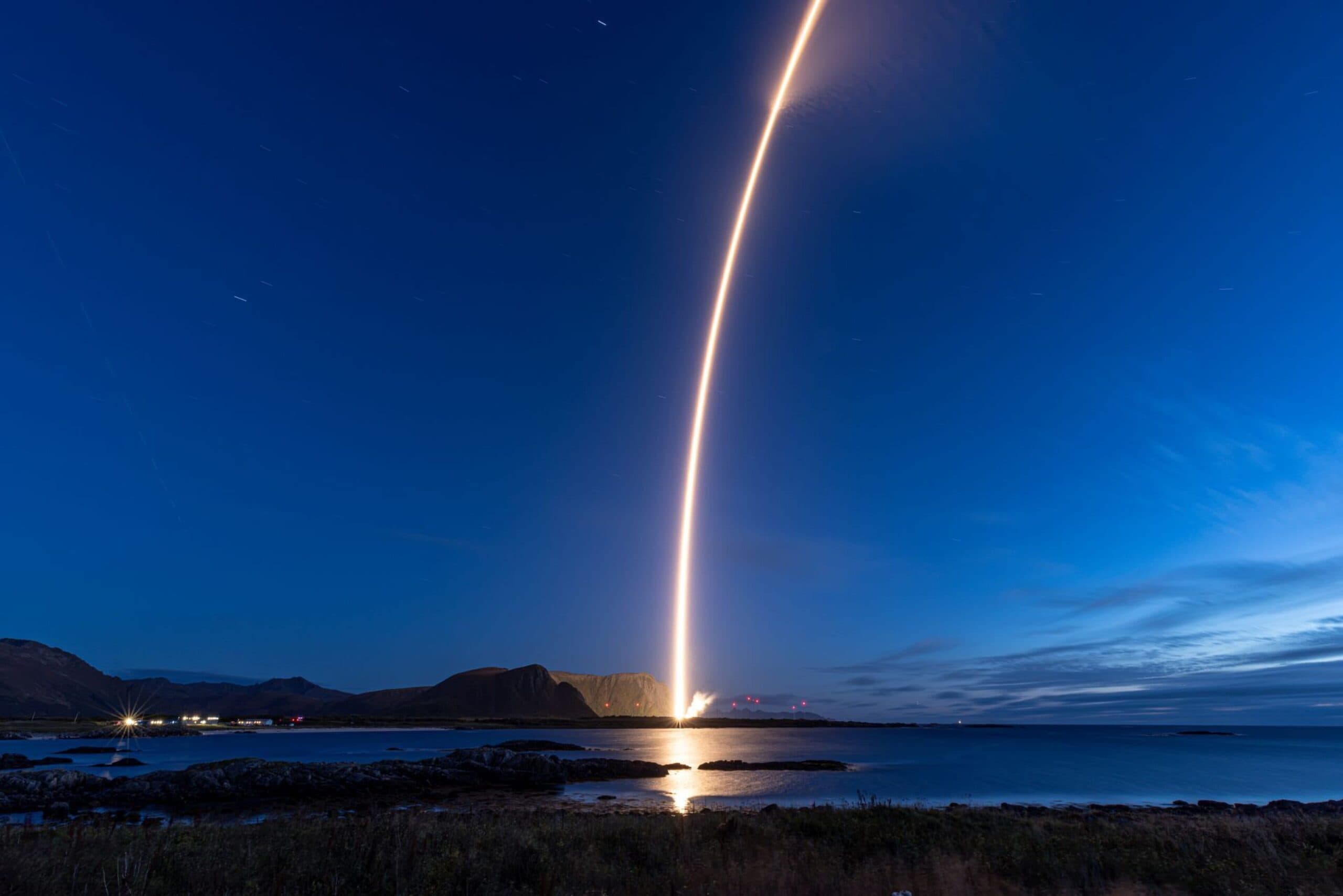

Navigating with smartphones, communicating via Starlink, logistics, energy supply, or satellite imagery for agriculture and wildfire fighting: anyone who only associates spaceflight with rocket launches has long underestimated its economic significance.
“Space is already essential for the functioning of the economy,”
says Florian Dötzer, Head of the TUM Venture Lab Aerospace & Defense, at the Munich Startup Festival. At the same time, access to space is becoming cheaper. Startups today no longer necessarily have to develop, launch, and operate complete satellites. They can focus on individual technologies and buy other components.
This is giving rise to new business models – from satellites and launchers to in-orbit refueling, space traffic management, and applications in agriculture, logistics, and security.
90 Million Euros for a Supposed Niche
Alex Plebuch demonstrates just how real this market already is. The rocket engineer worked for major aerospace companies for around twelve years, including on propulsion systems for the Ariane rocket, before founding Delta Vision with experienced engineers.
The Munich-based company deliberately started with what seemed like a minor problem: components such as valves, pumps, and pressure regulators for satellites and rockets. Based on their professional experience, the founders had identified vulnerabilities in the existing supply chain.
What initially sounded like a “niche within a niche” has since taken on a whole new dimension. Plebuch puts the order backlog for the components at around 90 million euros. Only about ten percent of that comes from agencies; the rest is commercial business.
According to Plebuch, Delta Vision now employs 134 people. In addition, the company announced a seed funding round of 10.2 million euros right before the festival. Getting there took around seven months.
In the process, the company opted primarily for family offices, supplemented by VC capital. Among other things, Plebuch appreciates that the investors in this setup bring their own experience in building companies.
The investor who loves “cluster risk”
One person who does not view space as a niche is Joram Voelklein. Together with former SpaceX manager Bülent Altan, he founded Alpine Space Ventures. The VC invests exclusively in space companies in Europe and the US and, according to Voelklein, now manages more than 300 million euros.
The thesis behind this is correspondingly ambitious:
“Space will become one of the largest, if not the largest, industries in the world. And in the foreseeable future.”
Alpine Space Ventures does not primarily focus on the most spectacular applications, but rather on the industrial foundation of the new market – the “picks and shovels,” as Voelklein puts it. In other words, the hardware and infrastructure on which future applications can be built in the first place.
Alpine also takes an unconventional approach when investing. There are only seven companies in its first 170-million-euro fund. According to Voelklein, the fund holds more than 45 percent in two of them.
“Those are figures that would usually send most VCs running screaming for the hills,”
says Voelklein with regard to the associated concentration risk. His reaction:
“We love it.”
The reason: in his view, space investments require special technical understanding and a very close look at the long-term development of a market. Alpine therefore relies on a team with extensive space experience and focuses on a small number of investments.

Prof. Dr. Nadine Chochoiek moderated the panel. Photo: Munich Startup
Why Munich of all places?
Research, industry, capital, and talent: For Florian Dötzer, several decisive factors come together in Munich. In addition to universities and research institutions, Dötzer sees the mix of diverse founders as a particular strength. In the aerospace sector, it is not just traditional student startups that are emerging. Experienced employees from large corporations meet PhD candidates and students who, in turn, try out completely new approaches.
Added to this is the industrial base in southern Germany, Austria, and Switzerland. Medium-sized hidden champions can serve as partners and suppliers for startups. As a result, young companies do not have to develop every technology themselves and can focus more strongly on their core competencies.
Plebuch even describes the Munich ecosystem as a kind of “machinery” capable of producing young companies. From pre-founding funding opportunities and accelerator programs to a network of other space founders, support is available across different company phases.
Voelklein’s investment track record underlines the Munich concentration: According to him, of the four European holdings of Alpine Space Ventures, all are located in Germany, two directly in Munich, and another with a hub in the city. His verdict is accordingly clear:
“It can be no coincidence that most of our investments are in Munich. We looked at the whole of Europe, and this is simply where the best companies are.”
“The benchmark is the US and China”
Yet it is precisely at this point that the discussion becomes interesting. Because Dötzer warns against resting on this strong starting position.
“It does us no good to tell ourselves how great we are right now,”
he says. Instead of comparing Munich with Stuttgart or Berlin and Germany with France, Europe needs to think bigger. His ambition:
“When it comes to space, we actually need to be the hub in Europe with global significance. The benchmark is the US and China.”
This is no longer just about economic growth. Space is increasingly becoming a matter of critical infrastructure and European sovereignty – for instance, when it comes to launchers, satellite communications, or surveillance.
Plebuch currently sees a particularly good opportunity to build up space and defence technologies in Germany. However, one difficulty continues to be providing young companies with direct access to the relevant decision-makers. Voelklein goes a step further. Traditional defence platforms are increasingly evolving into networks. As a result, major defence companies will inevitably also have to become space companies in the future.
“No one will be able to win a military conflict or have the upper hand anymore if they don’t also have the upper hand in space,”
says the investor.
For him, this is part of a much larger structural development. Space will play a key role in an increasing number of industries in the future.
In any case, the panel sees the conditions for this in Munich as exceptionally good. Research, talent, established industry, specialized investors, and an increasing number of successful startups are all in place. The decisive question is therefore perhaps less whether Munich can compete in the new space race, but rather how big the city and Europe are willing to think.
Brief Profiles of the Panelists
Dr. Florian Dötzer heads the TUM Venture Lab Aerospace & Defense. The non-profit organization supports startups on their journey to becoming successful companies. Dötzer particularly sees the combination of research, talent, established corporations, SMEs, and specialized investors as a key strength of Munich’s space ecosystem.
Alex Plebuch is a rocket engineer and founder and CEO of Munich-based Delta Vision GmbH. Before founding his company, he worked for around twelve years in larger aerospace companies across Germany and Europe, including on propulsion systems for the Ariane rocket. Delta Vision develops and manufactures components for satellites and rockets, among other things, and currently employs 134 people according to Plebuch.
Joram Voelklein is co-founder of Alpine Space Ventures, a VC firm specializing in space. According to Voelklein, the investor manages more than 300 million euros and invests in Europe and the US. Alpine Space Ventures focuses particularly on the industrial base of spaceflight and concentrates its capital on a comparatively small number of investments.
Prof. Dr. Nadine Chochoiek moderated the panel. She is a professor of innovation and entrepreneurship as well as co-founder of Bright and Bold.