
Munich Startup: What problem do you solve?
Amir Zahiri, Co-Founder: Active women already use wearables, track their workouts, and watch their diet, but much of the information they receive is still limited to a score or a dashboard. We see three problems with this. First, physiological signals can become less reliable precisely when movement and training intensity increase. Second, much of sports and exercise science has historically been based on male-dominated research and was not tailored specifically to female physiology. And third, even when a wearable detects a change, the user often has to figure out on her own what to do next.
Our goal with Zura is to bridge this gap between measurement and action. We want to understand each woman’s individual baseline values and use them to answer practical questions: Should she train today or recover? Should her training volume be adjusted? Does her nutrition need to change? And once we make a recommendation, did it actually work? Zura is not designed simply to give her another metric, but to translate physiological processes into decisions.
Munich Startup: What can only you do as of today?
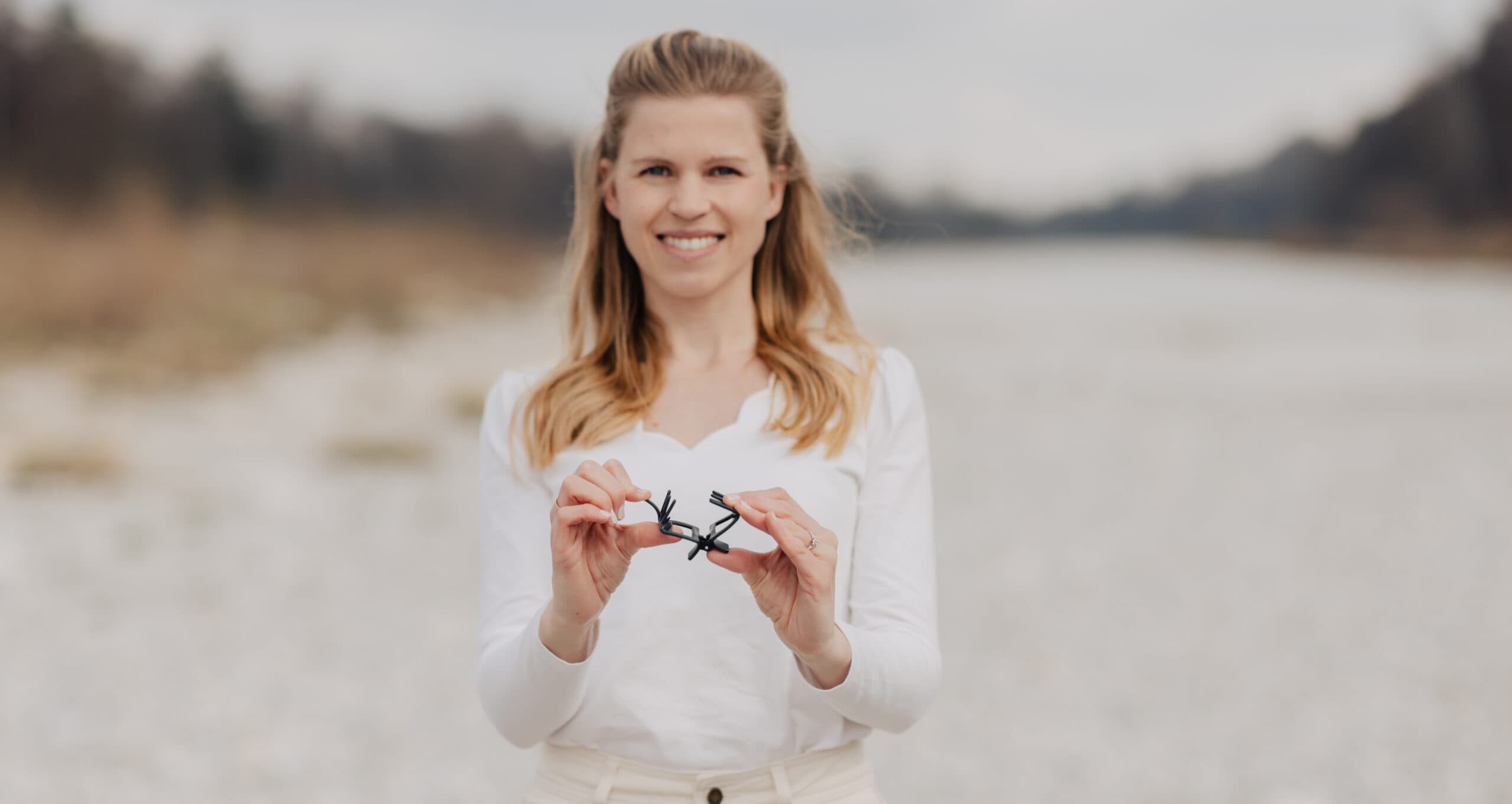
Amir Zahiri: We combine two things that are typically separate: an adaptive AI coach that is already in use, and our proprietary hardware for capturing physiological data via the ear. Our first validation prototype for a smart earring measures heart rate, heart rate variability (HRV), temperature, and activity directly at the earlobe. The ear is an interesting measurement location because it experiences less movement during many activities than the wrist; furthermore, our tests have shown promising signal quality, especially during physical exertion.
There is also a practical difference compared to other wearables. Rings can become uncomfortable or have to be removed during strength training with barbells or dumbbells. Watches and fitness trackers remain visibly technical devices. An earring stays clear of the hands and wrist and can be designed so that the wearer would genuinely enjoy wearing it anyway.
That’s why form is just as important to us as the sensor. We are developing the device as a piece of jewelry with interchangeable fronts, rather than simply shrinking a fitness tracker and attaching it to the ear. The goal is for the earring to become part of everyday life, workouts, and ultimately also worn overnight.
But it’s not just the earring that sets Zura apart. The physiological signals are combined with information such as cycle context, sleep, activity, and behavior to create an individual baseline. Our AI coach then uses this context to adapt training, nutrition, and recovery, and to learn from the user’s bodily responses. This closed loop—sensing, understanding, adapting, and learning—is what we ultimately want to build.
From a software idea to an adaptive coach
Munich Startup: What triggered the founding?
Amir Zahiri: Zura actually started as a software idea. Originally, we wanted to develop an adaptive health coach that connects training, nutrition, sleep, and recovery, instead of overwhelming users with managing multiple independent apps. During software development, however, we ran into a more severe limitation. Relying exclusively on third-party wearables means depending on the type, quality, and availability of the physiological data provided by these devices.
At the same time, we became increasingly aware of another gap: many of the models and recommendations used in the fitness and health sector were not originally tailored to female physiology. That changed our mindset.
Instead of developing a comprehensive health platform for everyone, we decided to shift our focus more towards women. And instead of merely interpreting other people’s sensor data, we explored whether we could ultimately develop the sensor technology ourselves. That’s how Zura became what it is today: an adaptive AI coach combined with a smart earring tailored to female physiology.
Munich Startup: Was there a moment when you thought about giving up?
Amir Zahiri: There were certainly moments when we questioned the direction we had taken, even if not the problem itself. Initially, Zura wanted to cover too much. Fitness, nutrition, recovery, mental well-being, and prevention are all interesting areas, but trying to solve everything at once makes it very difficult to build a focused company. And then we added hardware, which obviously didn’t make things any easier.
The most important lesson for us was that a change of direction is not the same as giving up. As soon as we focused on active women, female physiology, and the connection between perception and adaptive coaching, the picture became much clearer.
This focus also helped us reach important milestones: We secured Exist funding, incorporated the company, began testing our AI coach as part of a TUM pilot project, and built the first validation hardware for the earring. There are still difficult technical and economic questions ahead of us, but we now know much more precisely which questions we need to answer.
Zura aims to become an everyday companion
Munich Startup: How would you know in a year that you are on the right track?
Amir Zahiri: For me, the most important indicator wouldn’t simply be the number of downloads, but whether women continue to use Zura because it actually helps them make better decisions regarding their health. We want to see strong user retention, paying users, and clear behavioral changes: Are women adjusting their training, nutrition, and recovery based on Zura’s recommendations, and do these recommendations become more useful as the system learns more from their individual physiology?
We also want to create increasingly personalized models of each woman’s cycle and continuously measure hormonal physiological patterns from signals we obtain from our smart earring and the cycle context without directly measuring hormone levels. Overall, with Zura, we want to contribute to a shift in women’s health—away from generalized, one-size-fits-all recommendations toward a better understanding of each woman’s unique body, cycle, and physiological patterns.
When women tell us that Zura helps them better understand their bodies and make more confident decisions for their health in everyday life, then we know that we are on the right track.
Munich Startup: Would you start up in Munich again, and why?
Amir Zahiri: Yes. Munich is particularly well-suited for a company like ours because it brings together engineering, AI, health research, industry, and entrepreneurship within a single ecosystem. Our connection to TU München was especially valuable. We benefited not only from technical expertise, but also from scientific knowledge, entrepreneurial support, and access to people who are willing to challenge our assumptions.
Exist also played an important role for us. Deeptech and hardware-intensive ideas need time to clarify fundamental technical questions before they are ready for the market. Programs like Exist make this possible without forcing a startup to immediately focus everything on commercial growth.
In addition, there is an exceptionally strong talent pool here. For a company that needs employees from the fields of AI, electrical engineering, health sciences, product development, and business, that is of major importance. So yes, I would definitely choose Munich again.
Further areas of application could follow
Munich Startup: Focus or diversification?
Amir Zahiri: Focus first. That is probably one of the most important lessons we have learned so far. Zura could develop into many things in the future. Continuous physiological data collection could be relevant for general women’s health, prevention, fertility, menopause, and potentially clinical applications. But these opportunities can also turn into distractions if you pursue them too early.
Our focus today is much simpler: Can we understand the physiology of an active woman and use this information to make her training, nutrition, and recovery more meaningful and adaptable? That is the problem we need to solve first.
If we succeed, the underlying technology, longitudinal data, and physiological models can ultimately enable much broader applications in the field of women’s health. For us, diversification should therefore be the result of having built something valuable – and not a substitute for focus.