
Munich Startup
Feldwerke Solar GmbH

Feldwerke Solar GmbH

We face one of the greatest challenges of our time: the need for renewable energy is rising, while at the same time we must secure our agricultural production. In Germany, after all, 86% of food comes from domestic production. But...

Founded2023
Business Model-
IndustryEnergy
This content was machine translated.

About Feldwerke Solar GmbH

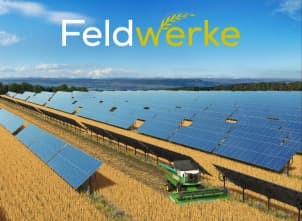
We face one of the greatest challenges of our time: the need for renewable energy is rising, while at the same time we must secure our agricultural production. In Germany, after all, 86% of food comes from domestic production. But both renewable energy and agriculture require land – and this is exactly where Feldwerke comes in with the agri-PV concept. To do this, we work with farmers who value sustainability – and who think economically and are interested in an additional, stable source of income. They are open to innovative technologies that don’t interfere with their agricultural activities, but rather complement them. But why agri-PV? Agri-PV is diverse. There are, for example, fixed systems that install solar panels on fixed structures, such as the elevated systems for example over the apple fields at Lake Constance. Or there are mobile systems like our single-axis trackers – they move with the sun and thus capture solar energy throughout the day, maximizing energy yield by 20% compared to fixed systems. And the best part: our systems require only 10% of the land. This means that conventional agriculture can continue on the remaining land. And everyone involved benefits from this! For farmers and landowners, we offer a secure source of income. They can continue to use their land for agriculture and additionally benefit from lease payments and energy yields. This creates financial security, especially in times of crop failures or fluctuating prices. Furthermore, our concept ensures greater acceptance, as neither is the soil sealed nor is the landscape significantly affected. In short: at Feldwerke, we combine agricultural use with green energy generation and thus offer the perfect solution for the future of our land – for sustainable agriculture and a successful energy transition!

More like this

Discover more articles, startups, and events from the ecosystem
HTGF Plans 150 Investments With New Seed Fund
Ecosystem

HTGF Plans 150 Investments With New Seed Fund

01.09.26
2 Min.
This moving box by The Ocean Package is designed to have 20 lives
Inside Stories

This moving box by The Ocean Package is designed to have 20 lives

01.09.26
4 Min.
2 Million Euros in Funding for Reformer Club
Deals

2 Million Euros in Funding for Reformer Club

31.08.26
5 Min.
Linkvolt Operations UG

Linkvolt Operations UG

Linkvolt automates charging electricity billing for property operators and companies on existing charging hardware. As a technical intermediary, the platform handles metering, allocation, and legally compliant billing for every charging session. Linkvolt provides the billing layer but does not buy or sell electricity itself. Operators such as property managers, real estate companies, and business parks use Linkvolt to bill third parties for charging electricity—guests, tenants, and regular users. Every charging session is automatically recorded, documented in a legally compliant manner, and settled without manual effort. Companies distribute charging electricity internally to employees and their own vehicle fleets. Linkvolt assigns each transaction to the correct person and cost center and provides the export ready for accounting, including for DATEV. This makes billing for company cars and shared vehicles a one-click process. What distinguishes Linkvolt from pure charging billing is the next expansion step: integrating locally generated solar power directly into the same billing system, delivering higher margins for operators and cheaper charging for users, instead of feeding solar power into the grid at low compensation rates. The business model is purely transactional, with a few cents per kilowatt-hour mediated. Pilot operations begin in summer 2026 in Munich with 10 to 20 households in one building; the scaling potential extends across over 3 million PV systems in Germany and a rapidly growing number of electric vehicles in residential and commercial buildings.

B2BEnergy

2026Founded
1-10Team size
Seed stage