
Munich Startup: What problem are you solving?
Victor Dzhagatspanyan, co-founder & managing director: Before an electrical contractor can submit a fixed-price quotation, they have to determine quantities from the planning documents – outlets, switches, meters of cable. In practice, this takes several days up to a whole week of manual work. In many companies, there’s no longer a dedicated calculation team, so branch managers count outlets on floor plans in the evenings instead of leading their staff. We turn weeks into hours – upload a PDF, get the finished quantity list out.
Why electrical contractors need to rethink their calculations
Munich Startup: What can only you do today?
Victor Dzhagatspanyan: We work with what actually arrives at the contractors: PDF plans in any conceivable quality. Classic CAD-based solutions require DWG files, which usually aren’t available for quotation requests. Plus, we’re vendor-independent and deliver in formats that contractors already use – Excel, GAEB, ERP systems like PDS. We don’t interfere with pricing. What sounds technically straightforward is the crucial point in practice: we’re not isolated software, but rather we accelerate the process that’s already running.
From construction site drones to AI for PDF plans
Munich Startup: What triggered the founding?
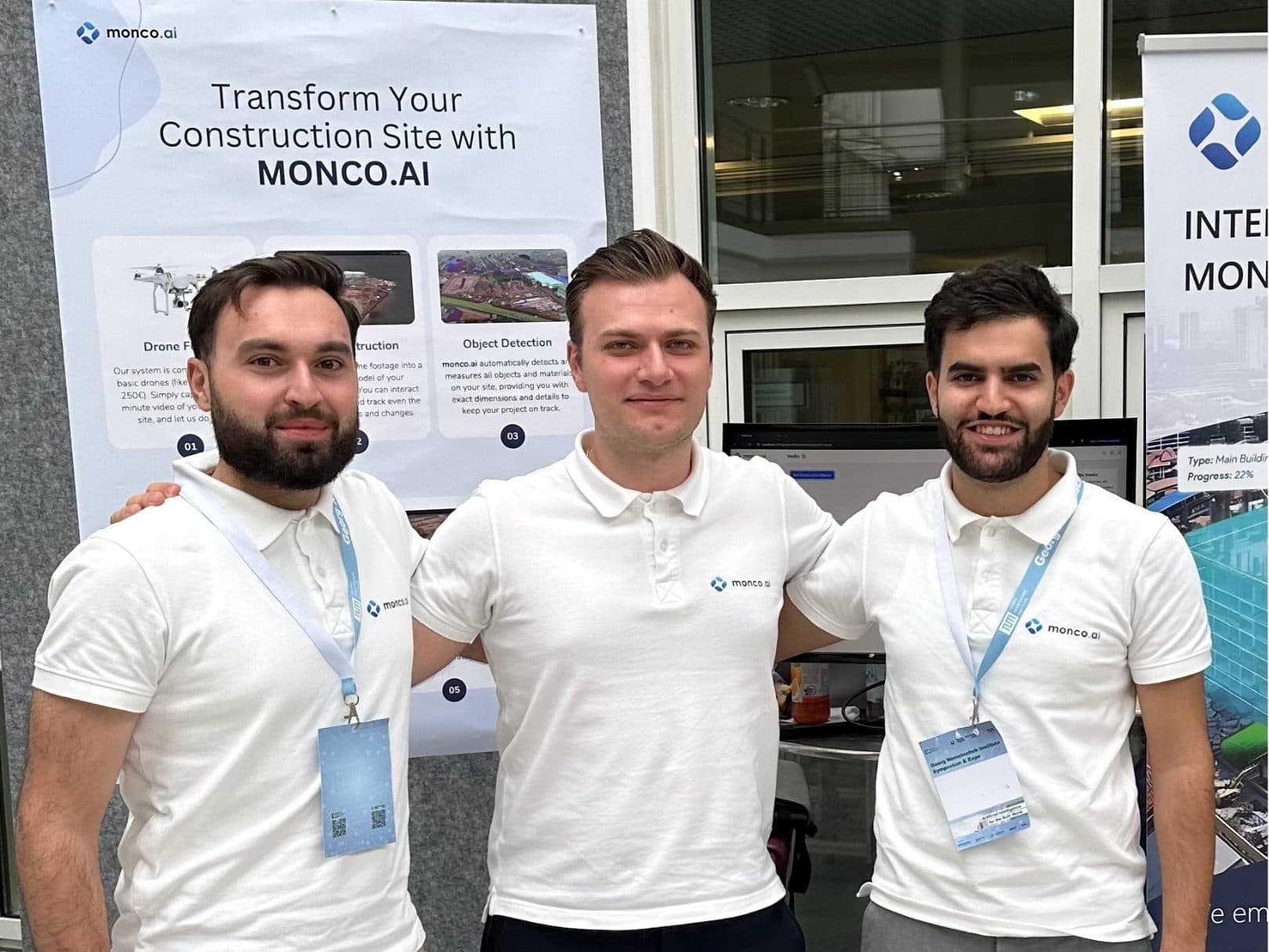
Victor Dzhagatspanyan: A Wednesday evening in Munich, an internship setup for autonomous driving at Mercedes – and a random construction site video. My co-founder Ashot had applied the 3D visualization from his Mercedes internship out of pure curiosity to a recording he had from his father’s construction site in Armenia. His father has been managing raw construction projects for decades, and in that exact moment it was clear: that’s his daily problem. We then started testing with a drone – in the end, the technology wasn’t the right solution, but the industry wouldn’t let us go.
Munich Startup: Was there a moment when you thought about giving up?
Victor Dzhagatspanyan: Not about giving up, but about “throwing everything away and rethinking” – yes. After months of drone work, we realized we’d tackled the problem in the wrong place. We wanted to measure quantities on the ongoing construction site, but the real pain point comes much earlier, in the quotation phase. Before anyone even steps on the construction site, contractors have to spend days pulling quantities from plans. We then changed both things: the tool – from the drone to AI analysis of PDF plans – and the industry, from raw construction to electrical contracting, where the pain was most clearly tangible. It was tough because a lot of energy went into the first approach. In retrospect, the most important decision in the company’s history.
How Monco.ai accelerates existing processes
Munich Startup: How would you recognize in a year that you’re on the right track?
Victor Dzhagatspanyan: Three indicators: significantly more paying customers in the DACH region than today, the first productive pilot in a second trade – probably HVAC – and customers who no longer ask us if the AI works, but when the next feature is coming. The latter is actually the most important. Once trust is there, you have a different conversation with the industry.
Munich Startup: Would you start a company in Munich again and why?
Victor Dzhagatspanyan: Immediately. The three of us came to TUM from Armenia without consulting each other beforehand and randomly ran into each other here. That alone says a lot about Munich: a city where talent from all over the world lands. Add to that the proximity to the industry we address – without this proximity, we wouldn’t understand the industry the way we do today. And honestly: after many years now, Munich has long been a second home for us.
Munich Startup: Perfection or speed?
Victor Dzhagatspanyan: Speed – with one exception: when our AI determines quantities for a fixed-price quotation, the profit or loss of a project depends on it. At that point, precision is not an option but a requirement. Everywhere else: better to learn today than be perfect tomorrow.