


Startup means many things: The successors of a family business launch a “startup” for the development of new products. The “food startup” on the corner sells the latest Instagram creations. Corporations advertise their “startup culture” in job postings.
The term startup promises exciting new products, a friendly working atmosphere, pace and flexibility. Munich sociologist Armin Nassehi once said:
“Startup means that you […] belong to a new social class, namely the creative class, that is, those who by nature actually reject what they are doing, namely developing a business model.”
So are startup founders entrepreneurs in the guise of creatives? In the narrower sense, “startup” means something else and very specific. Corona aid for startups, for example, only applies to a very specific type of company. When we speak of “startup nation Israel,” we don’t mean the countless fantastic fusion restaurants in Tel Aviv, but rather the many young software and high-tech companies in the country. And Munich Startup also reports primarily on startup companies in a very specific sense.
Startup or start-up?
First, regarding the term: The Duden lists only the spelling “start-up.” In recent years, however, “startup” has become more common. “Start-up” presumably emphasizes the origin from the English “to start up.” In English, however, “startup (company)” is also more common than “start-up (company),” for example in the corresponding Wikipedia article.
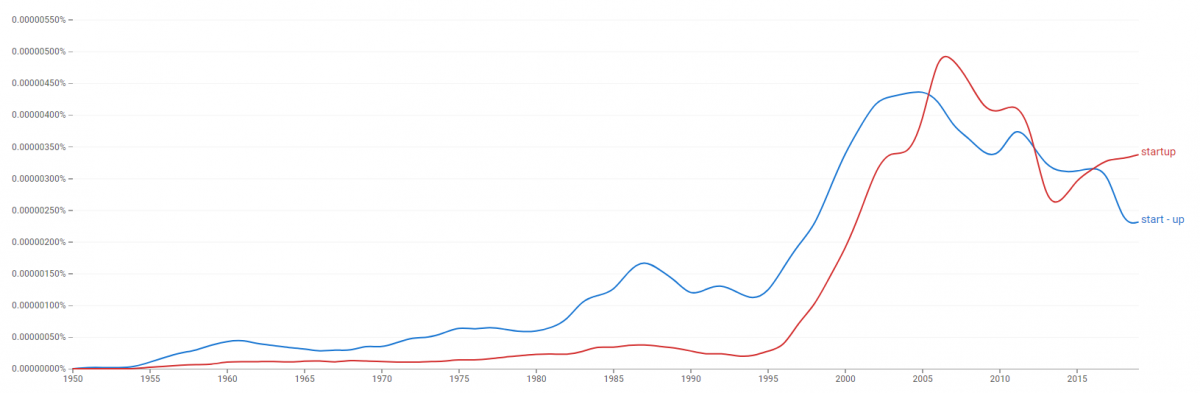
A search in the Google Books Ngram Viewer shows how frequently “startup” and “start-up” were used in German-language books. In 2006, “startup” was able to overtake “start-up” for the first time. From 2013 to 2015, “start-up” briefly had the edge, but then had to cede the lead permanently.
These 5 points distinguish a startup from other companies:
1. Forever young
First, the most obvious thing: startups have something youthful about them. Not only in the cliché image do startup founders wear hoodies instead of suits and are more likely to be 30 than 50 years old. Startup icon Elon Musk also deliberately presents himself as youthful, smoking marijuana during an interview, selling and playing with flamethrowers and arguing on Twitter with half the world. The 49-year-old sometimes seems like a mix of college student, Bond villain and rockstar, but certainly not like a middle-aged man.
2. Lean and agile
The path from a customer requirement to a finished product used to be relatively clear: On the customer side, there is a need for a product or service. The customer writes down what they need in a requirements document and looks for a service provider who can deliver the desired product as cheaply as possible.
But there are some problems with this approach: During the development process, requirements can change and the finished product is no longer needed. Or the customer doesn’t even know exactly what solutions are available. Or it turns out after years of development time that the budget is tight and development will take much longer than planned. Or, or, or…
Startups have some methods and ways of working to address these difficulties in the development process and that distinguish them from other types of companies. First, there is the “lean startup” model. The goal of this principle is to streamline company processes as much as possible and focus all actions on the actual goal: developing a product for which there is a market. Instead of elaborate deliberations and tests, hypotheses are tested in the market as quickly and cheaply as possible. The team builds a functioning prototype with minimal effort, the MVP or minimum viable product. In very short cycles, this prototype is revised and tested again and again with the customer. If it turns out that a product does not find a sufficient market, there is no sentimentality—the product is changed, resold, or discontinued—anything to avoid wasting further resources. Fail fast.
Agile working goes in a similar direction: Product development is placed at the center of a dynamic process. In short iteration cycles, the team constantly reflects on their own work. There are also some other differences to classic product development: The agile method Scrum, for example, rejects hierarchies in the development process. Instead, equal developers work together with a product owner who represents customer wishes and a Scrum master who ensures process compliance. Agile experts Christian Kroemer and Tobias Hingerl discussed agile working and Scrum in more detail in an interview with Munich Startup some time ago.
3. Exchange instead of backroom dealing
Both internally and externally, startups value openness, collaboration and exchange. Startup founders are used to constantly talking about their companies and products: pitching to investors, competing in startup competitions, at networking events. While traditional founders perfect their products or even fear that a competitor might steal their idea, startup founders seek constant exchange because they know: The idea is nothing, execution is everything. So they’d rather have good contacts and public visibility with potential employees and customers than hide in a backroom. Even the heads of unicorn companies like Flixbus or Celonis were constantly found on the stages of small and large events—before Corona prevented events from happening.
4. Change as a permanent state
While traditional companies usually struggle with change and change management, startups have made constant change a principle. It is a normal occurrence in the lean startup model to throw non-functioning products overboard or to pivot, i.e., to make a radical change to the business model. And even former startups that have grown into giants are constantly transforming: Zalando is developing, as Amazon did before it, from a seller to a platform provider. Google now only operates the world’s most successful search engine on the margins. The way young companies like Tesla have driven industry giants ahead of them in recent years shows how effectively and flexibly startups can handle change—and traditional companies cannot.
5. Growth instead of profit
Representatives of the old economy repeatedly accuse startups of simply burning other people’s money and not creating value. And the accusation is often correct: Startup companies don’t want to make money in the early phases—they want to grow as quickly as possible. Because startup founders know that ideas are worth little and only execution matters (see point 3), you have to be faster and better than the others. This is especially true for business models based on network effects: here, the value of a product increases with the number of users. This applies, for example, to social networks, marketplace portals, and much more. Whoever gets big first wins the whole pie. In other words, you shouldn’t start a new Airbnb, eBay Classifieds, or Facebook now.
Behind the growth imperative is also a cultural shift: For the “honorable merchants” of old, a spotless reputation counted for something. The founder pays his debts, operates prudently, and doesn’t overcommit. The startup founder, on the other hand, collects money from investors who factor a possible total loss into their calculations. Whatever you may think of it morally—a look at the most successful companies of the past decades shows that this model is overwhelmingly successful.